Daily Coping 8 Dec 2020

I started to add a daily coping tip to the SQLServerCentral newsletter and to the Community Circle, which is helping me deal with the issues in the world. I’m adding my responses for each day here. All my coping tips are under this tag. 

Today’s tip is to contact someone you can’t be with to see how they are doing.

One of the things I did early on in the pandemic was reach out every day or two to a few random people in my contact list. The pace of things slowed down across the summer, but I decided to have a few more in-depth conversations, rather than just a “how are you” query.

I opened up a Facebook Messenger conversation with a friend recently, reaching out to see what they were up to, and how life was going. Across a few days, we exchanged numerous messages, touching base and having a conversation around the rest of our busy lives.

On one hand I enjoyed the chance to reach out to someone and contact them. It was good to catch up and see how life was getting along.

On the other, this brought some sadness, as I had planned on seeing this person across the summer, which didn’t happen. With the prospect of months more of living like this, I’m disheartened that I won’t see this person for awhile.

Not a great coping day for me.

Posted in Blog | Tagged , , | Comments Off on Daily Coping 8 Dec 2020

T-SQL Tuesday #133–What I Learned From Presenting

tsqltuesdayThis month Lisa Griffin Bohm is the host and thanks to her from hosting. She was one of the last people I pressured lightly to host. She came up with a very creative invite. She is asking us to share something technical that we learned, that wasn’t related to the actual presentation.

While I’ve presented many times on various topics, and seen many more talks, I often go for a specific reason. At work it might be because I need to go, but at events, I usually pick a session based on the topic or presenter. Since most do a good job talking about their topic, I had to really think about this one.

A Couple Choices

I’ve got two that came to mind as I pondered what wasn’t related to the topic. One is small, with minor impact to my work. The other had a much larger impact to me.

The first is a story where I was researching for a talk on Always Encrypted in 2016, I ran into an issue I hadn’t expected. This was Microsoft’s first big change to encryption options since 2005, and I was excited about it. I knew about the restrictions with data types, collation, etc, but they seemed to be acceptable to me.

As I was building demos and working on how to show certificate movement, I created certificates in various ways, I created some in text files using the common PFX format. Little did I know that SQL Server can’t read these. Instead, you need to convert them to PVK, which isn’t well known. Many people use the .cer or .pfx, but for whatever reason, SQL Server doesn’t support those.

The second story was while rehearsing for a talk at Build. Once again, I was speaking, but delivering only a small piece of a multi-person talk with a few Microsoft employees. Donovan Brown was one of them, and as we worked on timing, transitions, and tailored my section to fit, we had time to chat a bit. This was in the mid days of Visual Studio Team Services, which become Azure DevOps a short time later.

As I was talking about some of the challenges I’d had in TFS, Donovan showed me a Java app he was maintaining as a side project, which was being built, tested, and released from VSTS. I was surprised, as Microsoft was still mostly focused on their own technology. He showed me some of the any language, any platform, any framework philosophy that was being used to make Azure DevOps a complete platform, not a Microsoft one. I was surprised, and I’ve continued to be as I watch new capabilities and features appear, few of which are tied to Microsoft products.

That greatly impacted my career, and continues to do so today as I work with more and more customers that use non-Microsoft technologies.

Posted in Blog | Tagged , | Comments Off on T-SQL Tuesday #133–What I Learned From Presenting

AutoCorrect in Git

I can’t believe autocorrect is available, or that I didn’t know it existed. I should have looked, after all, git is smart enough to guess my intentions. I learned this from Kendra Little, who made a quick video on this. She got it from Andy Carter’s blog.

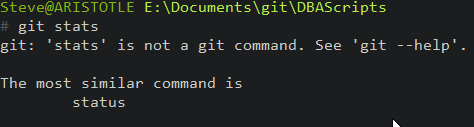
Let’s say that I type something like git stats in the cmd line. I’ll get a message from git that this isn’t a command, but there is one similar. You can see this below.

2020-12-04 11_32_06-cmd (Admin)

However, I can have git actually just run this. If I change the configuration with this code:

git config --global help.autocorrect 20

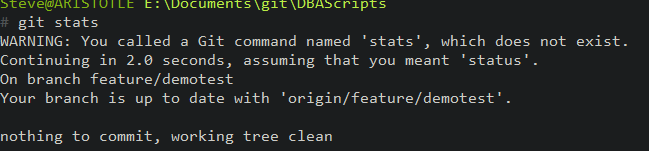
Now if I run the command, I see this, where git will delay briefly and then run what it things is correct.

2020-12-04 11_34_45-cmd (Admin)

The delay is controlled by the parameter I passed in. The value in in tenths of a second, so 20 is 2 seconds, 50 is 5 seconds, 2 is 0.2 seconds, etc.  If you set this back to 0, autocorrect is off.

A great trick, and one I’d suggest everyone enable.

Posted in Blog | Tagged , | 3 Comments

Seeking Growth

The word of the day is na·ive·té:  lack of experience, wisdom, or judgment.

I used this word in a post, and wound up checking the spelling, since I constantly want to include an “i” instead of an “e” in middle of the word. As I saw the definition, I started to think about what this really means.

We all experience this at times, after all, how can we gain experience except by working in a field where we lack it. The wisdom and judgment, hopefully come with experience, time, and (not too large) mistakes.

The thing I’ve found often for myself is that I try to avoid situations where I am naive. I lean towards those places where I have some confidence, some wisdom, and experience. I work on my strengths most of the time. Certainly I’ve seen lots of people embrace that. We polish those things we enjoy, we have success with, and from which we get good feelings.

When I coach, I see this often. Arguably, this is not the best use of most of your time. You ought to work on those things you don’t do well, those weak points, the places where you are naive. Improve the lower end, and the entire finished product is better.

Or is it?

I think you need a balance here. It pays to continue to refine you top skills, but it’s also good to grow and embrace things where you have little skill. Step into areas with the acceptance that you may make mistakes. Grow and learn, and embrace new ways or working, or even refinements to your skills.

Steve Jones

Listen to the podcast at Libsyn, Stitcher or iTunes.

Posted in Editorial | Tagged | Comments Off on Seeking Growth