Category: Blog

  • Daily Coping 3 Jun 2020

    I’ve started to add a daily coping tip to the SQLServerCentral newsletter and to the Community Circle, which is helping me deal with the issues in the world. I’m adding my responses for each day here.

    Today’s tip is find three good reasons to be hopeful for the future.

    Reason 1 – Most people are recovering

    One of the things that I haven’t seen often shown in various reports on data is how many people have recovered from the Coronoavirus. I know the more conservative people that I see post will point out that most people recover, and that’s true. It’s also true that a lot of people haven’t, and 99% recoverability is still a scary number. I coach kids on tournament days where there are often 100 people between athletes and coaches. If one of them died every tournament, I’d be devastated.

    However, many people are recovering and that’s good news. I have no idea of this means some level of immunity, some herd protection, or anything else, but I am hopeful that this will mean the world will start to progress forward at some point.

    Reason 2 – My family is coping

    Selfish, but as we’ve gone through this, some of us leaning on each other, and getting closer, we’ve also been healthy and managed to find ways to still enjoy life. The hopeful thing for me is that we still have hope.

    Reason 3 – I’ve Learned to Appreciate More of Life

    My life is chaotic, and on the go. I flew over 100,000 miles in the air last year, spent many nights away from home, and enjoyed my adventures, many of them with family. I love the gym, I love coaching, and more.

    These last few months have taken much of that away, with us mostly resigned to being at home and learning to be there all the time. There have been some hard days, and some difficult days for me, but I’ve learned I can cope and find ways to enjoy the changes in life.

    I’m hopeful that no matter how the world looks for the rest of my life, I’ll find ways to enjoy it.

  • Daily Coping 2 Jun 2020

    I’ve started to add a daily coping tip to the SQLServerCentral newsletter and to the Community Circle, which is helping me deal with the issues in the world. I’m adding my responses for each day here.

    Today’s tip is to think about how your actions make a difference for others.

    We are all in this together. We may not agree, and we certainly may react and go about our days differently, but this pandemic has affected everyone and we are all living in a world that I wouldn’t have imagined on Jan 1.

    I certainly could think about what I do that helps people. Part of this tip series and the Community Circle is that we are trying to help people.

    However, I want to take something from Grant’s blog (Be Kind). I’ve written a few times about the topic, but we are all experiencing things differently. We have different circumstances, different ways our day has gone, different moods and emotions, different challenges. Or the same things at different times.

    I’ve started to think more about my actions and how they might negatively impact others. I try to be more empathetic, understanding, and react less. As I write this, it’s just days after the death of George Floyd, a few more days since Ahmaud Arbery. I see lots of reactions from many people, and I find myself upset, saddened, angry, and more. I could be in that situation, and I’ve been careful and lucky not to be in those situations.

    However, I also know my actions might not make anything better, certainly not for most people I might engage with. I don’t need to add more discord to this situation, and I certainly could make things worse for others.

    I don’t mean to focus on these situations, but on the main interactions I have with people at work, in this limited society, even with family. My roller coaster of emotions and coping can affect others, and I try to remember that. I try to temper myself and aim to be pleasant, respectful, and understanding.

    More and more, I just try to follow Wheaton’s Law. It’s not that hard most of the time, and when it is, it’s worth making the effort.

  • Daily Coping 1 Jun 2020

    I’ve started to add a daily coping tip to the SQLServerCentral newsletter and to the Community Circle, which is helping me deal with the issues in the world. I’m adding my responses for each day here.

    Tell someone about an event in your life that was really meaningful.

    I’ve been lucky enough to have a very rich and exciting life. Certainly less eventful than others, but also more full than some. I don’t know I’ve had any amazing experiences, but I have had moments that have touched me and stick with me.

    I was always a fairly shy kid. I didn’t do much in groups, hated speaking in front of my class for any presentation, and often interacted with only a couple friends at a time. Quite a change from today when I look back at things.

    During high school, I enjoyed music, saw many concerts, and learned to play guitar. Eventually I formed a band with a few friends. Somehow, and I’m not sure how, near the end of my senior year, our band was given the chance to play a couple songs for the school, in the gym. I’d played in front of crowds, always nervous, but since I knew few people, this wasn’t too bad. It was also a few dozen people. I was much more anxious about playing in front of my classmates, over 800 of them.

    I did it, and things went well, though this was a punk/alternative style band and I think a few of my teachers were shocked.

    I survived, and didn’t have to deal with too many comments as this was just a few days before school ended. However, it was an event that stuck with me, helping me to learn that being in front of people wasn’t the worst thing in the world. This was really the first big event for me, even though I didn’t have to speak.

    From here, I went on to be better speaking in front of classes in college, bartending and talking with strangers, and eventually to where I am today, giving presentations in front of small and large crowds on a regular basis.

  • Setting Up GitHub Desktop (formerly GitHub for Windows)

    When I started using Git, I first download GitHub for Windows.

    I went searching, and instead found GitHub Desktop, which is the new client from GitHub for working with Git. This replaces GitHub for Windows, and gives a unified experience across Windows and MacOS. I hope it also works better, as I found the GitHub for Windows software to be quite flaky. I abandoned it early and moved to SourceTree and GitFrakken ( I couldn’t decide).

    I downloaded the installed and when I clicked the file, the install ran, with no other actions from me. No UAC, no picking files, not EULA, no crazy installer. It just runs. Good and bad, but overall, this is likely a few MB, and I like this.

    Installer Notification

    When this gets done, I get asked to sign into GitHub. I can skip this, and likely use this as a local git manager, but since I have a GitHub account, I’ll do that. Signing up is easy, it’s free, and since lots of people use GitHub, just sign up.

    GitHub Desktop Welcome Screen

    Once I sign up, I need to approve permissions. I’m always wary of this, and I think that I should really understand what this means, but for most things, this is fine. If I lose control of my local machine, I have bigger issues.

    Authorize GitHub Desktop

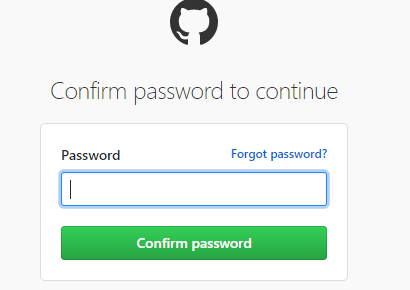
    I do have to authenticate, which I think is important. I have two factor set up, which ensures that you can’t just link to my repos and guess my password.

    Enter GitHub Password

    Once this completes, I get asked to allow my browser to open the app. I agree, and I see a get started view, with my online repos listed.
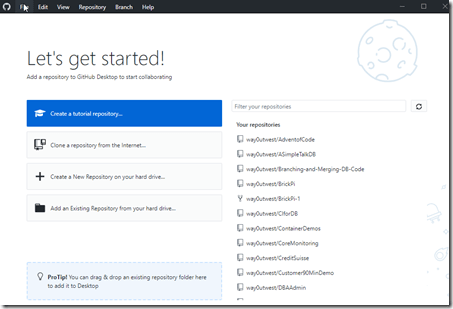
    GitHub Desktop Get Started Screen

    Trying Out the Interface

    I decided to see how well this works, to see if this is more stable. With that in mind, let’s drop an existing repo folder onto the client. I have a git repo that isn’t in GitHub yet, so let’s drag that folder and drop it on the “Pro Tip” section in the lower right (see the image above).

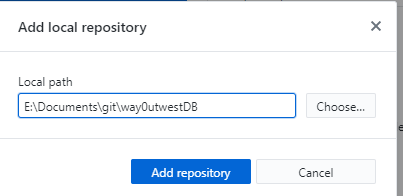
    When I do that, I get a pop up.

    2020-05-26 18_25_49-Window

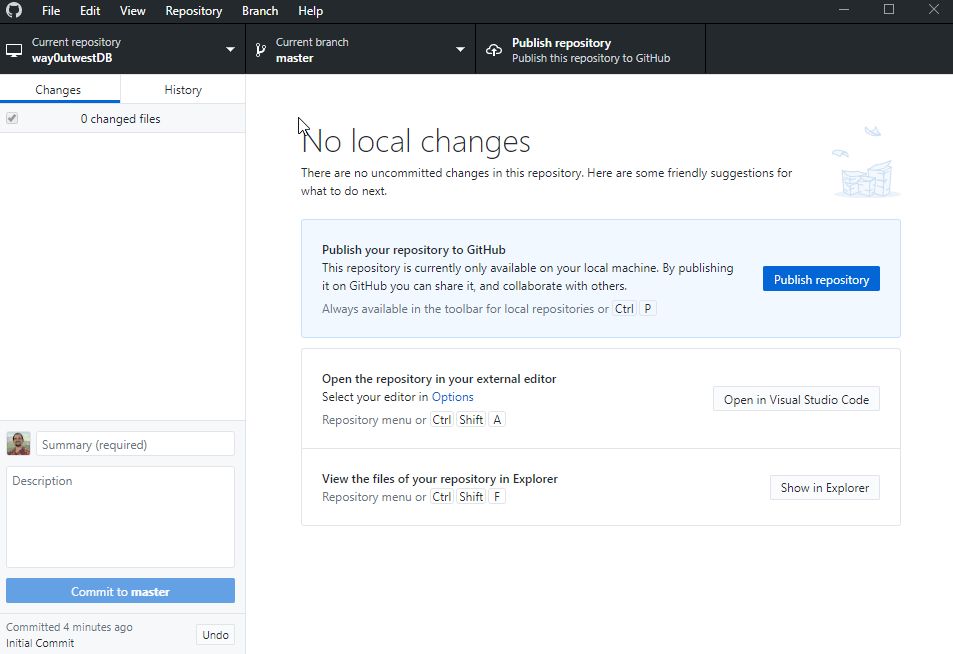
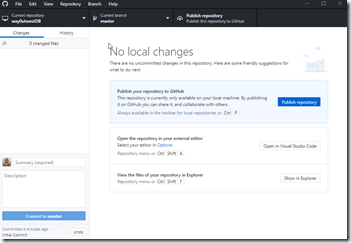
    This is the path of the repo. I click “Add”, and it’s added. This becomes my current working repo, and I can see a somewhat standard view of my repo that I see in SourceTree or GitKrakken or any client.
    2020-05-26 18_26_58-Window

    As you might expect, this is geared towards publishing to GitHub. I have a “publish to GitHub” link. I also have a link to open VS Code.

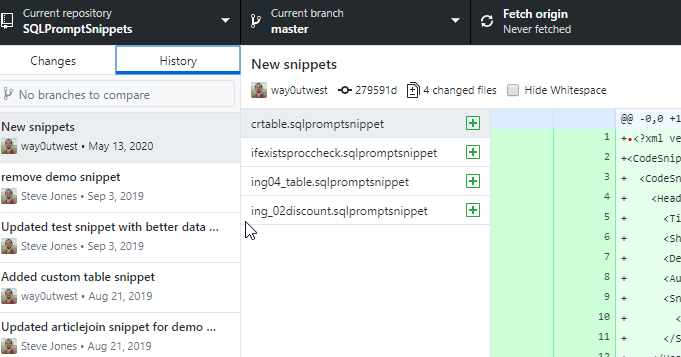
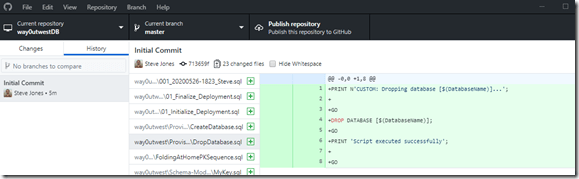
    If I click the “History” tab, I see my commit of this repo on the left, the files in the middle, and file contents on the right. Standard stuff, but a nice layout.
    2020-05-26 18_28_42-Window

    I wonder what happens if I drop a local repo on here that’s in GitHub? Let’s try that.

    The “Getting Started” screen isn’t listed, and I can’t close the repo. At least, I don’t see a close menu item. If I restart the app, I come back to my main repo screen. Let’s try using the “Add repository” menu item. This gives me the same type of dialog I got from a drag and drop repo.

    I can cancel that and just drop another repo folder onto the app, and I get the same dialog as well. So drag/drop seems to always work. When I look at history for an older repo, I see lots of commits. No graph, but all the commits and dates.
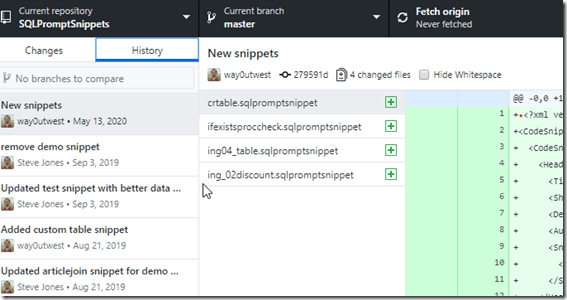
    History of older repo

    This repo always has a remote at GitHub, so I see the “Open the repository” link on the “Changes” tab.
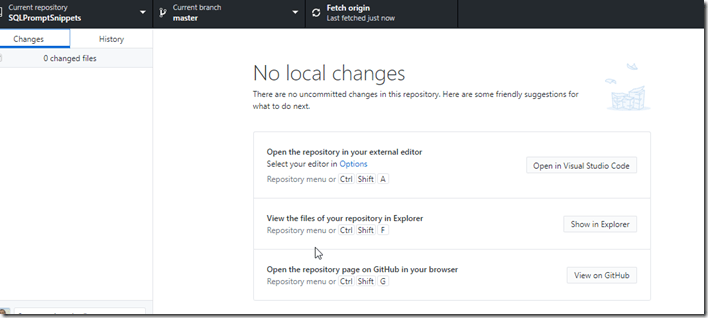
    Main repo page with open on GitHub link

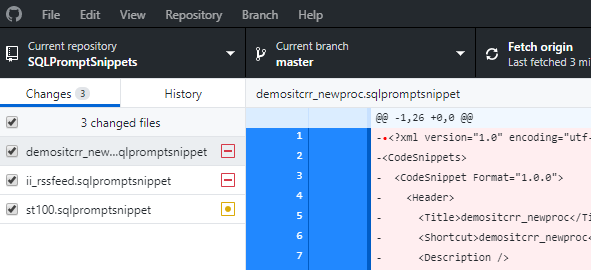
    If I make a few changes in this repo, in a few seconds I see the changes reflected on the main page. I deleted two files and edited another. The right side of the filename has a hyphen for a delete and a circle for a chance.

    List of Current changes

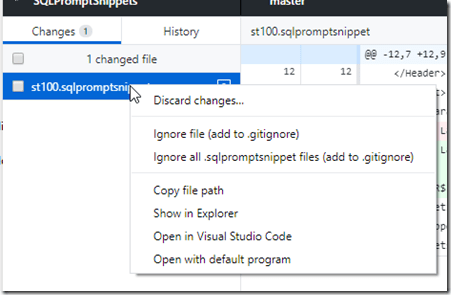
    I committed two changes and that left the third. I don’t see a stage/unstage option here. If I right click the file, I do see a few options. This is likely good enough for me that I can discard the changes. However, the “ignore” feature is nice, as well as the add all of this type option.
    2020-05-26 18_38_20-Window

    Opening this in VS Code, Explorer, or a default program is a nice touch as well.

    Options

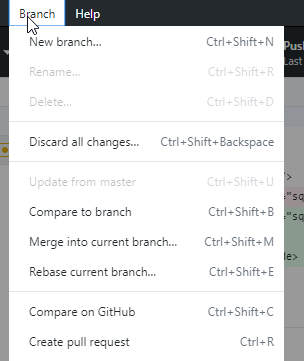
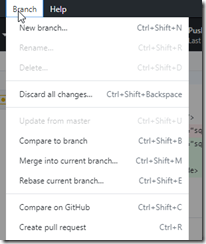
    There some interesting options in the tool. I’ll cover a few things I found to be nice items. First, I like that the branch menu has some things beyond the “new branch” and compare. I can merge, or rebase. Those are good things to have in this tool and common tasks.
    Branch menu items

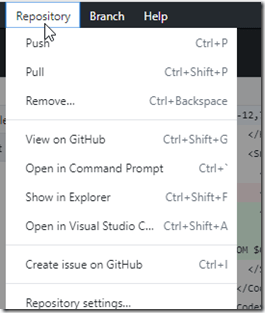
    The Repository menu is what you’d expect, but the “Create issue on GitHub” is really nice. I submit quite a few of those to keep track of work, so it’s nice to be able to get there quickly from here.
    2020-05-26 18_40_35-Window

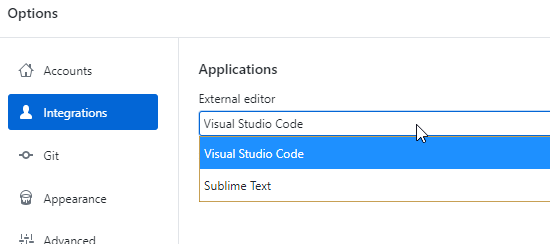
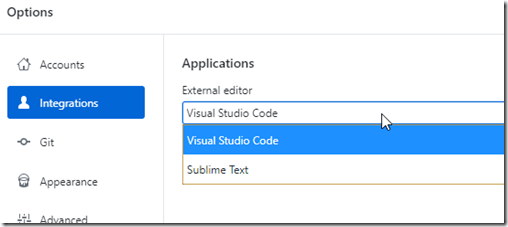
    Under File – Options, there are some good, handy things that much software has these days, but much also doesn’t. For Integrations, the app detected I have Sublime Text installed, so I can use that instead of VS Code. I assume notepad++ or other editors might appear here.
    Integration Options

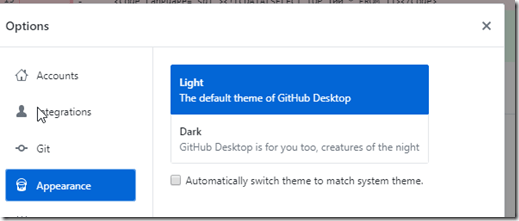
    The Appearance option has a light and dark theme. Important to a lot of people, though I’d like the ability to easily modify things here. I find that these pre-defined themes are sometimes hard for me to see. I’d like to alter the colors slightly in many of them, especially as I get older.
    2020-05-26 18_41_05-Window

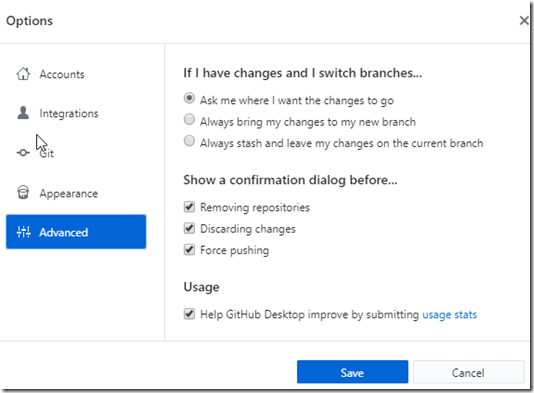
    I like that the Advanced menu lets me choose to get rid of some confirmation dialogs. Overall, I like these, but they do get annoying for some things.I also get a basic default of what to do with changed files when I switch branches. Since I sometimes do this without thinking, it’s a nice feature.
    2020-05-26 18_40_59-Window

    Impressions

    So far my initial impressions are positive, but I need to use this for a bit as my main git tool to see if it works well. I enjoyed GitHub for Windows as well, but I kept having it break with certain changes I’d make, which forced me to learn the command line to fix my repos.

    This is a much simpler app, and it provides the basic git functions I mostly need. Time will tell if this feels intuitive, but I like the simple nature and the ability to quickly navigate back to a file in Explorer or VS Code. I don’t know if I need that, since often I have an IDE open when I’m working with files, so I’ll experiment and see how well this works.