Category: Blog

  • 2018 Advent of Code–Day 1

    I enjoy when the Avent of Code comes around each year. I seem to make this a December (or sometimes New Year’s) resolution to get through them all, but life usually gets in the way. In any case, I decided to at least start this year and see how far I get.

    Day 1 – First Puzzle

    This is a simple one, and one that seems to lend itself to T-SQL. We have an input file that looks like:

    +11

    +9

    -10

    -5

    etc.

    This asks us to walk through the file, summing the values together and getting a new value. So the first row ends with 11. The next ends with 20 (11+9). The next is 10 (20-10), and so on. This feels like a simple calc, so let’s get it.

    I wanted to load this with BULK LOAD, so I started with a table:

    CREATE TABLE Day1(rawdata VARCHAR(20))

    I know I’ll need to change this, but let’s make this easy. I use this command to now load my data.

    BULK INSERT dbo.Day1 FROM 'C:\Users\way0u\Source\Repos\AdventofCode\2018\Day1\input.txt'

    Once this is done, I’ll move on. Since I need to get this into some numeric values (this is a math problem), I’ll make another table.

    CREATE TABLE Day1_a(frequency INT)

    Now I move the data.

    INSERT dbo.Day1_a
    (
         frequency
    )
    SELECT CAST(rawdata AS int)
    FROM dbo.Day1
    GO

    That seems to work fine. How do I get the end result? Well, addition doesn’t matter here, so I can do this:

    SELECT SUM(frequency) FROM dbo.Day1_a
    GO

    I get an answer, plug it in, and viola, I’m right. That feels good.

    Day 1 – Second Puzzle

    This one is a little harder. I’m supposed to find out the first time that the end result repeats it’s value. The test cases show this working as follows:

    Value    New result

    0       0
    1       1
    -1      0

    If I walk through this, the 0 repeats. The other test cases show this, but with the large input set, I need to change a few things.

    1. I need to preserve ordering
    2. I need to process this row by row.

    The second item doesn’t mean that I’m looping necessarily, but I need to calculate out the sums as I go and potentially repeat the list.

    To get started, let me modify my Bulk Insert and table to keep the ordering. I created this table.

    CREATE TABLE Day1b(datakey INT IDENTITY(1,1), rawdata VARCHAR(20))

    I then ran BULK INSERT. I got this error:

    2018-12-03 15_24_00-SQLQuery5.sql - dkrSpectre_SQL2017.sandbox (DKRSPECTRE_way0u (53))_ - Microsoft

    I tried a number of items, but nothing really worked. This was a very, very annoying error, and the main solution I saw on Stack Overflow was to add a column to the input file, which I don’t want to do. I initially thought this was a problem with the encoding, but it’s really the identity.

    The best solution was a lower down answer, which was to create a view without the identity.

    CREATE VIEW vDay1b
    AS
    SELECT rawdata
      FROM dbo.Day1b
    GO

    If I run the BULK INSERT to this view, it works fine.

    OK. We’re moving and I have the data in order. Let’s move it to get the integer results we need.

    CREATE TABLE Day1_2
    ( n INT, frequency INT)
    GO
    INSERT Day1_2
      SELECT datakey,
             CAST(rawdata AS INT)
       FROM dbo.Day1b

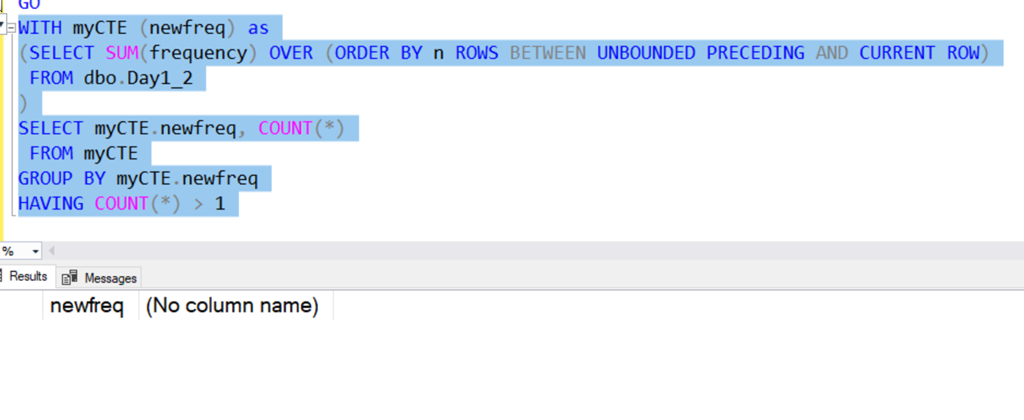
    If I run a quick query that does a SUM() OVER(), I get a series of results. I can see there are no duplicates here.
    2018-12-03 15_32_29-SQLQuery5.sql - dkrSpectre_SQL2017.sandbox (DKRSPECTRE_way0u (53))_ - Microsoft

    OK, this means I need to repeat the data. I can re-insert data into the table, but that feels inefficient. I ought to be able to group data together.

    Let’s do this by selecting the data as a group, but adding a value to it. I can do that with a cross join. Here’s a short example that illustrates this. Suppose I have a table with the values “Broncos”, “Chiefs”, “Raiders”, “Chargers”, I get select data like this in groups.

    2018-12-03 15_36_36-SQLQuery5.sql - dkrSpectre_SQL2017.sandbox (DKRSPECTRE_way0u (53))_ - Microsoft

    With that in mind, let’s create a tally table and start to duplicate data. I have no idea how many times, but having done the Advent of Code before, I’m guessing 5 groups isn’t enough. Let’s start with 100 repeats.

    One note, I do need to start with 0, so we’ll use a UNION to add the 0 row. We don’t want the 0 row repeated, so we don’t add that to the table.

  • Only One New Shirt in 2018

    Usually I get a few shirts each year, and may donate/give away a few others. However, in 2018, I only got one new shirt, and didn’t even get time to monogram it. Here it is from #SQLintheCity in May.

    32873712_10215886774711160_2254488192629604352_o

    This was an Intel promotional shirt, with their SSDs and older, white USB web cams on it.

    I got a promotion from the place I use, so I’m thinking to try and get a couple new ones for next year. The Wild West and World Traveler shirts are tempting. Though, maybe the National Parks one is good since I made it to 3 parks this past year.

  • Restarting a Sequence–#SQLNewBlogger

    Another post for me that is simple and hopefully serves as an example for people trying to get blogging as #SQLNewBloggers.

    As part of my experiments with the sequence object, I wanted to see what allows me to restart a sequence at a new value. This is useful in a few situations, some of which I want to see in this post.

    Starting Over

    One common scenario might be where I create a sequence and test it a few times, but don’t want those values lost. For example, Suppose I create this sequence and test it a few times.

    CREATE SEQUENCE Counters.TopTen
    START WITH 1
    MAXVALUE 10
    CYCLE
    GO
    SELECT NEXT VALUE FOR Counters.TopTen
    GO
    SELECT NEXT VALUE FOR Counters.TopTen
    GO

    I don’t want the first two values to be removed from the sequence. Instead, I want to get the next number back to 1. I could run 8 more SELECTs to allow the sequence to cycle, but if you’re like me, you’ll end up executing this one too many times and then have to repeat the experience.

    Instead, I can use the ALTER command to fix this.

    ALTER SEQUENCE counters.TopTen RESTART WITH 1

    Of course, I’ll test this with a SELECT, but once I am confident this behaves as expected, I’ll re-run the ALTER again.

    Going Backwards

    One common situation might be a case where an application requests a number of sequence numbers for a situation, but they never get inserted. Suppose I set up an insert statement to load some data in a table, but a key error or some other problem prevents the inserts. I don’t want those values to be lost, so I want to restart numbering.

    As an example, I find that one of my sequences has the value, 41.

    2018-12-05 15_49_08-sequences.sql - dkrSpectre_SQL2017.sandbox (DKRSPECTRE_way0u (65))_ - Microsoft

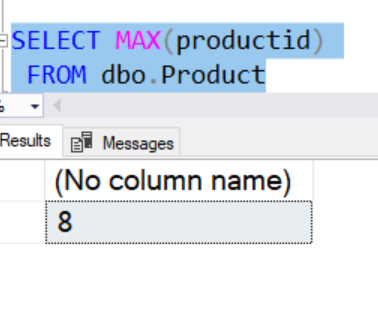
    However, this is because a load of new products failed. The last number used in the table was 8.

    2018-12-05 15_49_29-sequences.sql - dkrSpectre_SQL2017.sandbox (DKRSPECTRE_way0u (65))_ - Microsoft

    In this case, I want to reset the sequence object to 9, so let’s do that.

    ALTER SEQUENCE Counters.Products RESTART WITH 9

    Now I can proceed on loading products into this table, using the sequence object to get the next value.

    SQLNewBlogger

    This was a continuation of a series of posts on the sequence object. As I continued to experiments, I captured the code and some images to use in posts, writing this up as I had time.

    For this post, I took about 10 minutes of experimenting and then another 5-10 trying to sort out some of the experiments into an area. This writeup was about 10 more minutes.

  • Azure at the Ranch

    From our webinar today, I mentioned I had a dog named “Azure”. Here she is.

    IMG_20181113_115510

    No, this isn’t an homage to Microsoft, and I didn’t name the dog. My daughter did, and she’s not a data platform person.