The anniversary of the birth of my country is today. Many of you have the day off, which is nice, but inside of all the celebrations, cookouts, or other events, please think about re-reading the Declaration of Independence or the Constitution and think about what it means to be a citizen.
That’s all the thoughts for today. Enjoy the blooper reels:
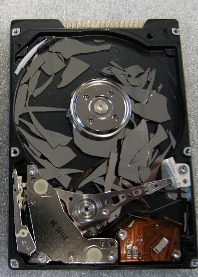
You don’t need this kind of failure to consider replacing your hard disk.
What makes PCs fail? Recently Microsoft Research published a research paper that looks at PC failures. The research spanned a million consumer PCs and examined failure rates and the suspected causes of those failures. The data came from the Windows Error Reporting system that runs after crashed inside of Windows, so this data doesn’t include other operating systems. It also is for fatal errors, those resulting from system crashes and doesn’t include non-fatal errors.
It’s an interesting read, though a little boring since it’s an academic style paper. It does have a few highlights thatcaught my eye. The first is that when a failure occurs, the chance of another failure occurring soon is high. That means that disk failures predict another failure is likely in the next 30 days. Server machines might be different, but those of you with consumer grade hardware might think about an immediate backup and the purchase of a hard disk replacement if you have a fatal disk error.
There are other highlights that over-clocking can dramatically increase CPU failure rates. It isn’t completely clear if this means a shorter lifetime, but if you’re like me, having errors that crash systems is incredibly annoying and time consuming, so I’m not sure I’d ever want a system over-clocked. There was another interesting point that said CPUs and RAM in white box (non-OEM) machines was less reliable than brand name systems. I struggle to see how a CPU would be less reliable, but that was part of the analysis. I’m not sure that would stop me from purchasing my own parts in the future, but it is something to keep in mind. Perhaps you should burn in the machine as soon as you can to allow for a parts return if you have issues.
Laptops were more reliable, which was surprising, and also comforting since most IT pros I know use laptops. People tend to keep old memory around, which can wear out over time, so be careful about moving memory from machine to machine. There weren’t a tremendous number of surprises in the study, but it did make me appreciate my long running desktop that rarely reboots, and even more rarely crashes. I was pleased to see such a detailed analysis being undertaken by Microsoft Research using data from actual Windows systems. Hopefully there are engineers also looking at the data and improving the OS as well.
Steve Jones
The research paper for this editorial was highlighted in the Brent Ozar, PLF newsletter.
The Voice of the DBA Podcasts
We publish three versions of the podcast each day for you to enjoy.
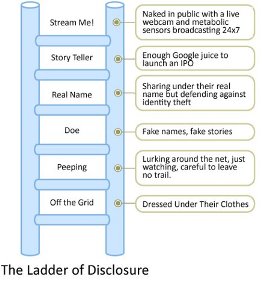
I really think we need better disclosure on security issues.
Information is power. That’s been a saying I’ve lived by as a data professional for years. That has guided me to capture additional data in applications, often data business users did not think was important initially. The power of information led me to monitor my servers, and proactively look for ways to improve performance. Using resources like SQLServerCentral allowed me to learn about what others were doing, what worked, and what didn’t. The dissemination of information has helped me to have a successful career as a DBA.
When I see articles like this one, where companies are not disclosing the security issues they face, I worry that our industry is not advancing as quickly as it can. It’s important for us to share technical challenges and solutions among as many people as possible in technology. Our systems are complex, the sheer number of technologies is overwhelming for any one person or even company. The vulnerabilities, bugs, and attacks outweigh the technologies by far, yet our employers so often do not want to disclose any issues for fear of bad publicity.
It’s time that this was required. Every company gets attacked, and probably most get hacked in some way. Rather than prevent that they are invulnerable, make the information public, or at least public to other IT workers. It doesn’t have to be a press release from your company, but companies should be required to disclose the problems they’ve had, the vulnerabilities they faced, and the mitigation measures. I don’t want to invite attacks, but I also think that we are building more and more poorly developer applications on top of poorly architected foundations.
Within a reasonable time, companies ought to be forced to disclose the issues. They don’t have to fix them, but the disclosure might just encourage them to spend a little more time ensuring that their infrastructure is protected.
Steve Jones
The Voice of the DBA Podcasts
We publish three versions of the podcast each day for you to enjoy.
Is it worth it to you to build a highly available database?
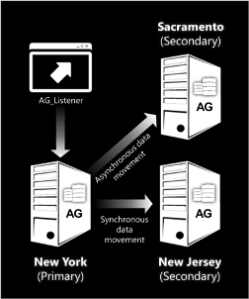
The cost of building highly available databases dropped with the introduction of Database Mirroring in 2005. Without the need to purchase identical hardware for a spare system, it became much easier and less expensive to set up extra systems that could handle a workload in the event of a disaster. This technology was improved in SQL Server 2008, and in SQL Server 2012 we have a new option: Always On.
When I first heard about the changes coming in SQL Server 2012, I thought for sure that many people might upgrade to take advantage of the HA enhancements and provide more stability for their systems. However as I see the actual changes in detail, and talk to more and more data professionals, I’m not so sure. Many of us have spent years building systems that tolerate most issues meet the majority of our needs. With that in mind, I had a question for the DBAs out there.
How important is a highly available database with automatic failover to your employer?
Having a spare system that automatically picked up the load when a database server failed would seem to be on the wish list of every user, but plenty of environments don’t implement one. Many companies desire such a configuration, but when they see the cost or complexity, many forego an implementation.
This Friday I’m wondering if your business sees this as critical and has implemented such a system, or are you more tolerant of minor issues, and willing to accept some downtime in a simpler environment.
Steve Jones
The Voice of the DBA Podcasts
We publish three versions of the podcast each day for you to enjoy.