Tag: build

  • AI Thoughts on the Build Keynote

    If you haven’t seen the Build 2023 keynote, it’s, well, interesting. At a surface level, it’s focused on AI and delivers some demos that many of us might find to be useful and intriguing. I didn’t attend the event (or watch it live), but I did see it a bit later and I made some notes, pausing the 30-minute talk a few times to think about what I’d seen.

    The opening lightly glosses over some of the AI enhancements to development tools and the environments that can be created quickly in GitHub or Azure. Some of us will like those, and maybe they’ll grow on me, but I tend to prefer a development environment on my own hardware, where I have unlimited compute power at a fixed cost. The first big announcement is then showing Copilot technology, essentially some ChatGPT-like abilities, embedded into Windows 11. The demo shows asking Windows where settings are, with the response including buttons to take actions, like setting dark mode. Minorly useful, though I think Windows search works fine. I can type “env” and get the “edit environment variables” in the results. I still have to click through to change things, but this doesn’t seem like a better use of AI, especially if I need to type “set dark mode” instead of “dark”.

    To be fair, the demo has the user asking for ways to adjust the system to get more work done. The suggestions are for dark mode and a focus timer. I knew about the former, but not the latter. Perhaps being able to ask for general assistance with tasks is useful as there are likely lots of features I know nothing about and wouldn’t even think to look for. There is also the option to drop a document, like a PDF, in the chat and Windows asks if the user wants the system to “explain”, “rewrite”, or “summarize” the document. The user clicks summarize and gets a summary of the document.

    There is also a demo with plugins that developers can write for Bing, such as one that uses a legal package to make a change to a document. While lawyers might be worried about their practices (or paralegals about job prospects), I’m more worried about a fundamental problem that many of us data professionals have seen in the past: garbage in, garbage out.

    In this case, if the AI model isn’t well-trained, can I really trust it to summarize a PDF or change a legal document? How can I tell if it’s wrong, or slightly off? In some sense, this reminds me of a high school report. It might summarize some text at an A level, or a D level. It’s up to me to judge that, and I can’t assume the results are good or bad.

    The important thing to keep in mind, however, is that we aren’t in that place with AI. We can’t just trust the AI. We are in a time when AI is an assistant, where it can help us complete a task or get something done a little quicker. We are still responsible. We still have to verify and do some work, but if the Copilot can automatically launch Jira and navigate to a ticket, or attach a document and create a short message to our team, that saves us time. It saves us tedium. It can make our jobs easier. We are still needed, but we don’t do all the heavy lifting.

    I do worry about some of the opportunities for plugins that developers will write strictly to monetize their efforts. If I want a shopping list, I don’t want it to go to Instacart. I want a list I can use. I realize that doesn’t necessarily make Microsoft or a developer any money, but not all the tasks and advances are about profit. Or at least, I hope they all aren’t. I hope some are here to just make the world better. For a quick view of what that could be, watch the keynote closing video.

    Steve Jones

    Listen to the podcast at Libsyn, Stitcher, Spotify, or iTunes.

  • Looking Back at Build–CosmosDB

    Part of a series looking back at Build 2017, going over the 20+ pages of notes I took.

    One of the big announcements at Build 2017 was the release of CosmosDB. This is a rebranding of DocumentDB, the document store in Azure, with some additional capabilities. You can also choose to store as

    • Column-family (columnar)
    • Key-Value
    • Graph

    The service is interesting in that it supports the MondoDB and Gremlin protocols for querying, which should allow some people to consider Azure instead of those platforms. The announcement was interesting from the data perspective. Microsoft focused a decent amount of time on this platform, and certainly people at the conference were very interested in the offering. Quite a few developers were thinking this would replace SQL Server, since it has some nice capabilities.

    One of the big ones is that CosmosDB offers < 10ms latency for reads and < 15ms for writes. They scale up to millions of transactions/sec, and also grow to PBs in size. There are some good guarantees for the database.

    They call it infinite, but that’s a marketing term. There’s a limit, and there certainly may be a limit you’re willing to store in the service. Jet.com was the featured customer and they talked about how much data they used and how they can scale the platform. I’m sure they went with DocumentDB and moved over, but they have their story in the keynote, if you want to watch. They get over 100 trillion, yes trillion, CosmosDB transactions/day. No matter what you do, a trillion of anything is a lot.

    Perhaps the more interesting thing is that Azure is offering five different consistency models in CosmosDB. They are

    • Strong
    • Bound Staleness
    • Session
    • Consistent Prefix
    • Eventual

    I don’t know how well these are supported in other platforms, but I like to see that developers have a choice. I’m not sure how many will understand the trade-offs and implications, and how many will get burned by choosing one over the others, but I’m glad the choice exists.

    They are also saying a money back guarantee. What that means, or how you get money back, is going to be something to see. I haven’t always been thrilled with the disclosure in billing for new parts of Azure services, but perhaps there is going to be some way to request credit, though I would hope that any telemetry that shows issues results in some credit.

    The other good thing is that the SLA is guaranteed across multiple dimensions: latency, throughput, availability, and consistency.

    Rimme Nehme, who demo’d the product, had an interesting quote. It was something like “developers can concentrate on the app, not the database.” Forgive me if I’ve slightly misquoted as I’m going from notes. While I cringe a bit as a data person, I do know that most developers don’t want to really work deep in the database, especially for many simple apps. If I were building some simple mobile app, I’d seriously look at CosmosDB, and I plan to learn a bit about it.

  • A (mostly) Unwired Week at #MSBuild

    Part of a series looking back at Build 2017, going over the 20+ pages of notes I took.

    Last week I had the opportunity to attend Microsoft’s Build conference, and as I wrote, I planned to use a notebook and not my PC. For the most part, that was my week from Wed-Fri, with a small exception.

    I had an interview with Channel 9 (airing this week?) and had to prep a demo. After rebuilding my machine last month, a few things weren’t working, so I dragged my machine to the Thursday sessions and worked on the demo during a few breaks. However, I didn’t take any notes and closed it when sessions started.

    The trip over was nice, though I was scrambling to finish some work on the plan. At least I had a nice view coming into Seattle.

    Photo May 09, 9 42 41 PM

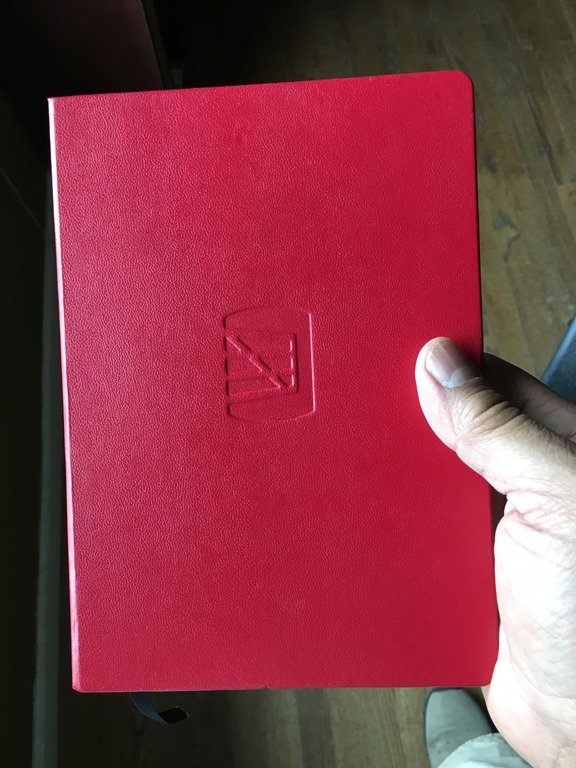
    Here was my notebook, and as I walked around, I carried this with a pen to all the sessions, keynotes, etc., just jotting thoughts and notes on paper. I like to write, as it helps me remember, so many of my notes were just things I heard, with some thoughts around them.

    Photo May 15, 10 02 09 AM

    It’s a good way to attend the conference, as every time I opened my phone or laptop, I was tempted to check things. Email, ESPN, Slack, etc. Taking time away from work was good, though I would have liked to avoid the demo commitment.

    At Build, there were a few things that caught me eye. I’ll talk about each in a post at some point, and I’m drafting some of those now. However, I’ve got to get some work done, and I travel again this week. For this post, let me start with one item from the first day.

    Hololens

    The Hololens mixed reality platform was announced last year just before Build 2016 and was featured there. I went to the conference last year to present part of a session on behalf of Redgate Software, but I was only in San Francisco for about 24 hours. I presented my session, was at the Redgate booth for a couple hours, and flew home. I was tempted to try Hololens, but there was a long line.

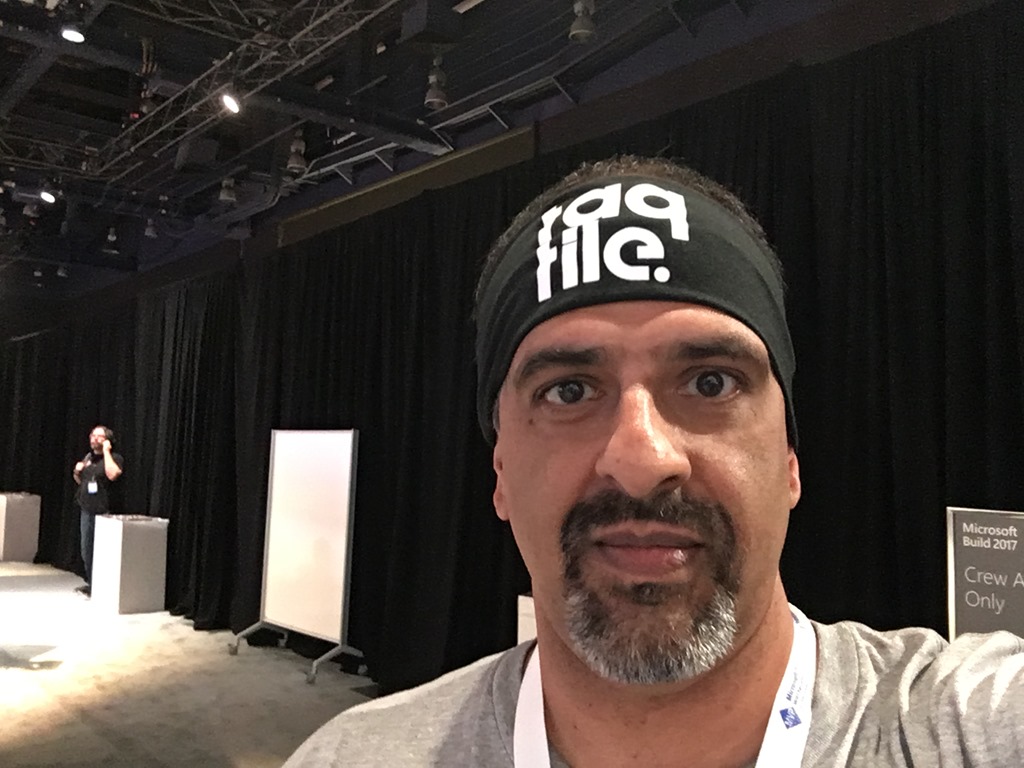
    This year, after the opening keynote, I walked to the expo area and there were 4 or 5 large setups for Hololens from difference companies, each with a different application. I stopped by the Taqtile booth, mostly because it was the closest one I saw near the VSTS display. There wasn’t much of a line, so I decided to stop. They gave me a headband, which I thought was a great idea with lots of people all wearing the same device.

    Photo May 10, 12 28 01 PM

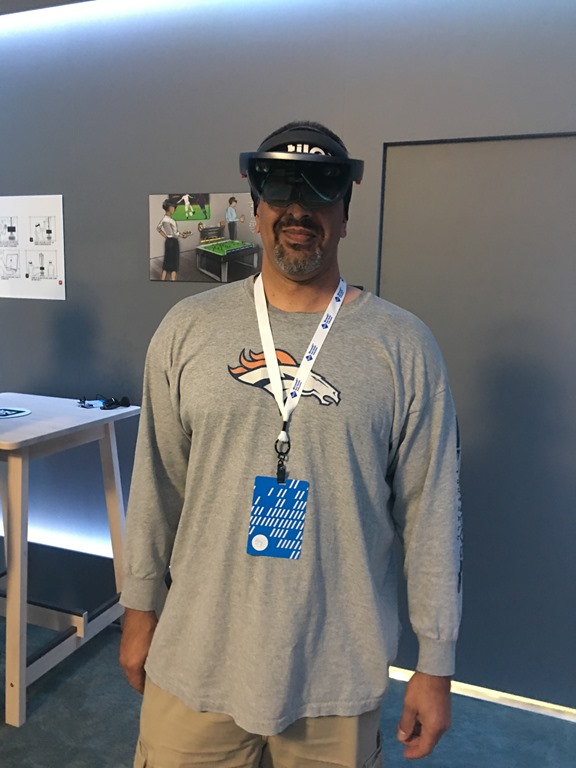
    They measured my pupillary distance, which helps ensure the device focuses the display correctly. Then they explained how the device worked, showing brightness and volume buttons, as well as hand gestures. However, we weren’t going to use any of that as this was a guided walkthrough by one of the app.

    Photo May 10, 12 36 38 PM

    Wearing the device is interesting. It’s a padded loop that tightens on your head, with an outer loop holding the display that can rotate independently. It’s heavy. Not noticeably at first, but across the ten minutes I saw the app, I could tell it was something that might bother me.

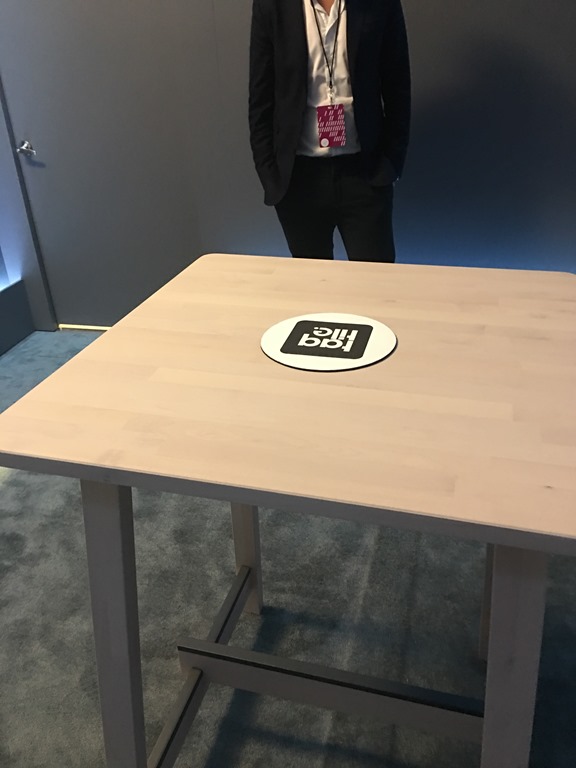
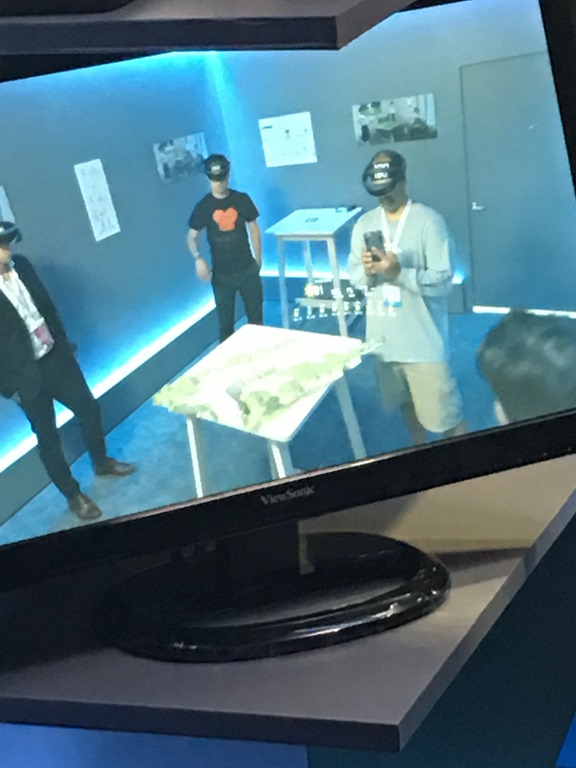
    There were a few of us in the demo, and we looked at a table, which looked like this to everyone in line.

    Photo May 10, 12 38 39 PM

    Nothing to see there. However, the app is a mapping app, in this case for golf courses, and on the display you can see what I saw. Somewhat.

    I could see a three dimensional gold course, with decent, maybe standard def, resolution. I don’t know what the specs of the device were, but this was good enough to see details, but not overly sharp. The model behaved as if it were really on the table, so that as I moved, the device rendered the model in a static manner, as I would see it if I turned, moved, or stepped to the side.

    Photo May 10, 12 38 46 PM

    The demo guy added information, such as the score of players or the weather, that appeared to float above the golf course. It was always in front of me, even if I moved. We could even see animation that showed how the golf ball would move across the course from a player’s shot.

    It’s an interesting device for sure. One of the PMs was nearby and we chatted. He wanted to know what data applications we might think of from the SQL Server perspective. I’m not entirely sure how Hololens is better than other visualizations, but I’m going to try and come up with something.

    My overall thoughts. First, the bad.

    This is too heavy. Not bulky, but something that I think would bother me after a period of time. It’s not as heavy as a motorcycle helmet, but a similar feeling of tiredness over time. Just as with a helmet, if you wear it often then you’d build some strength and get used to it.

    The other issue is the field of vision. It’s similar to what I get with my glasses, but a little narrower, top to bottom. I just don’t get a lot of viewing. If I look down with my eyes, not my head, I see nothing. It’s like a narrow strip of virtual overlaid on reality. I think the amount of screen would have to grow for virtual reality, but maybe not for mixed.

    The thing I couldn’t tell is how the mixed reality works as this demo didn’t let me see much of the real world. There were others, including people demo’ing the Hololens with a real semi-truck in front of them, presumably able to redesign or understand the engine with some overlay’ed imagery. I’d have liked to see that, but lines were too long.

    The good. It’s cool, and interesting. I certainly think the gaming and training industry would like this. I don’t know if the resolution is good enough for medical work, but I’m sure things will improve.

    The lag was really non-existent, and I could easily see the information displayed, whether graphical or text. I think that visual design, fonts, and colors are going to be important for the display, but I was impressed with what I saw.

    It still feels a bit like a toy. It wouldn’t replace monitors as a computer interface for me, nor would I watch movies. Perhaps the resolution is better than I saw, but it felt limited to me.

    It’s still an expensive device, though there were lots of them at Build to demo. I don’t know I think this is the future of computing, but I do think there will be lots of use for this in industrial settings where we are looking for a remote person to transfer knowledge across distances.

  • Three Days and a Notebook

    This is a short week of work for me, really just today before heading off to attend Microsoft Build 2017. I’ll spend the rest of the week watching Microsoft show off their latest tools, ideas, technology, and more at the developer’s conference. I’m not speaking (I think) and am looking forward to three days of learning, watching, and getting excited about building software that for the most part depends on data in some way. I’m not sure what will be presented, as the schedule hadn’t been posted as of the time I wrote this, but I’m sure there will be plenty of Azure and SQL to go with all the Windows and .NET sessions. I’m especially interested in ways that DevOps is making its way into the Microsoft stack and looking forward to seeing the creative solutions out there.

    I haven’t attended Build since it was the PDC many years ago. It’s been since the early 2000’s when I went to a few of these events as a software developer. I first saw Microsoft showcase XML tools in the late 90s and tablets a few years later.  I always enjoyed these shows and after a few years off was looking forward to going back. Then they cancelled the event before it was reborn as Build. I’ve been trying to schedule a trip for the last 4 years, but scheduling keeps getting in the way. I know, it’s a hard life, and I’m not complaining. It’s been disappointing for me.

    Last year I was actually offered the chance to go speak on behalf of Redgate at a session, and I did go, but with volleyball trips planned with my daughter, I was in San Francisco about 24 hours, saw 1/2 of the keynote and part of one session (besides my own) and then left. Not much of a Build event for me. I didn’t even have time to go through the HoloLens line and give it a try. However, I had a few days with my daughter, so I can’t complain at all.

    This year I didn’t have anything scheduled for May and got the chance to register early. I plan to try and leave my computer in the hotel room and work little. Instead, I’ll walk around with my notebook, jot down ideas, and just think a bit about software, my career, and where Microsoft is going. This will be my thinking time for the week. Actually, I haven’t had much thinking time this year, so I’m looking forward to the break.

    I rarely attend any events or training without having some sort of commitment or responsibility these days. I try to fit in a few sessions or a pre-con here and there, but training time and focused time on something other than work is rare. For the first time in many years, I’ll actually going as an attendee and doing the things many of you do at SQL Saturdays, SQL Bits, the Pass Summit, and other events. I’ll be learning, focusing, racing from session to session, networking, and hopefully overdosing on new technology.

    I’ll try to summarize notes in a few blogs, and maybe even give a short recap as an editorial one day, but this should be a fun technology week for me.

    Steve Jones

    The Voice of the DBA Podcast

    Listen to the MP3 Audio ( 4.5MB) podcast or subscribe to the feed at iTunes and Libsyn.