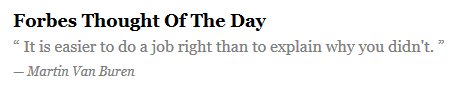
I wish this were the mantra of all people, but certainly those in technology:
Recently someone posted a question on SQLServerCentral asking for potential interview questions. A few people were annoyed by this and their annoyance showed in their replies. I completely understand that feeling, with fewer jobs than candidates, people looking for jobs do not want anyone with less knowledge to get any help.
However there are other sides to this question, and I’m torn as to how I feel. If you haven’t interviewed in awhile, or if this is your first interview for a database job, wouldn’t you want to get an idea of what somoen might ask you? I wouldn’t want anyone to misrepresent their skills, but I’d also want them to be able to talk about the skills they have had. Perhaps realizing that they should think about their experience in T-SQL more than their experience with replication might be valuable information.
There’s another side to this. Plenty of managers, developers, and even DBAs that are tasked with interviewing candidates for a position don’t necessarily realize what questions might help them evaluate a candidate’s skills. This is especially true when you have a staff of people trying to find a senior level person because their only talented person resigned. Hiring someone to interview for you, especially for the first or second interview, just isn’t cost effective.
Many of us work in companies, and as much as we’d like to think we are gaining new knowledge and experience every year, it’s very, very easy to get caught up in our daily work and accumulate many years of similar experience. Without an effort to branch out, take on new responsibilities, and try new technologies, it’s easy to become very specialized in the skills needed for our job, even if those aren’t a broad range of skills.
I am highly torn on how to handle requests and content on interview questions, but ultimately I think that putting more information out there is the best way to handle things and allow people looking for jobs, as well as those hiring, to educate themselves.
Steve Jones

I talk about branding at many different events, with the idea that you should control your personal career brand, and make an effort to improve it. As more and more employers look to validate your experience and verify your skills, having a strong brand helps you to stand out amongst the competition. The cost of a bad hire is high, and companies are trying different things all the time to reduce the chance they’ll make a bad hire.
I’m not the only one that thinks you should have some brand out there. Troy Hunt wrote a piece about being a ghost programmer and how it hurts your career. It basically talks about how a programmer that doesn’t leave any kind of trail on the Internet is not likely one you want to hire. There are all sorts of reasons someone might not have a blog, or participate on a site like Ask SQLServerCentral, but many of the reasons are signs that a person isn’t really working efficiently. I’m not sure I completely agree with this interpretation, but I do think that the less information a potential employer can find about you, the more reason they might have to ignore your resume and move on to someone who they can perform more due diligence on.
I completely understand the desire for many people to keep their lives private. There’s nothing wrong with that, though it can be detrimental to your job search. However you can overcome some of this, but maintaining some documentation about your projects, skills, thoughts, and providing that along with your resume, or as additional proof to your resume when requested. You can even use anonymous handles on the Internet, providing them in the same manner you have “references upon request” on your resume. They can be sent in an instant, but they aren’t public. I’d even make a note on my resume to that effect, if I were inclined to maintain more privacy about my career.
You don’t have to be a Jon Skeet or an Iris Classon, but you should have some information you can share about your career when you are looking for a job. If you don’t, you might never know how much it impacts your job search. After all, is your phone not ringing because you aren’t qualified or employers just don’t know if you are?
Steve Jones
We publish three versions of the podcast each day for you to enjoy.


I’ve written about offices I like in the past. I’ve worked in a variety of offices, and having telecommuted for the last decade, I find that I mostly prefer a variety of environments. I have a standing desk, where I do most of my work, but I often find myself moving to another room with my laptop to work in a quieter, or louder, environment. I work at a coffee shop, in hotels, even in the car at times. It seems like I might be working too much, but I think I have a good balance between life and work. I just find myself working for short stretches in very disparate environments as I wander through life.
For me, the ideal environment has varied according to the job that I did. Software development seems to require more quiet and separation than operational work. The more I coordinate with others, the more I like an open floor plan. The more I have to concentrate on my own work, the more I prefer a peaceful, solitary environment. As a DBA, I’ve had to work in both environments and I’ve had my own office, a shared office, a hot desk, and an open plan. I often haven’t had a choice of the arrangement in most jobs, so it’s a good thing I’m adaptable.
I ran across a piece that looks at the history of the open and closed office, as well as different ways or organizing desks. There are great pros and cons in the article for each setup, and the compromises people make. This week, I’m wondering what many of you would like your arrangement to be.
Would you prefer an open plan? A closed office? A hot desk arrangement that incorporates both of these? Do you want public spaces at times and private locations where you can get solo work done if you need it? If you have preferences, or comments about your current setup, let us know today. Maybe we can design a few “ideal” office spaces together.
Steve Jones
We publish three versions of the podcast each day for you to enjoy.

