Tag: career2

  • Those Who Can, Do

    Getting a certification like this is good if it teaches you new skills and you use them.
    Getting a certification like this is good if it teaches you new skills and you use them.

    There was a time I considered staying in college, getting a masters or PhD and teaching others. I still might follow that path at some point since I enjoy speaking and teaching others how to better work with SQL Server. At some point, however, I became frustrated with the theoretical approaches many teachers had. Like many 20-something-old students I tended to subscribe to the mantra “those that can, do. Those that can’t, teach.”

    I was reminded of that by this piece: Those Who Can Do, Those Who Can’t, Get Ceritified. It compares IT workers to the computer systems they manage, and it points out that if all that’s required is to pass a test, that’s something a computer can do very well, perhaps even replacing those that can just answer questions in their daily work.

    There’s some truth to that. I always wonder about a person that has 3, 4, or more certifications; do they have actual skills with the product?. Have they actually used the knowledge from those certifications in their work? Is the certification the goal, or is it a way to learn skills and knowledge that can be applied at work? If it’s the former and not the latter, then I’d say your efforts to advance your career through certification are poorly aimed.

    However if the certification gives you structure and focus, if it allows you to improve the skills you have, and bolster the weak areas in your knowledge, it can be beneficial to your career. If you are taking that knowledge and using it in your daily work, or even in your spare time, then the certification is merely a stepping stone to something greater.

    I don’t think that people who are certified are somehow incompetent at their jobs, but they have to showcase more than just the certification for me to believe they are valuable employees.

    Steve Jones


    The Voice of the DBA Podcasts

    We publish three versions of the podcast each day for you to enjoy.

  • The First Event of 2013 – SQL Saturday #183 – Albuquerque

    I’ll be delivering the Modern Resume presentation at SQL Saturday #183 in Albuquerque, NM on February 9, 2013. I got my acceptance today and replied that I’ll be there.

    This is the first SQL Saturday in New Mexico, which is a little exciting. I’ve been there a few times since my brother used to live there and thought it was a neat city. I’m looking forward to going back and wandering around for an afternoon before the event.

    If you’re anywhere nearby, register and come to the event. It should be a lot of fun.

  • Test Your Restores

    The ultimate testers.

    I was talking with someone the other night about their database systems and they mentioned they had implemented TDE (Transparent Data Encryption) to comply with HIPAA regulations. This person had verified that they were backing up the Database Encryption Key, which you definitely need if you want to restore a backup from a TDE encrypted database. However they weren’t sure if the certificate that protected the DEK, and the master keys on that instance were being backed up. Probably most scary to me, they hadn’t tested any restores of the database.

    Encryption is serious business, and if you are going to implement it in your databases, you had better be sure you understand how the various keys and certificates work. You better be sure you have protected your passwords, and that you can find them in the event of some issue.

    Most importantly, though, is that you need to practice recovering your database to another instance. Preferably you’d learn how to recover on an instance that hasn’t ever enabled encryption as well as one that has a different SMK or DMK.

    Practicing restores isn’t just about encryption and the potential for data loss because you don’t have a key. Practicing restores is important for all of your systems to be sure you have the skills to successfully complete a restore. It helps ensure you know where the files, tapes, disks, or any other resources are located. Most importantly it ensures that your backup process is actually running smoothly.

    Please don’t assume your backup process works. Whether you’re an accidental DBA stuck with their first SQL Server, or a ten year senior DBA that has performed hundreds of restores at previous jobs. You need to test your process and ensure that you can perform restores on the systems you are managing.

    Steve Jones


    The Voice of the DBA Podcasts

    We publish three versions of the podcast each day for you to enjoy.

  • Grow Your Skills

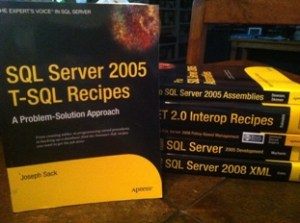
    SQL Server Books
    A large collection of books can help you improve your skills.

    The cloud is scary. Without a doubt the idea of outsourcing parts of your organization’s technology department should concern you if you manage systems. Anything outsourced, whether to another firm or automation, means there is less work for you to do. Even in the places where automation grows, we find that sometimes the growth of systems occurs so fast that there are still things for a worker to do, but that’s a losing battle in the long term. At some point the automation will catch up and less people will be needed to manage the systems.

    However the news isn’t all bad. There are some systems that will always be managed inside of a company. Whether because of regulatory requirements, performance needs, or even just the stubbornness of management, I am sure that some percentage of systems at most companies will remain in-house. Those will be the minority of systems in some places, and since many of us change jobs at some point in our careers, we should be concerned.

    I would argue that all of us working in technology should be looking to improve our skills in whatever field we work. However we should be growing the skills in the hard parts of our jobs, in the parts that we struggle to automate or describe. The easy parts of our jobs will become more automated, more likely to be managed by a tool or outsourced. The hard parts, the thoughtful parts, those are the skills we should concentrate on when improving our skills.

    Outsourcing isn’t all bad. As Toyota has outsourced some of their systems, they are not looking to shrink their IT department. Instead they are focusing on delivering new products and services for their customers. Make sure you are prepared to take advantage of new opportunities if your company follows a similar path.

    Steve Jones


    The Voice of the DBA Podcasts

    We publish three versions of the podcast each day for you to enjoy.