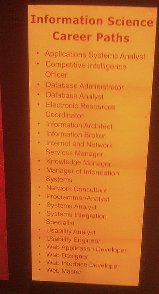
Tag: career2

  • Promoting Engineers

    CS career paths
    Do we have enough of a career path for technical people? I’m not sure we do in many companies.

    Never, ever promote your best salesperson.

    That’s the advice that Scott Horowitz got from his father. He talks a little about how this relates to technical people who find themselves looking at management to further their careers, or are sometimes even get promoted just because they’re the strongest technical employee in a group. Mr. Horowitz sees the transition as one that rarely works well, though he has some good advice on how you can increase the likelihood of success.

    In my career I’ve moved to management a few times and back again to a technical role, though never at the same company. I am sure it would be a strange move to be in charge and then move back to a contributing employee, but I do know some other people that have done it successfully in their careers. I have enjoyed both roles, and at different times in my career, the different role has fit me better.

    Many companies struggle with their technical people as they advance in their careers. Few companies think ahead and build dual career tracks in both the technical and managerial areas for their staff. As a result, many technical people find their career stalled in a company and may look to leave for another position. Setting aside a technical track that allows an employee to advance as a strong technical worker, and continue to grow their challenges and salary seems like a no-brainer, but it’s something rarely implemented outside of technology-oriented companies.

    Perhaps senior technical people can’t continue to add the same value as a manager or director in an organization. There are definitely lots of technical people that have a lot of seniority in a company, but do not necessarily bring a lot of additional value for all their experience. However some do, and those are often the people that a company should not let go. If they continue to grow their knowledge, and add more value, there ought to be a career advancement track for them in the technical area.

    Steve Jones


    The Voice of the DBA Podcasts

    We publish three versions of the podcast each day for you to enjoy.

  • A Lifetime of Software

    old programmer
    I hope I’m still working with technology at this age.

    I’ve been working with computers and software for most of my life, but it’s been a career for a couple of decades now. I don’t do as much technical work as I used to, mostly testing and experimenting, but my job is related to SQL Server and software, and I anticipate that’s what I’ll be doing for the next two decades.

    However that’s not necessarily the plan for everyone that works in the technology business. I know plenty of people that would like to move into management, or even move into some other career field if they can afford to do so. In the responses to many editorials in the past, I read that quite a few people think the technology business isn’t a great choice and wouldn’t encourage their children to enter this field.

    I disagree, and think that this business has been very good to me, overall I’ve enjoyed it, and I think it would make a good career  for any of my kids. However this Friday I wanted to ask the rest of you what you think.

    Do you expect to work in the technology field until you retire?

    I know many of you will change your focus in technology, perhaps moving to develop from DBA, vice versa, or moving into another field. I know most of you will change companies before you retire, but I’m curious about whether you think you will remain a technology worker for the rest of the time you work.

    Steve Jones


    The Voice of the DBA Podcasts

    We publish three versions of the podcast each day for you to enjoy.

  • Social Media and Interviews

    Will You Get Fired Because of Facebook?
    Too much time on Facebook during work is a bad idea

    When I first saw this story, I was a bit disturbed. In an interview, for a statistician, the candidate was asked for his Facebook username and password. The interviewer wanted to view non-public parts of the candidate’s profile on Facebook, and the candidate refused and withdrew his job application. I’ve heard of this in the past, with the city of Bozeman asking for credentials, but it appears the practice is growing. College athletes are asked to “friend” coaching staff, and some public sector workers must connect with their superiors.

    If I were asked in an interview, I would politely decline and state that I have set up privacy for a reason. There are things I post to share with friends and family that are not meant to be available for the general public. In my mind, these are akin to photo albums or letters I’ve written that I store in my house. Anything that I post publicly I take responsibility for, but private posts are private. I would suggest you do the same.

    On one hand companies are free to ask and candidates are free to decline, and that’s the free market. At some point, however, if all companies were to ask for this, employees would essentially have no choice but to comply, which feels like an intrusion into employee’s lives at a higher level than I feel should be allowed. It strikes me as a little too 1984-ish for my own comfort.

    Part of the problem is that the laws we’ve written for the real world frame the way we interact. Those laws, however, don’t necessarily translate and apply to the digital world, which means that we struggle to apply them in this new frame of reference. I think that we also aren’t always sure exactly how we would want to have our privacy or rights preserved in the digital world, and all too often we have companies, and criminals, taking advantage of that fact.

    I suggest everyone make an effort to separate your public and professional posts and profile online. Point employers to a professional profile, and let them know this what they should expect from you at work. Your personal thoughts and ideas are separate, and you’ll keep them that way at work, just as you do in the digital world.

    Steve Jones


    The Voice of the DBA Podcasts

    We publish three versions of the podcast each day for you to enjoy.

  • The Best of the Best

    Today’s editorial was originally pubished on June 26, 2007. It is being re-run today as Steve is traveling. 

    Men in Black
    The best of the best of the best, sir.


    Of the best of the best, sir! (remember that one?)

    Where’s the best place to work? Here’s the list from Computerworldfor 2007. I’m not surprised that a few of these companies (University of Miami, Quicken Loans) were in last year’s list. After all, if you’re a great company, you should be able to maintain that in the short term.

    What’s more interesting, is that in the various lists (Best overall, Diversity, Benefits, etc.) is that a number of companies show up multiple times. For example, the University of Miami shows up in 4 of the 5 top tens. With the weather, maybe that’s the place to be.

    I’m not sure I’d use this list as a way to seek out a job, but I’d certainly check it if I were applying somewhere because it shows that there are people that like the company. That’s important since I’m of the opinion that the people you work with and their attitudes are extremely important to having a good term of employment.

    But most important is that you need to find the best fit for you. I interviewed with Pulte Homes (#69) a few years ago (2002?) and wasn’t impressed with the people. In fact, I wouldn’t have wanted to work there. Maybe things have changed since then, but I know I’d be wary of going back there as the culture didn’t seem to fit me.