One of the things that I’ve seen crop up at various points in my career is a question of diversity. I know there are many people that don’t think this is a problem, or maybe more specifically, their problem. They don’t think that it is their fault that not enough women or minorities are represented in their industry.
One thing I’d ask user groups and events to do is publish a diversity scorecard, either after a schedule is selected, or annually for user groups.
What do I mean? Here’s a short look at something I noticed. I went out and grabbed a set of data from a few user groups and event that I thought of. I have no real idea of what to make of this:
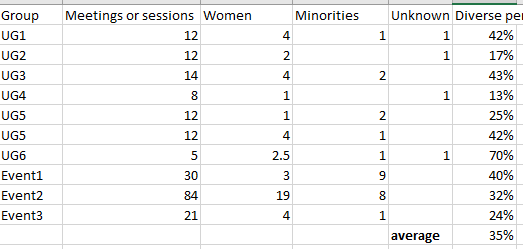 An average diversity of 35%, though I could have made some mistakes. I counted women, and separately counted minorities that were not white males as diverse. I think I counted those I know as LBGTQ as minorities as well.
It’s not scientific, nor is it necessarily some quota I’m looking to meet here. As a minority (I’m in a few data sets above), I think 35% is pretty good, but likely it ought to be higher, especially with regards to women. They make up half of the world, but are underrepresented in our industry.
A quick anecdote, in case you think that this isn’t important. Early on, the computer jobs were mainly for women. They programmed a lot, and helped get things working in various industries. The job was seen as “secretarial”. Once companies started to pay more, men wanted those jobs, and took over the industry. Hiring practices, and men being comfortable with other men, not because of talent. Good programmers come in all colors, creeds, and genders.
That has happened in other industries as well. It’s not a malicious thing, but it is a trend when there isn’t visibility or attention paid to the issues. Those that are in charge tend to aim for homogeneousness, or some level of uniformity. That displaces others.
I’d like to call on all user groups to add a report to their main meeting page. Just cull the data from the last 12 months (or meetings) and report on it. Microsoft does something like this for their company, as does Apple, Google, Facebook, Redgate, GE, Walmart, and many others.
Do us all a favor and pay attention to your actions in this area, and encourage others. I was happy to speak to the local WIT group years ago on how to give a presentation and managed to get one person to start speaking. If I did that every year, we’d have a lot more women speakers, so this is on me as much as on many others.

