Tag: energy

  • Energy news that caught my eye

    I’ve been a big fan of nuclear energy ever since I worked at a power plant. Before that I was terrified and didn’t think it was a good idea, but I learned quite a bit about how it works and while there are issues, I think it’s a good source to consider.

    If we redesign the reactors. Right now we use old designs, old technology, and we could make them more efficient and much more safe.

    I ran across this piece on Small Nuclear reactors. These are in the 200-300MW range, as opposed to the 1,000-2,000MW reactors that we use today. Those large ones cost $10b, as opposed to a $1-2b investment, a much more manageable cost for many power companies. I could see smaller companies putting these up, with much lower operating costs and potentially giving us true energy independence.

    I have a fascination with wind power. I’ve wanted to get a vertical axis wind turbine (VAWT), but few companies make them, and there are mixed views on whether or not these are efficient. I caught a piece on a field of VAWT. These are much less noisy, and potentially the wakes from them don’t interfere with the other turbines, resulting in more density. I hope these work, and become affordable enough for me to get one.

    Barring the VAWT, the HAWTs now can come with batteries, to keep power flowing more consistently. This isn’t really for residential users, but for large commercial users, giving power vendors the chance to ramp up more expensive (and dirty) alternatives if the load is growing.

    Also, some auto news. Finally I see something on fuel cell vehicles. I had high hopes for these years ago, with thin platforms. This is similar to what the Tesla has, and the idea would be that you could actually purchase multiple bodies (sports car, truck, sedan) and change them out on demand.

    fuelcell

    With hybrids and fuel becoming cheaper (after two wars), this idea dropped off the radar.

    Perhaps it’s back. I know the hydrogen infrastructure is an issue, but the same thing holds true for natural gas vehicles, and I have friends buying those now. There are only a few stations in Denver, but they make them work, especially for commuting.

    I like the Tesla, and I loved the 90s battery change. The economics don’t make sense, but the idea is great. I would love to see this for fuel cells as well. Rather than fueling to start, what about changing out jerry-can sized “fuel” cells at a station. The station and refill them as needed, and drivers wouldn’t spend too much time filling their cars.
  • Less Energy through Better Design

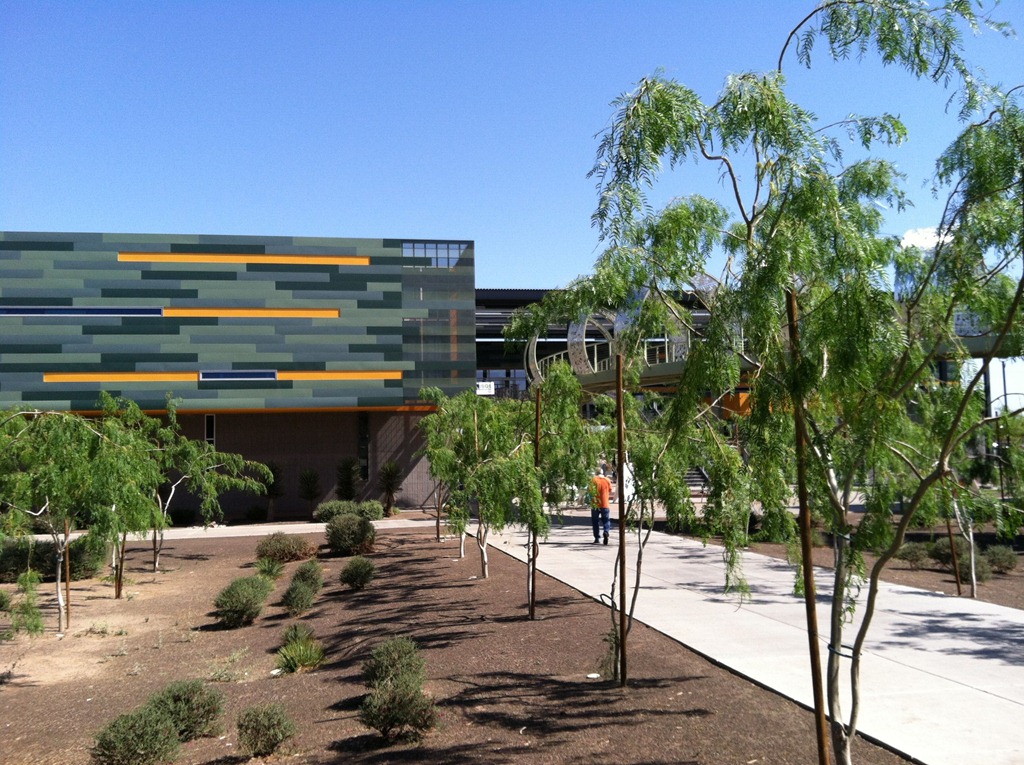
    When I attended SQL Saturday #131 at the Chandler Gilbert Community College, I was struck by a few design elements that I thought were great examples of how a little thought can improve the experience of a space, and use less energy.

    The event was outside Phoenix, which is hot. I mean really hot. It was 93F or so on the April day that I was in attendance, and it was expected to go over 100 the next weekend. A few local people told me that they really need to have fans in their houses to assist with the AC, otherwise they tend to dramatically shorten the life span of their units with the desert heat.

    As I walked up, I noticed a few things. Lots of wide overhands and buildings placed in each other to shade courtyards. Many rooms opened from an outside wall, so less hallways to cool inside buildings. I’m not sure if this is good or bad, since cooling those rooms whose doors might open frequently might be worse than trying to cool hallways. I also didn’t’ see many airlock structures, which is something we see more in cold climates.

    Photo Apr 28, 10 43 37 AM

    The building above has a skin like structure outside of the main building, essentially shading the building itself. It reflects a lot of light, and at the same time, looks interesting. Not sure how the material costs compare with the energy costs, but I’ve seen this on a few buildings in the Middle East, so I’m guessing it’s a good trade-off.

    The main student center, shown below, was like a glass garage. Each 10 or 12 foot wide section could roll up. I stood just outside one open door, and you can see another across on the left side of the picture. This was a pleasant building all day, even when it was over 90F. In the upper right, you can see a large ceiling fan. The blades on this had to be at least 10ft long, possibly longer. There were two in the space, but only one ran all day, even when there were close to 200 people eating lunch.

    Photo Apr 28, 9 19 15 AM

    Here’s one of the courtyard structures.

    Photo Apr 28, 10 32 15 AM

    Shaded, not completely so. Nice in the shade, definitely hot in the sun.

    There also was an elevated walkway with a spiral art structure that would provide some, but not a lot of shade. I’m sure it makes things better, and it looks really nice. It was made of metal, with designs cut into it. Many of the railings and structures around the campus were metal, which holds up better in the sun. Most with artistic designs in them.

    Photo Apr 28, 9 28 01 AM

    I’m sure many of you have seen hot air hand dryers in bathrooms before. This college had the newer Dyson dryers, which are supposed to be more efficient and cleaner for the air. However they had a few other things:

    Photo Apr 28, 2 30 53 PM

    A few simple change (probably) to the toilets, but with this plaque, you have the choice to use less water for liquid waste. I hadn’t seen this before, but I’d hope that more buildings would implement something like this. It would be great for homes as well.

    Photo Apr 28, 11 40 02 AM

    Many of the urinals in the Men’s bathroom were waterless. I’ve seen these before at various ski resorts. They get used a lot, but they don’t stink, and they’re a great idea everywhere, but especially in places like CO and AZ where the water supply is limited.

    Photo Apr 28, 9 51 48 AM

    There were plaques describing structures all over. I think this is a great idea, because it helps people to understand there’s more to the design than architecture. These items were built to add useful space to the campus without adding to the energy bill.

    There were all multi-language inspirational plaques and posts all over. This was one of the ones I passed, and I wish I’d walked around looking for more. I remember sayings like this on the grounds at Virginia, and they were always inspirational to me as I thought about all the people over time that had walked the path I was walking.

    Photo Apr 28, 10 54 14 AM

    I’m a fan of alternative energy and sustainable practices. I don’t think we need to end our dependence of fossil fuels, but I do think we ought to try to better use our resources, especially when we can use design to do so.

    I was impressed with what is being done at this college, and it shows some effort is being made to build a structure for the long term. Is it worth it? Are things working? I’d like to know both from an ROI standpoint and an energy standpoint what differences there are from other designs. I sent a note to the school, and we’ll see if they respond.

  • Smelly Power

    waste treatment data center
    Not sure I’d want to work here, at least not without a clothespin for my nose.

    Power is a limited resource and it’s become an issue in more and more data centers over the years. As we use more computing resources, the effort to provide power becomes a challenge. A decade ago I wrote an inventory system to help us keep track of our thousands of servers. The challenge of locating a particular machine to manage the hardware was a problem for our hardware people, and we built a system to allow them to easily find a particular server, with hardware configuration updated from software queries made by our management software.

    Almost as soon as we got the system deployed, we had to modify it to add additional pieces of data related to power and heat. We were approaching the limits of both, and knowing where we had spare power, the consumption of power on each circuit as well as the heat load in different parts of the room allowed our hardware people to better plan for future requirements.

    Over the last few years I’ve seen some creative solutions being used to build new data centers and handle the power and cooling requirements. Google has built data centers near rivers and hydroelectric generators to take advantage of those resources. Old mines and open air cooling solutions have been implemented, and just recently I saw Microsoft had one thing I’d never thought of: a waste-powered data center. That’s a new one for computing, though a local brewery in Colorado has been using methane to generate power for a few years.

    I like the idea of trying new solutions, and trying to build a sustainable energy source that uses less of our fossil fuels. It makes sense to me, and seems like it’s a longer term view of advancing our computing infrastructure in a cost effective way. I applaud Microsoft for trying this; I’m just not sure I’d want to be the DBA working in this particular data center.

    Steve Jones


    The Voice of the DBA Podcasts

    We publish three versions of the podcast each day for you to enjoy.

  • Smart Car Charging

    I don’t know if electric cars are the answer, but I do think electricity will play a larger part of how we move things around in the future. Overall it’s more efficient, if we can figure out how to generate it well, and also provide it to vehicles in an efficient manner.

    This article on smart car charging is fascinating to me. It essentially moves the cost of the power from the owner of the outlet providing the power, to the person using the power. I don’t know how feasible this is, or how much it would cost to deploy this in the US, but it’s a good idea.

    Smart charging a Volvo


    I am, however, concerned about the security implications. How many people will attempt to hack this and charge others? How much of a legal issue will we have with disputes?