Tag: GDPR

  • Opportunity or Restriction?

    I’ve been at the Redgate office all week, broadcasting SQL in the City and meeting with product teams. Quite a bit of our focus is on the GDPR law, with enforcement beginning in May. We’re building and enhancing tools to help you cope. That means I’ve been spending a significant amount of time trying to learn and comprehend the potential impact to data professionals, both to help guide customers, but also to ensure our software will help them ensure compliance in their data systems.

    Over the last year I’ve seen lots of doom and gloom, everyone needs to fix their systems and ensure data can be deleted on demand concerns in the media over the GDPR. Ultimately I think there is work to be done for many companies in the EU or those that sell products and services to the EU, but we don’t quite know to what extent we need to change existing applications and databases. Lawyers and solicitors will sort some of this out across the next few years, though I certainly think any data breaches in the next year will be dealt with more harshly by regulators if organizations haven’t made any effort to secure their systems.

    There are also some simple things that I think most of us should just do. When I first saw the addition of data classification in SSMS, it seemed fairly trivial. However, the more I’ve thought about it, this simple addition is a way of ensuring that I can easily spend a relatively little amount of time to just think about the information in a database. Just tracking this down can be a pain, and if the information isn’t recorded in an easy to access format, it’s easy to forget what items need our focus. Using Extended Properties is a great idea, as the information is kept with the database, but this means that a better interface than the table properties is needed. There are also a few potential problems doing things this way, but this is a good start to becoming better data stewards.

    That’s what we need. A few good starts. We need to see this as an opportunity to clean up practices and move forward in a way that shows us to be professional data professionals that take our responsibility for data security, accuracy, and usage seriously. This is a chance to move forward in a way that reduces our risk of losing data, of becoming the next “headline” corporation or government agency that makes a mistake. Instead, we can embrace this as an opportunity to find new ways of managing our data and extracting information while still complying with data privacy rules.

    I read a white paper that talk about the challenges of IoT data in a GDPR world. There are issues to be concerned about, but this also means there will be opportunity for those that devise better data handling methods, that learn to clearly disclose their purpose and practices. I suspect most people realize that there is a certain amount of information that companies collect, and that if there is some value or usefulness that company gives back, we can accept their data storage. Where individuals often become concerned is when organizations move their data to other parties without their consent.

    To me, this means it becomes more important for an individual company to understand and process their own data. There will be less movement of data between companies, and perhaps less ability to purchase and import data from others. We’ll need to help our organization extract more value from the data we are allowed to hold, meaning those of us that are data professionals will become more important. At least, that’s what I hope happens.

    Steve Jones

  • Kicking off SQL in the City 2018

    I’m off today. Not taking a break, though perhaps it’s a touch of a break. I’m actually in an airplane, heading to the UK for the first 2018 SQL in the City. We’ll be broadcasting this Wednesday, and you can still register and watch. Let your boss know that you can get some cheap training (it’s free), refresh yourself away from work, and you’ll appreciate the perk as a part of your job. Maybe you’ll even get to watch from the comfort of home.

    Grant and Kathi are already in the UK enjoying SQL Bits, but this year I’ve been trying to do less travel and coaching volleyball more. My team of 14 year olds had a tournament yesterday, so I was blowing whistles and giving (loud) advice in a high school gym. Today I’ve got a laptop on a plane and am making my way a third of the way around the world. I may get to watch a movie, but there will certainly be a little demo practice as well.

    The theme for this SQL in the City broadcast is Data Privacy and Protection. GDPR will start being enforced this spring, and many people around the world with be affected. Those outside the EU might not be sure of the ramifications of the regulation, but I wouldn’t be surprised if similar legislation gets passed in other countries. In any case, the idea of ensuring you can control and protect data, with an eye on designing privacy for users into the system, is a good idea.

    You can read the GDPR text, but that’s what many of us have done and tried to interpret it for you. We have a great piece at SQLServerCentral and our product teams have been working hard to ensure that our products will help you improve your compliance. Lots of other vendors are doing the same thing, either working to change their policies or enhance products. Microsoft has certainly spent a lot of effort getting ready, and I’m sure they’re not along in their efforts.

    We all want better security for our data. Many of us empathize with the customers and clients about whom we collect data and often wish our systems provided better security, controls, and options. Sometimes our management doesn’t agree, but certainly they feel the impact if we suffer a data breach. This Wednesday we’ll be talking about Redgate products specifically, but also including general knowledge and ideas that you might use within your organization.

    Register for the event and watch along on Wednesday. Ask questions and see how you can improve your data privacy. Most of our applications could use a little work on security, and we hope to help educate you on what you can do and how Redgate might be able to help.

    Steve Jones

    The Voice of the DBA Podcast

    Listen to the MP3 Audio ( 3.8MB) podcast or subscribe to the feed at iTunes and Libsyn.

  • Classifying Data with SSMS 17.5

    I upgraded SSMS to 17.5 recently and found an interesting addition. This version has incorporated the ability to classify data. With the GDPR coming for many of us, this is a welcome addition.

    This is a quick look at this feature.

    Classify a Database

    If I select a database and right click it in SSMS, I get a few new items in the Tasks menu (as shown).

    2018-02-16 13_15_58-SQLQuery1.sql - Atlas.master (sa (51))_ - Microsoft SQL Server Management Studio

    I’ll select “Classify Data”, and I get a new tab opened. I see there are some recommendations and also a list of classifications of data.

    2018-02-16 13_16_28-Data Classification - NBA - Microsoft SQL Server Management Studio

    There’s a getting started link, which takes me to the SQL Server Security Blog. I suspect that’s an incorrect link. I think it should go here: SQL Data Discovery and Classification.

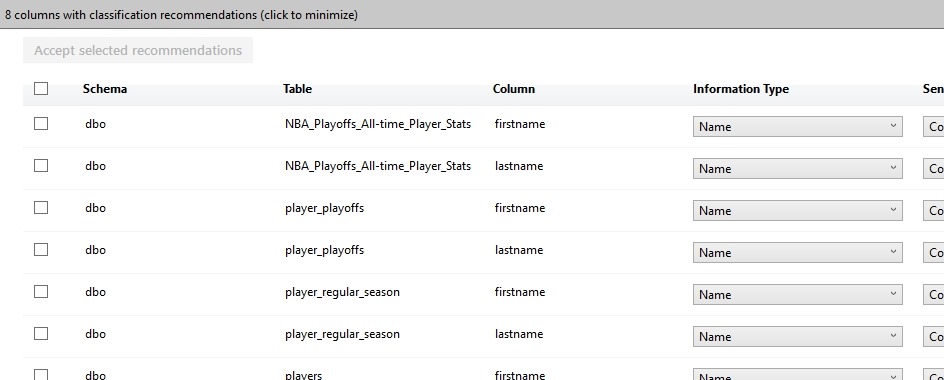
    Below this, I see a list of the recommendations. This has grabbed tables that appear to continue to contain some data that might be sensitive and require classification. One of the tenets of the GDPR  is that you know your data. You aren’t allowed to figure this out later, but rather you must proactively know what data you are collecting and processing.

    2018-02-16 13_17_47-Data Classification - NBA - Microsoft SQL Server Management Studio

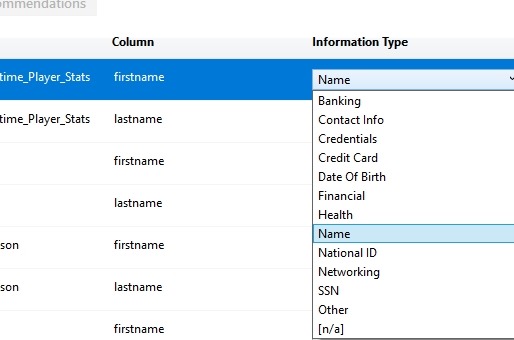
    Here we can see a few drop downs to the right. I’ll scroll and look at these. First is the Information Type. This is listed as a name, but I have other options I can set. The list is the types of that that might be sensitive information about a data subject (a human or entity) that I need to classify.

    2018-02-16 13_19_36-

    Beside this is the sensitivity label. My choices here are shown below. These range from public information, which removes some of my responsibility to highly confidential and applying to the GDPR.

    2018-02-16 13_21_14-Data Classification - NBA - Microsoft SQL Server Management Studio

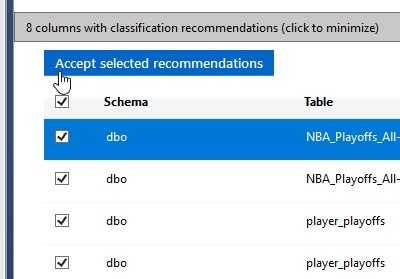
    If I’m happy with these recommendations, I can select them all (or a subset) on the left. I can click the “Accept” button to add them to the classifications I have for this database.

    2018-02-16 13_22_07-Data Classification - NBA - Microsoft SQL Server Management Studio

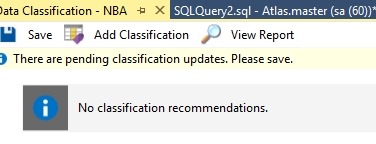
    This doesn’t save them, but adds them to the list. At the top of this tab I can see the need to “Save” my changes.

    2018-02-16 13_22_13-Data Classification - NBA - Microsoft SQL Server Management Studio

    Once I’ve done this, I could add more, or view a report. The report shows me this:

    2018-02-16 13_22_26-Data Classification - 2_16_2018 1_22 PM - PLATO_SQL2016 - Microsoft SQL Server M

    Implementation

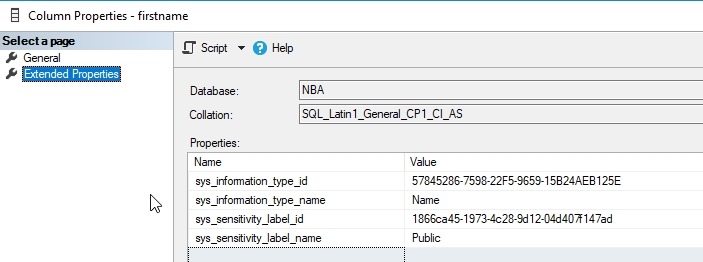
    My guess was that these are implemented as extended properties, which makes sense. That’s how many things could make SQL Server better, and I’m right. If I examine the EP for the firstname column in one table, I see this:

    2018-02-16 13_26_46-Column Properties - firstname

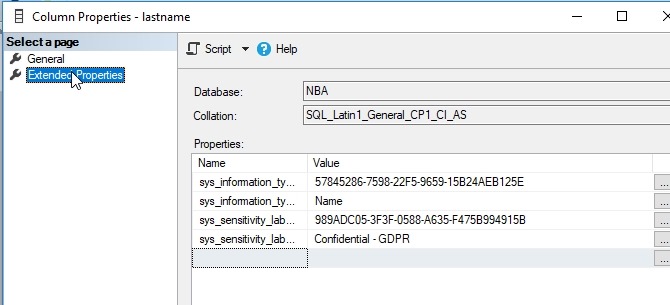
    This was the column I changed to public information. The lastname column in the same table is marked as confidential.

    2018-02-16 13_26_55-Column Properties - lastname

    Helpful?

    Ultimately is this useful? Yes. I can see other products taking advantage of this, such as the new Data Masker from Redgate, which could let you know which columns are sensitive and not masked. I’d also expect that this is useful and important for ETL and other operations to carry this metadata to new columns that might contain transformations or movement of this data.

  • Finding the Right Data

    For a couple years, Big Data was heavily hyped, and Hadoop became incredibly popular. In fact, so popular that Microsoft build HDInsight and Polybase to allow us to take advantage of these technologies and integrate them into our own systems. While the year has seen less hype on “big data” specifically, more and more of us are dealing with large amounts of data every day. There isn’t a good definition of Big Data I’ve seen, but whatever you thought it meant five years ago has surely changed to mean larger volumes today.

    One of the important things that many organizations are learning is that they don’t necessarily need more bits and bytes of all their data. They’re increasingly learning that they need more of the right data, which is the data that is useful to them. Often this is the data that lets them make decisions that improve their revenue, profits, efficiency, etc. As we move to GDPR this spring, it might also me more auditing data that prevents problems or satisfies regulators.

    I ran across an interesting article that talks about companies needing the right data, which can often mean unstructured data outside of their traditional OLTP databases when dealing with customers. The article focuses on NLP (natural language processing) and social media data, but it could just as easily mean audio/video data from customer calls (or emails) or even sensor data from systems that are managed and track the ability of customers to use your product or service.

    As the world of computing advances, many of us know that we need to find new and better ways to provide value to our employers. This might be with managing and gathering or tracking a wider variety of data, perhaps meaning that some of us need to keep some of those tweets or posts inside our systems. It could be that we need to provide new ways of analyzing data, maybe with some sort of ML (Machine Learning) or AI (Artificial Intelligence) processing. Perhaps it’s that we need to collate and collect detailed auditing information we can produce on demand to ensure our organization complies with legal requirements.

    Perhaps there’s some other way that our work as data profressionals will change, but I’m sure it will continue to change and evolve across the next decade. I’m also sure this means lots of new and different data opportunities for us, if we’re willing to grab them with the right data.

    Steve Jones

    The Voice of the DBA Podcast

    Listen to the MP3 Audio ( 3.9MB) podcast or subscribe to the feed at iTunes and Libsyn.