Tag: SQL Server Central

  • Having a Little Fun at SQL Server Central

    When we started the site, I had never met most of the other co-founders (we went from 7 to 3 inside of a few years). A few knew each other, but Brian, Andy, and I had only communicated through emails and phone calls. We ran the company remotely from Denver, Orlando, and Jacksonville. In fact, I met Brian for first time when he came to Denver for the 2002 PASS Summit (moved from 2001). I met Andy later that year at the Seattle Summit in November 2002. That, coincidentally, was my first meeting with Simon Galbraith, founder of Redgate Software.

    Over the years, we’ve tried to enjoy running an online community in different ways. We wanted this to be a profitable endeavor, but one where we could have some fun. We did this in few different ways. One was with some off-topic articles. Early on, Andy wrote a piece asking Is Steve Jones Really Steve Jones? I still enjoy reading that one today.

    Once I was running the site full-time, and stuck with the Question of the Day and editorial responsibilities, I added a category for humor that I used on holidays and other random times. April 1 was a fun day (and still is), with me trying to write plausible, but completely untrue articles about database topics. I’m still thrilled that my joke from Apr 1, 2005, SQL Server on Linux, finally came true.

    We had a Lighter Side category for editorials that didn’t fit anywhere else, which I and others have used to try and remind ourselves that not everything is about databases and it’s also not the most important things in our lives. We have had a lot of articles on career topics and soft skills, especially editorials, as the guest editors and I know these are some of the most important skills to develop for career growth.

    Thankfully, Redgate has supported some of my fun, as they agreed to pay for and publish a series of crosswords and cartoons over the years.

    Perhaps the most fun I’ve had over the years was running the SQL Server Central parties at the annual PASS Summit. In exchange for promoting the event and getting people to register with our code, we got a small payment for each person. This started in 2002, and we decided not to take this money as profit, but rather to have fun with it. Each year we’d get a few thousand dollars from referrals, so we tried to be creative. We gave away books and shirts the first year, with a line stretching out the door during the welcome reception. In Florida in 2003 or 2004, we decided to have a video game party with XBOX consoles. We not only purchased consoles, but also TVs, and gave everything away at the end of the night to random people.

    Somehow, I stumbled on the idea of a Casino party one year and contracted with a firm in Seattle. We ran those parties for years and even charged admission for people who hadn’t used our code. I would guess how many people would come and then go shopping at Best Buy when I arrived in Seattle, spending a few more thousand dollars on random prizes to give away. I’m sure we lost money in a few of those years, but it was all for fun.

    Maybe one of the most memorable things I did was for TechEd in 2004 or 2005. We wanted to brand ourselves and try to raise awareness of the site. Since I was in charge, I ordered 3 different styles of Hawaiian shirts for each of us, with a SQLServerCentral logo and name embroidered on each, intending to wear a different one each day. Andy and Brian were good sports, going along with me most of the time. There was a day Brian refused to wear my choice as it was a little too out there for him.

    However, I did meet Euan Garden (RIP) for the first time there and he loved our chili pepper shirts. I arranged for a shirt to be made and shipped to him and I loved seeing him wearing it at a events over the next few years. I also got inspired to do an interview series, which I really enjoyed.

    Thinking back on the history of this business, I’m both amazed by how it changed my life, and I can smile at so many good memories. Hopefully, you feel the same way.

    Steve Jones

    Listen to the podcast at Libsyn, Spotify, or iTunes.

    Note, podcasts are only available for a limited time online.
  • Doing Good at SQL Server Central

    This is part of a few memories from the founders of SQL Server Central, celebrating 25 years of operation this month.

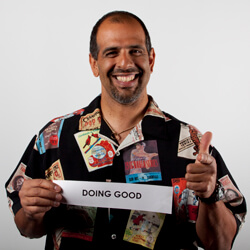
    We did photoshoots at Redgate many years ago. We had a bunch of props, including some phrases written down. We could create our own, but my handwriting is atrocious (likely why I never became an architect), but I ended up with this one:

    Steve Jones caption "Doing Good"

    I couldn’t really explain why I picked “Doing Good”, but the more I thought about it over the years, it’s been a lot of what has driven my life forward, both here at SQL Server Central and in my personal life. I’ve been a Boy Scout and Girl Scout leader, have been and am a sports coach, and I have given up no shortage of time to help others with speaking efforts. I put time into the SQL Saturday charitable foundation, trying to get more SQL Saturday and Day of Data events that teach, train, and inspire data professionals.

    SQL Server Central has a huge reach. We’ve been very popular, and millions of people have seen our newsletters. Our mission early on was to help database professionals get better every day, and we provided a lot of free (as in beer) resources: articles, quizzes, and answers to your questions. Many community members have also volunteered their time and expertise to help, and I thank them as well.

    There have been a few times when I’ve tried to use that reach to do good. I don’t want to point out the specifics, but a few times I’ve known people with very sick children. One was a local friend I’d worked with (tech pro, but not database) and another was a speaker in our community. This started when I was sitting at dinner with a fellow speaker, who was talking about this family struggling and needing help. I thought, surely we as a community could raise money and help them. I used the reach of our newsletter at that time to ask for donations and managed to raise substantial amounts of money to help a family. I did it again a few years later, raising well over USD$10k in both cases.

    In those cases, as well as with SQL Saturday, I have done what I thought was in the best interests of everyone and ensured all the monies raised went to the intended recipients. The families got all the money donated, and all sponsorship monies to to events. If there are bank charges or other fees, I absorb them. In the case of SQL Saturday, I go begging for donations to support the admin costs and fees.

    Those might be some of the things I’m most proud of in my life, which is an interesting thing I learned. I really like helping others. As much as I enjoy living my life, I get more satisfaction that I would have expected by helping others grow, learn, succeed, and enjoy their own lives.

    I think everyone should volunteer some of their time/resources/knowledge/etc. at some point in their life. It might not be now, but think about where you can help make the world better. You’ll gain way more than you ever spend from helping others..

    Steve Jones

    Listen to the podcast at Libsyn, Spotify, or iTunes.

    Note, podcasts are only available for a limited time online.

  • Expanding into Print

    This is part of a few memories from the founders of SQL Server Central, celebrating 25 years of operation this month.

    When we started SQL Server Central, our goal was to build a great resource that helped other people advance in their careers and also made some money. Our decisions in building the site were based around the digital world and treating the community as we would want to be treated. Over time, however, we realized that continuing to grow this business was hard in a digital-only world. We experimented and proposed helping others build similar sites, like ReportingServicesCentral (which would have been great) or NotificationServicesCentral (which would not), but ultimately, we weren’t experts enough in those areas and couldn’t find people willing to partner.

    Everyone thought they could do it themselves and that the knowledge was the hard part, and execution was easy. The truth is that the reverse is the way it works.

    In any case, there was a point in time when we were sending 6 newsletters a week (Monday through Saturday) and we didn’t think there was much room for growth there. Andy suggested that we compile all our articles into a Best of SQLServerCentral book. I didn’t think they would sell well (they didn’t), but we did enjoy giving them away at our annual SQL Server Central Party at PASS. We even added a second series where we compiled the Question of the Day series into books, based on the Two Minute Mysteries I read as a child. We called them SQL Server Stumpers. Those were hard to manage, and were multi-month long projects that I had to toil away at almost every week.

    Then came the magazine: SQL Server Standard.

    In the early 2000s, the Professional Organization for SQL Server was trying to grow as well. We knew magazines were popular and profitable back then, so we proposed helping them produce a magazine every other month (6 times a year). They were charging an annual membership fee and needed to give members more value, so we agreed to produce, publish, and ship a magazine to all their members. It was both a source of tremendous stress for me to manage, as well as a proud item I could point to every month.

    I wish I had some online links, but this was intended to be a real-world, analog item. We hoped it would grow to be a substantial revenue item, but it never did and PASS shut it down after around a year of publication.

    I was glad because these projects were a never-ending source of stress. Managing book projects that were 4-6 months, along with the every-other-month magazine, and a daily newsletter was overwhelming at times.

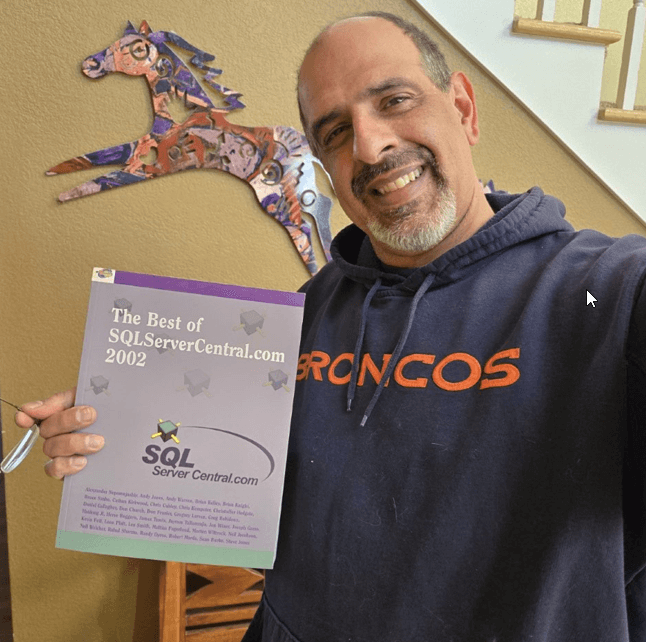
    Our forays into the print world provided me with a lot of education about how books and magazines work, and gave me a few mementos.

    Steve Jones

    Listen to the podcast at Libsyn, Spotify, or iTunes.

    Note, podcasts are only available for a limited time online.

  • When SQL Server Central Went Down

    This is part of a few memories from the founders of SQL Server Central, celebrating 25 years of operation this month.

    “The site is down.”

    I got a phone call from one of the other founders around 9 am in Denver one day. At the time, I was working at a small startup, in a semi-private office with one other person. Most of the company knew I had a site on the side, and alternately cheered me on or celebrated hiccups, depending on the person.

    I checked, and things were down. I had a side channel to telnet into the server, but couldn’t access things. At this time, the site was hosted on a single server, running IIS and SQL Server, in a friend’s basement. This was in 2002 or 2003, and broadband was a lot different then. No cable internet, and most other solutions were in the kbps range. I had ISDN at my house, but a friend had gotten into a trial from Sprint, giving him 3Mbps over a microwave link.

    My office-mate was listening and watching. I said I was taking an early, and long, lunch. She chuckled and went back to her own tasks. I let my boss know and started driving, stressed out. After all, the site was growing, popular, and downtime could be a killer.

    We’ve had a few outages over the years, but not many. This was one of the more stressful ones as I fought traffic on I-25, trying to get from the Denver Tech Center up to Westminster. I can’t remember the weather, but I was sweating when I got to my friend’s house. This was the before-times, when remote work was a rarity. Luckily, my friend had left me a key to get into his house, where I ran into the basement. Unable to get the server to respond, I rebooted it and crossed my fingers.

    I’m sure a few of you have had the stressed-out feeling of waiting for a database server to restart, hoping that it comes back up cleanly. It did this time, and I don’t remember what went wrong, but things were back up and running with no major issues. I was probably in the basement for less than 30 minutes, and I left, dreading the long drive back to the office. Almost two hours driving for a 30-minute fix.

    I do remember thinking if this was going to be a regular occurrence, I might need a new job. Or a new place to host the server.

    We weren’t in the basement for too long. Revenues were increasing enough that I started to look at co-location facilities. My current employer had investigated quite a few when we set up our systems, and I reached out to a few contacts. I negotiated a half-rack at some point, moving our servers to a real facility. By that time, my employer had failed, and I got an F5 firewall as part of my severance, which fronted SQL Server Central for quite a few years.

    Those were the days, with lots of CLI access to remote systems and a power strip where I could cycle them off and on. Those were skills I had to learn to avoid more drives at inconvenient times.

    Steve Jones

    Listen to the podcast at Libsyn, Spotify, or iTunes.

    Note, podcasts are only available for a limited time online.