Tag: syndicated

  • PASS Keynote–Dr. Rimma Nehme

    I missed the PASS welcome, but I did arrive to see Cloud Databases from Dr. Rimma Nehme.

    We begin with a few references to Dr. DeWitt, who has given amazing keynotes. It’s a tough act to follow, but Dr. Nehme goes in her own direction. Dr. Nehma is highly qualified. An MA and PhD, working with Microsoft Research and EMC as her career has grown. She’s currently at the Gray System Lab.

    We start with the Blind Men and the Cloud – Lot of different views on what the “cloud” means. People have Shiny Object Syndrome, and think that the cloud is something new and might solve their problems. That’s certainly been true for many companies.

    Cloud computing – Computing resources and software delivered on demand, as a service. That’s a good definition, but it’s also what I want to see from my database. It’s a service. It’s not a box, not a server, but it’s a service I ensure developers can use. I think as we move to that mindset, we’ll also start to manage our on-premises boxes differently and perhaps perform our jobs differently.

    Charcteristics of the cloud

    • on demand self-service
    • location transparent resource pooling
    • unbiquitous network access
    • rapid elasticiity
    • measured service, pay per use

    It’ a little scary to think about that last one, and I certainly that has people concerned. Do we really know what we use, or even need to use? Often we don’t get elastic revenue even if we go to elastic cost. It’s a scary balance.

    One big thing, which I wonder how many IT people realize, is that IT eliminates, or reduces, CAPEX. If you don’t know what that is, you should. It’s important.

    I truly think that many DBAs and other IT staff need to be thinking more widely, considering the impact on the business of our work. The positive and negative.The more we can phrase, discuss, and couch out benefits and costs in terms that business people understand. That alone will help us advance our careers, and our industry.

    Data centers

    Where do they live? For Microsoft, they’re all over. They have over 100 in 40 countries, and over 1mm servers. Dr. Nehme moves to efficiency, since that’s one of the reasons the cloud matters.

    What’s the efficiency of a data center? Traditional centers spend according to this chart.

    Photo Nov 06, 8 50 18 AM

    Why do we care? Certainly you could look at climate change, but perhaps more importantly, we want to remember resources are not infinite and the limits, or races to reduce costs and raise efficiency drive companies towards innovation.

    PUE = Facility Power / IT Eqiupment Power, usually in a data center, this is 2. So half our power is spent on non-computing resources. Modular data centers have gotten down to a 1.12 – 1.2 PUE. The fifth generation data centers, integrated ones, are in the 1.07 range.

    We now move to the cloud, and how the services may differ. We get a picture of the various cloud service levels, it’s a complex picture.
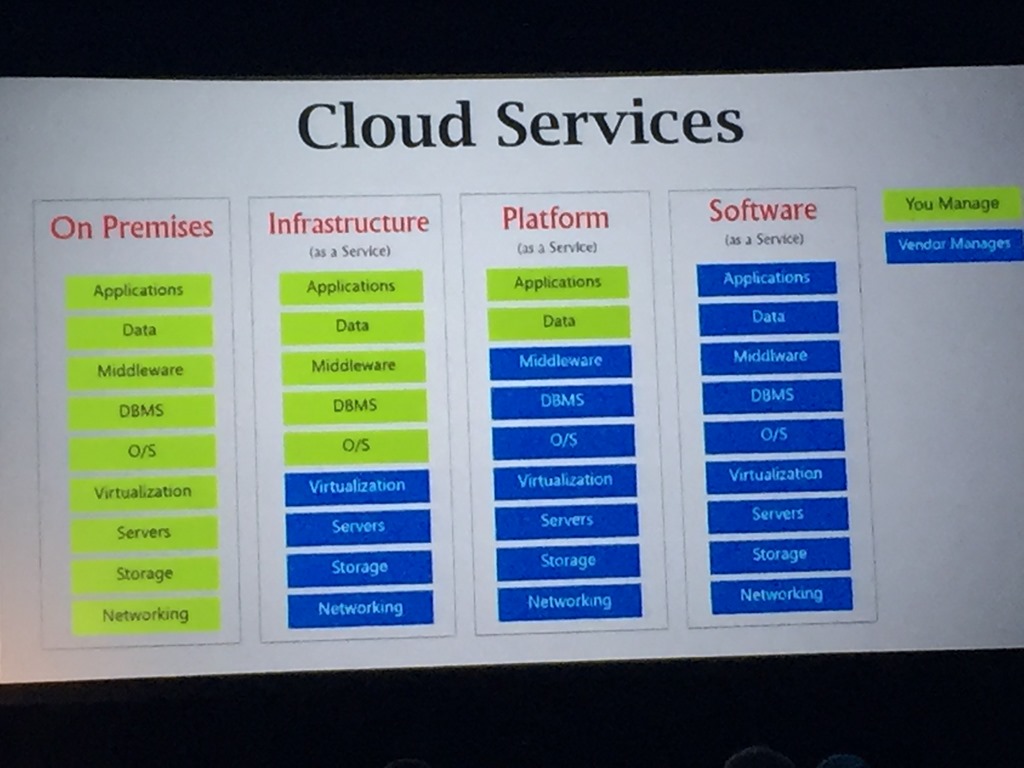
    Photo Nov 06, 8 58 02 AM

    Pizza as a service, a good analogy.

    Photo Nov 06, 8 58 54 AM

    Life and ship your database to the cloud? I’m not sure it’s that easy. If you are IaaS, then it probably is, though load is an issue. II f you go to PaaS, then because the “surface” of what’s available as a database, you probably need code changes.

    The focus shifts to cloud specific services for data management, looking at areas that do not exist for the “earthed” databases. That’s a better term than on-premises, and I’ll start using it. It might help us differentiate the two types of databases that I suspect more and more of us will deal with.

    Virtualization came about because it’s better for using resources, but it does bring issues. Bottlenecks and delays for the various services using the hardware. The abstraction of resources (CPU, memory, network, disk) mean that there are indirect paths to use those resources, which can cause performance issues.

    There is a good slide, showing the ways you might look at consolidation. I’ve often looked at the timing of workloads, but understanding IO v CPU v memory (for the buffer pool), might be good.
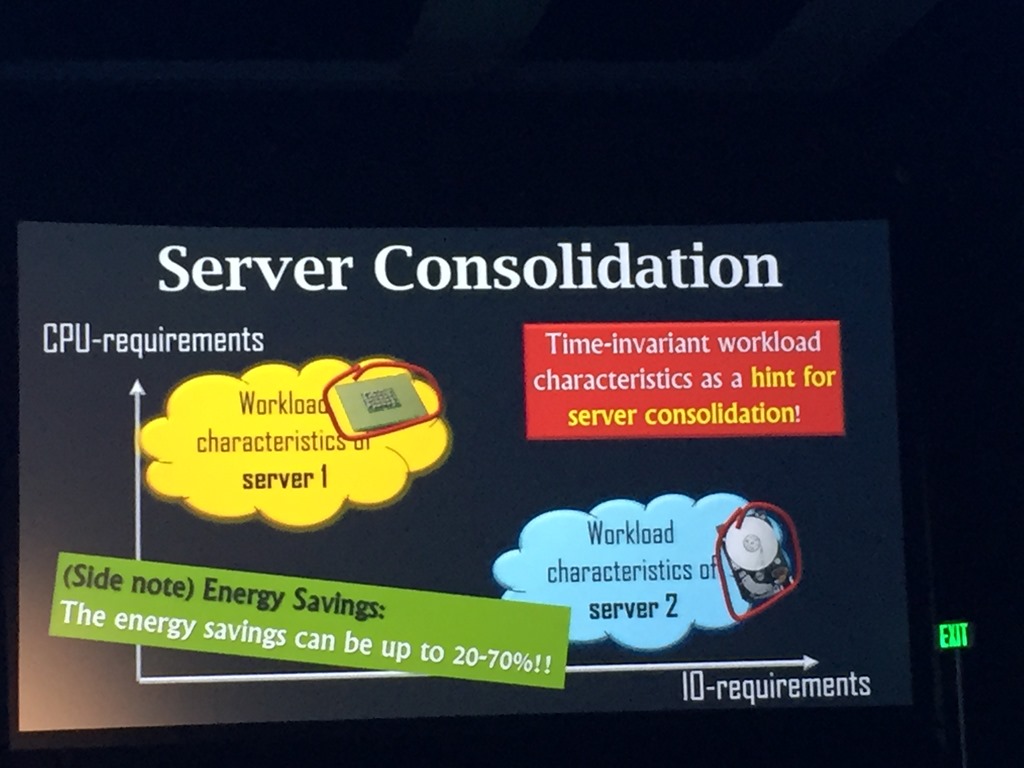
    Photo Nov 06, 9 09 12 AM

    If you don’t use virtualization, I’d be surprised, but I certainly think you should start to understand it. Even if only on your own desktop, start to learn about how things work.

    We get a slide on multi-tenancy – four main approaches, with examples.

    Photo Nov 06, 9 11 07 AM

    This is interesting. It’s good to build comparison on the differences. I typically hadn’t considered the right two, though the third one I one I’ve one for auditing or ETL.

    Inside Azure

    It’s designed with HA in mind, with 2 secondary replicas of the data. We’ve heard this before, but we’re building a base here.  We get a little architecture, layers for routing and billing sit between clients and databases. However there’s a twist.

    Each machine has a SQL Server instance (not the edition you buy) with a master, msdb, model db. However with that is one SQL DB of some sort. Inside of this SQLDB is the primary for one of the databases you create, along with secondaries for other SQL databases from other customers. That’s an interesting concept.

    Somehow we share a database, but we can each build whatever schemas we want. There must be some sort of “virtual schema” that separates those things but we don’t get details.

    The DBA’s Role

    Photo Nov 06, 9 23 01 AM

    Dr. Nehme sees the cloud as not a threat to DBA. Demand grows for apps and capacity increases, but DBAs don’t grow as quickly. You could argue that the low growth of DBAs (relatively) is because we need less.

    However we still need data quality, security, HA, provisioning, tuning and more from DBAs. Arguably we might need more of those things in the cloud, so I don’t think the cloud matters, unless you are unwilling to learn. If you build your skills, and get away from the simple aspects of managing databases, I suspect you’ll be fine.


    Watch the keynote. It’s interesting and should make you think. Whether you agree or not, there is something here.

  • Wednesday PASS Keynote–Microsoft

    We open with video, quite long. It’s two parts. The first being a community thanks and embracing of the community. Perhaps a little cheesy, but I do like that executives at Microsoft realize this isn’t just a conference where workers show up and learn. It’s a closer knit community.

    The second part of the video is a commercial. It’s a lot of sound bites and comments from people at Microsoft and customers. It starts out with a bit of cloud push, talking Azure, talking hybrid, and then going into more “Microsoft is great” comments.

    I think think this is redundant. We’re all Microsoft devotees. We’re sold. Personally I dislike the “sales” of the platform when we’ve already decided to purchase the platform and build careers on it.

    T. K. “Ranga” Rengarajan is up first. He’s an executive in the CVP Data Platform.

    We have an explosion of devices. 1.3B in 2010, projected to grow to 25B in 2020. That’s amazing, and that makes a different. However, it’s data growth, projected to be 40% year over year, that matters.

    40%.

    If that happens, that’s incredible. I personally think that’s high, but perhaps not. Certainly unstructured data growth is crazy. Now, can Microsoft enhance and grow Filestream/Filetable/Full Text Search to keep up? We’ll see. The last version was disappointing here.

    Photo Nov 05, 8 44 35 AM

    Overall, some good stats, but I think this keynote makes a few mistakes that I’ve made. It preaches to the choir, talking about things we also believe and know. It’s not inspiring or driving us to move in a direction.

    We get a shot of Microsoft isn’t like other vendors. We can do anything.

    Photo Nov 05, 8 48 27 AM

    Huh? That’s a bit of a silly statement. And somewhat arrogant. It feels contrived to me.

    Ranga mentions that they’re “proud to be schema free with DocumentDB”. It’s a statement at the end of Ranga talking about Azure DocumentDB and how all these devices that need to capture and use data, need a way to do so. I’m not sure that I like the idea of schema free.

    More cloud, more ne wfeatures in Azure, some of which were announced last week at TechEd in Barcelona. I think some of these are good features, niche-y, but useful for people.

    SQLDB – The scale out approach, the practical approach. They want to be simple, but also powerful. There’s new SKUs, up to 640 cores, 64 virtual CPUs, 1TB of RAM. I’m sure that will help some, but if they price is what I think it is, can many justify it? I doubt it,

    A demo from the Pier One Imports site. Showing some auto-fill/auto correct on the form from partial entries, or misspelling. We see some code on how to get this easily into your apps. That’s good, though to be fair, I’m not sure that’s as much a DBA/data pro thing as it is a developer feature. Good, but perhaps mis-aimed for the audience.

    Demo 2 – DocumentDB, quick loads of JSON data. Less than impressive.

    We then get a bit of a sharding demo, with some code on how this is implemented, seeing ADO.NET code to help with sharding and auto growth of instances, but it’s a bit underwhelming. I find myself less than excited by this, partially because the story isn’t told well. Watch for yourself and decide.

    We see a few clicks to geo-replicate databases across the world. Not a great demo, but they have made it much easier to get copies around the world if you have the need. No idea on cost, limitations, but it’s still a feature that is needed.

    “”Simplify with cloud” – Take any data, in any format, and put it in the cloud. Then transform it and then get answers. I’m not sure that’s my world. At least not in a company and at scale. Far, far, too much of my data and work needs to happen outside of the cloud.

    A few notes from DELL IT, which was lots of buzzwords that didn’t provide any details or really any information. I’m disappointed.

    Major update announcement, new features coming to Azure SQL DB, but coming later this year, and in preview.

    I’m not sure what future items, which aren’t available, are major announcements. This reminds me of the vaporware announcements of so many companies in the past.

    A live demo, which is cool. As Jen Stirrup noted, no worry from the presenter, which shows some confidence in what they did. A site where we can click on one of three items to purchase something. Try it at http:aka.ms/gopass. People are clicking on devices and in real time we see the totals being aggregated on screen, with Perfmon showing transactions/sec.

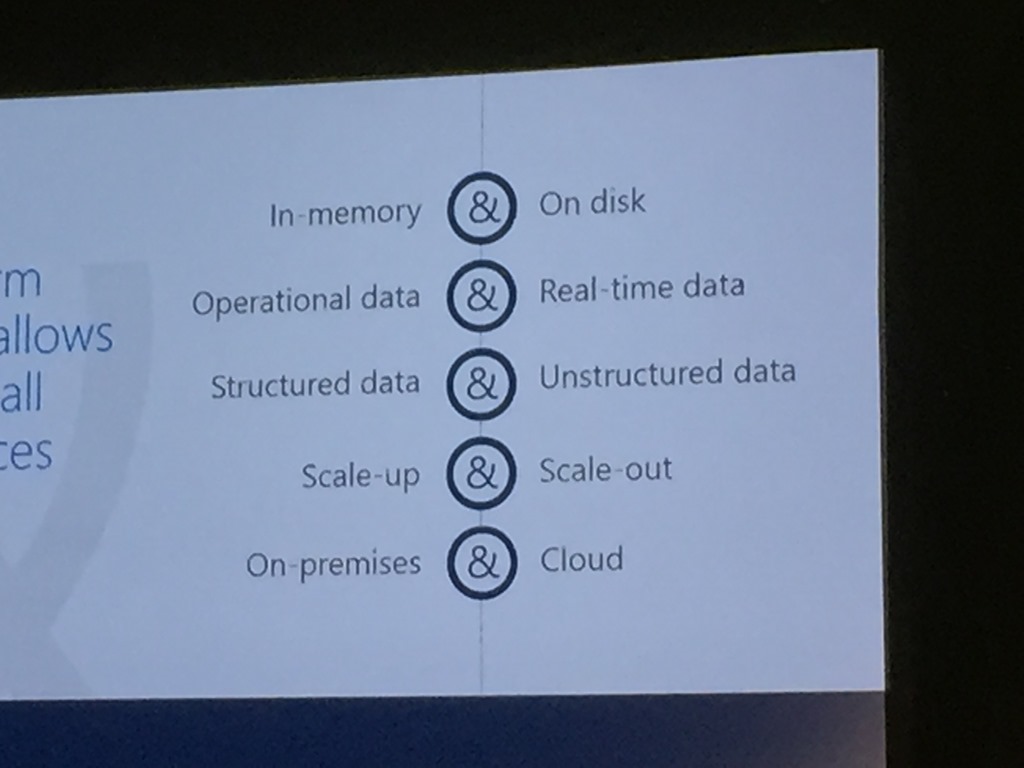
    Then we see this is in-memory OLTP, but with a writeable columnstore index. That’s cool.

    Database Stretch – We see part of our database in Azure, and part on premise. I’m sure it’s not as simple as it seems, but it’s a cool concept. We also see queries being spread out to Azure, combined with local on-premise database. We also see a restore, in real time. That’s cool, though no idea on how the costs might cause issues.

    Joseph Sirosh, VP of machine learning and something else at MS. He’s come from Amazon and shows a nice introduction. I do think this is the kind of stuff that is different in the SQL Server community. I don’t think any other conference, executives, companies, ever would have put up an intro like this in years past, or even today at many other tech conferences.

    Photo Nov 05, 9 30 59 AM

    We are more than work, and it’s good to see that on stage. Whether it’s a play or not, it’s a recognition of what we are.

    We now start to see the Azure Machine Learning introduction. The description is too vague, too full of buzzwords. However he knows this is the case, and promises demos to show how this works.

    Machine Learning – An interesting demo. We see Pier1, a store, using Kinect sensors to generate a heat map of where people are moving in the store. No real personal details, but just a map of density. That could be valuable, but the idea of re-arranging the “end caps” on aisles in response to movement is a bit contrived. This is the type of “hyper” change that doesn’t always produce the results you want. The world isn’t that simple.

    We move to customized searching and emails for customers, based on machine learning. The presentation that talks about the machine knowing what you want is slightly creepy. Seeing a Cortana demonstration integrated into the Pier1 app is interesting. I don’t know how many people use that for search and help, but if there is any significant number, then it’s a good idea to experiment with.

    Minus the creepy “the machine knows you” messaging.

    Certainly we need better machine learning that tries to use more data to target people in an effective manner than the simple “what you did last time”, or “this is what others did” recommendations we get. The fear from me is that marketing people won’t get that we also want “fewer” targets, not better ones.

    Next we have a look at Power Query and Power Pivot. Lots of downloads from people. One great quote “Data is a bucketful of potential”. I really agree.

    Let’s see BI, a live dashboard for a Pier1 store manager. We have a PowerBI system with tiles that we can drill through and get more information. It’s pretty, with lots of information. I think this stuff can be useful, but I also think it needs some training and work from end users. I wonder if the constant changing of tools helps end users get better or more confused?

    I’m not knocking what Microsoft is doing. I do think that if they can make things easier for users that’s good. However I also think that much of this complexity and the additional options can overload people. I sometimes wonder how much people really understand about what they’re seeing.

    Not a great keynote, disappointing. I wish that we’d stop getting executives and program managers that aren’t good speakers. It’s really not making a difference. Hire an actor and use them.

  • Wednesday PASS Keynote–Tom LaRock

    We’re live at the opening keynote for the PASS Summit, on Wednesday, Nov 5, 2014. Tom LaRock opens the conference learning with a welcome to everyone, those here in person, and those at home watching on PASS TV.

    Tom introduces the board, and say they’ll be in the Community Zone, as well as at a Q&A on Friday. Please ask questions, and talk to the board. It’s not just the elections where you can influence how PASS grows and changes.

    Hint: Ask for the Summit to move if you want it to.

    A few stats for the organization. In the last year, we have:

    • 285 chapters
    • 27 VCs
    • 25 24 HOP events
    • 86 SQL Saturdays (Thanks, Karla!)

    We’ve grown on member at a time. I was at the initial Summit in Chicago in 1999, and I think it’s amazing how PASS has grown. It’s really been amazing to see new people constantly come into the community, be welcomed, and become involved.

    Microsoft CAT and many support people are here on the fourth floor, near the bridge, in the SQL Server Clinic, ready to talk about issues you’re having. These are the people you reach on the phone when you call in, so this is a good resource.

    You can get certified here, and I’m not sure I’d take time out of the week to do that, but I can see the value. If there’s anywhere that you can get motivated and inspired, it’s at these events. Whether it’s at the Summit, or at a SQL Saturday, I think the boost to your confidence as a SQL Server pro come from interacting with the rest of the community.

    Nice to see the vendors being thanked. I know that many of you don’t want to be bothered by salespeople, but keep a few things in mind. First, vendors really make events work. Both large and small, because of their support. It’s worth thanking them, just for the vent.

    However vendors also make tools that solve problems. They might not solve your problems right now, or they might not fit for you, but more and more as I grow, I find that there are places where products fit in our company, and solve problems. It’s not everywhere, for all problems, and maybe not now, but at some point. It’s worth learning what products are out there, what options you have, and what you might consider when the need arises.


    Now on to the Keynote speakers.

  • Multiple AGs

    Today was my pre-con with Allan Hirt on AlwaysOn. It was great, and I learned a few things. I knew a bit about AGs, but Allan has a ton of experience, and he talked about some architectural things that I didn’t understand.

    We had virtual labs, which worked flawlessly. I managed to configure AGs with GUIs, PowerShell, and a bit of T-SQL. I configured multiple AGs in the lab, and finished early, though I had one PoSh error that stumped me a bit. I’m looking forward to resetting the lab and trying again on Friday, taking a few hours to try and rebuild AGs in my own way without help.

    Though I suspect I may be sending an email to Allan before this is over.