Tag: user groups

  • Are You a Diverse User Group or Event?

    One of the things that I’ve seen crop up at various points in my career is a question of diversity. I know there are many people that don’t think this is a problem, or maybe more specifically, their problem. They don’t think that it is their fault that not enough women or minorities are represented in their industry.

    One thing I’d ask user groups and events to do is publish a diversity scorecard, either after a schedule is selected, or annually for user groups.

    What do I mean? Here’s a short look at something I noticed. I went out and grabbed a set of data from a few user groups and event that I thought of. I have no real idea of what to make of this:
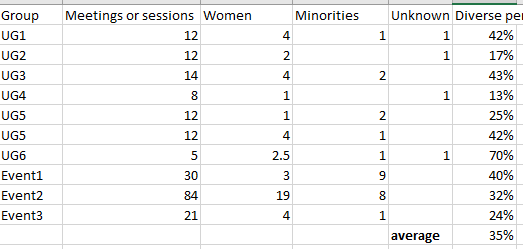
    2021-06-14 11_53_42-Dviersity in User Groups.xlsx - Excel An average diversity of 35%, though I could have made some mistakes. I counted women, and separately counted minorities that were not white males as diverse. I think I counted those I know as LBGTQ as minorities as well.

    It’s not scientific, nor is it necessarily some quota I’m looking to meet here. As a minority (I’m in a few data sets above), I think 35% is pretty good, but likely it ought to be higher, especially with regards to women. They make up half of the world, but are underrepresented in our industry.

    A quick anecdote, in case you think that this isn’t important. Early on, the computer jobs were mainly for women. They programmed a lot, and helped get things working in various industries. The job was seen as “secretarial”. Once companies started to pay more, men wanted those jobs, and took over the industry. Hiring practices, and men being comfortable with other men, not because of talent. Good programmers come in all colors, creeds, and genders.

    That has happened in other industries as well. It’s not a malicious thing, but it is a trend when there isn’t visibility or attention paid to the issues. Those that are in charge tend to aim for homogeneousness, or some level of uniformity. That displaces others.

    I’d like to call on all user groups to add a report to their main meeting page. Just cull the data from the last 12 months (or meetings) and report on it. Microsoft does something like this for their company, as does Apple, Google, Facebook, Redgate, GE, Walmart, and many others.

    Do us all a favor and pay attention to your actions in this area, and encourage others. I was happy to speak to the local WIT group years ago on how to give a presentation and managed to get one person to start speaking. If I did that every year, we’d have a lot more women speakers, so this is on me as much as on many others.

  • Announcing the Azure Data Community from Microsoft

    You can see an announcement from Buck Woody (b | t) of Microsoft on Data Exposed. Essentially, Microsoft is providing a number of free resources to help local user groups with their meetings. This is a fantastic way to support the various groups around the world that might not have infrastructure setup after the PASS organization failed.

    The offering from Microsoft includes:

    Community-owned, Microsoft-Empowered is the tagline, and I think that’s a good way to approach things. Microsoft is supporting groups, but not forcing them to run in any particular way. I believe they may ask that some portion of your topics are focused on the Microsoft Data Platform, but you are free to include other data related topics for your members.

    If you are a user group leader, check this out. If you’re a member of a user group, and you think this might help, pass this along to your leadership team.

  • Your User Group Goals

    Many of you reading this piece have likely been to a user group at some point in your career. Some may go every month, some may go a once or twice annually , and some may not have been for years. I also know some of you don’t have a group in your area, or perhaps not enough people for a SQL Server group, but I would bet if you are working in technology, there are enough people to have some sort of technology group, perhaps even an online book club.

    Recently I was speaking with Andy Warren about his group in Orlando. He’s preparing to turn over leadership of the group to others, and he’s actually looking for comments on the docs he’s put together. I’d urge you to take a moment and think about your group and how you want it structured and check out what Andy has done. He’d appreciate comments on his effort, whether you are in leadership or just show up at meetings.

    Our discussion, however, was on goals. What goals are appropriate for the group, and what guidelines should he leave for others. He’s tended towards goals of “more”, meaning more people touched, more attendance at meetings, more events. I’ve tended to aim for more ensuring you keep people interesting, inspired, and with some engagement, but not worried about size.

    Whether you are in the leadership of a group, just an attendees, or wish you had a more interesting group of technical people to meet with regularly, what do you wish your group would accomplish next year? Are there things that matter to you for an organization outside of work that might help your career? Take a minute to think and leave me a comment today.

    Steve Jones

    Listen to the podcast at Libsyn, Stitcher or iTunes.

  • Go Small

    The SQL Server community is a surprisingly close knit one. I find that people are much more willing to help each other and share knowledge. We have so many events and user groups, it’s amazing to me that on almost every weekend of the year, some event is taking place, somewhere in the world. I’ve been to dozens of SQL Saturdays, and most of them are run very well, but I’ve also seen lots of extravagance in putting on the events. There’s competition between the events and organizers, which is mostly healthy, but I do worry about the long term health of our community.

    Most events depend on some sort of sponsorship to get going. Venues can cost a good bit of money, and while many events now charge for lunch, the breakfast, coffee, sodas, etc. are the burden of the organizers. Add in signs, printed guides, gas, etc., and events can get expensive. Many events get shirts for volunteers and speakers (or a small gift), as well and a Friday night dinner to thank everyone for their help. These expenses have become commonplace.

    However as we continue to add new events, I can tell you that the overall cost to vendors is significant. I can’t speak for other vendors, but I know Red Gate wants to support these events, and we plan to continue providing sponsorship, as well as sending Grant and myself to speak. However we also have to make choices about which events to support and how many we can participate in. That means that as more events are run, fewer will get funding. Many existing events might see less funding from all vendors.

    I really like the idea of bare bones events. Jen McCown proposed a format and I like it. As we look to grow more events in the future, we need to be lean, efficient, and most importantly, focus on the goal: teaching. Big events are fine, and if you can make them happen, great. However let’s not let the lack of a big budget get in the way of helping teach people about SQL Server, growing our skills and bond as a community.

    Steve Jones

    The Voice of the DBA Podcast

    Listen to the MP3 Audio ( 2.5MB) podcast or subscribe to the feed at iTunes and LibSyn.