Author: way0utwest

  • Move a Stored Procedure to a New Schema–SQLNewBlogger

    Another post for me that is simple and hopefully serves as an example for people trying to get blogging as #SQLNewBloggers.

    One of the things I needed to do recently was move an object. I was testing the WideWorldImporters database and created an object in the dbo schema. That’s the default for me, which is fine. However, in this case I wanted it in a different schema.

    The way to do this is with the ALTER SCHEMA command. There is a TRANSFER option, which takes the original schema and object name.

    In my case, I had the dbo.GetOpenPurchaseOrderCount procedure in my database.

    2017-06-07 14_40_29-SQLQuery1.sql - (local)_SQL2016.WideWorldImporters-RR (PLATO_Steve (53))_ - Micr

    I used this command to move it.

    ALTER SCHEMA Website
    TRANSFER dbo.GetOpenPurchaseOrderCount

    And then verified things moved.

    2017-06-07 14_40_37-SQLQuery1.sql - (local)_SQL2016.WideWorldImporters-RR (PLATO_Steve (53))_ - Micr


    SQLNewBlogger

    This was one of those quick items where I checked the ALTER commands, thinking it was in there. I didn’t see a changeobjectschema procedure, and since this was a new skill, it was a 5 minute blog.
  • Backup Plans for Data Loss

    The British Airways computer failure has been on my mind for a few weeks. It seems like such an epic failure in 2017 from a high public company that many, many people depend on. I still struggle to believe the power explanation, and really, I’m not sure there’s any explanation that I would accept. At this point in our industry, there’s no good reason for any large, global company to not be able to restart services inside of a couple hours in a DR site. In fact, it really shouldn’t even take that long.

    However, for many of us, we will have a failure or disaster at some point. It might not even be a hardware failure or system crash. It’s much more likely that a user will cause an issue. As our systems grow larger, perhaps even more loaded with transactions, we might not always be able to easily separate out good data from bad, and I would expect we’ll experience a restore.

    For many of us this will mean we will lose some data from the system. Even with frequent log backups, we might end up with a short period where we can’t recover data. Most of us should have conversations with business stakeholders on what the acceptable level of data loss is, and plan to meet those requirements. We should also have plans around how to rebuild data. I wouldn’t recommend a full test on a system, but it might be worth a few conversations with those that deal with transactional data and discuss how the latest data might be recreated.

    No one wants to lose data, and in many cases, there are ways to rebuild or recover the data with manual efforts. Perhaps your company has paper records, or maybe there’s an audit trail that could be used to reconstruct actions. Maybe you rely on memory or even customers to provide information again. Today I’m wondering if you’ve thought about how you might recover data in a non-technical way and what methods you’d use.

    Steve Jones

    The Voice of the DBA Podcast

    Listen to the MP3 Audio ( 3.6MB) podcast or subscribe to the feed at iTunes and Libsyn.

  • Using OPENROWSET in SQL Server on Linux

    I wanted to import the million song dataset in SQL Server on Linux. There’s a github repo that has the SQL to allow you to use this with the graph database features. However, it’s built for Windows.

    Linux is a slightly different beast. Once I started down this path, I had memories of working on SunOS in college, messing with permissions and moving files.

    I run Ubuntu in VMWare, so I first downloaded the files to my Documents folder. That’s pretty easy. However, once there, the mssql user can’t read them. Rather than mess with permissions for my home, I decided to move these to a location where the mssql user could read them.

    First, I need to use mv to move the files. However, the default location for SQL Server (/var/opt/mssql) doesn’t let me drop files in there. Instead, I need to sudo the mv.

    sudo mv unique_tracks.txt /var/opt/mssql/unique_tracks.txt

    I repeated this for each file.

    However, I still had permissions errors. Files have their own permissions in Linux, so I needed to alter those. I decided to use chown since these are temp files the SQL Server will use and once imported, I’ll delete them.

    chown mssql unique_tracks.txt

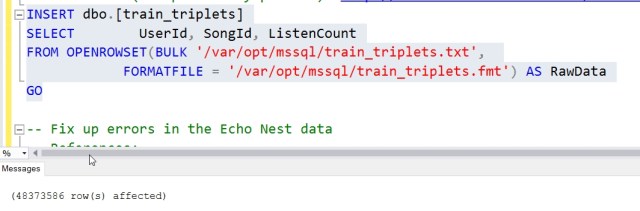
    From here, I could easily run the OPENROWSET commands and get the data loaded. Now to play around with a graph.

  • Speaking at the Data Platform Summit 2017

    I am honored to be speaking at the Data Platform Summit 2017. The event takes place August 17-19, 2017 in Bangalore, India. This will be my first trip to India, and I’m excited to be traveling halfway around the world (literally 12:30 hours difference) to speak at this event.

    I’ve got a pre-con on Aug 16, and then a few sessions during the main conference.  If you have the chance, register and come. I’ve heard good things about the event and I look forward to seeing some of you there.

    See if you can pick me out of the Teaser Video: