Author: way0utwest

  • Thinking Time

    I’ve been fortunate in my career to meet a lot of different people with a variety of views on the world, career, technology, and more. I’ve learned a lot about various things by focusing on conversations with these people and getting alone time with them, just talking. This is one reason I make it a point to get a couple quiet, focused conversations with a few person at events, and I’ll usually bail out of dinners with more than 6 people. They’re just too chaotic and less attractive to me when I’d rather have an engaging chat.

    I was reminded of a few pieces of advice I’ve received in life while watching Jes Borland’s keynote at the Chicago Code Camp. It’s a nice talk, and worth a bit of your time to help you reset your view of the world and remember to choose the things that matter to you. Certainly Jes’ advice to learn to say “no” is some of the best advice I’ve ever learned in my life. I’m still trying to get better at this, but I am learning to let some opportunities go by and not agonize. Time is far and away the most valuable resource I have in life, and I value it more each day as I age.

    One of the best pieces of advice, though, came from @sqlandy. Years ago, as we were both working full time jobs and keeping SQLServerCentral going at night, he let me know that we were treading water, just doing the same things we’d been doing and thinking about driving our enterprise forward. He’d noticed the same problem at work, with so many people letting themselves get caught up in day to day tasks and not looking ahead. We end up worrying about getting a query done, or checking a server, or writing an email, updating our resume, getting dinner cooked, and we are not coming up with ways to improve their job, career, life, server monitoring, development habits, and more. We’re not actively moving in a direction that matters to each of us.

    Jes reminded me of the need for thinking time in her keynote. We all need some time that isn’t devoted or focused on a task, or a particular endeavor. We need time that let’s us just think about anything, or everything related to a topic. Unstructured time that lets our mind wander over possibilities, opportunities, or even evaluating some course of action. Time away from a keyboard, time to think about how you might change your world.

    I often find running or swimming is good time for me. Taking a known route, not worried about speed or pace, just plodding along and letting my mind wander. Sometimes I’ll even end up walking, or sitting by the side of the pool, just thinking because my body won’t move on automatic when I get deep in thought. I have sometimes tried to just sit and think, staring out the window, letting my thoughts take me where they will.

    Life is busy, and it’s easy to get caught up in all the demands on our time. It’s even easy to get caught up in trying to relax and focus on a task (cooking, playing games, etc.). Taking some time to think about a topic in an unstructured way, without any goal or outcome is important to help us evaluate and review where we are, and where we might want to go in some part of our life.

    Steve Jones

    The Voice of the DBA Podcast

    Listen to the MP3 Audio ( 5.5MB) podcast or subscribe to the feed at iTunes and Libsyn.
  • I’m on dbatools!

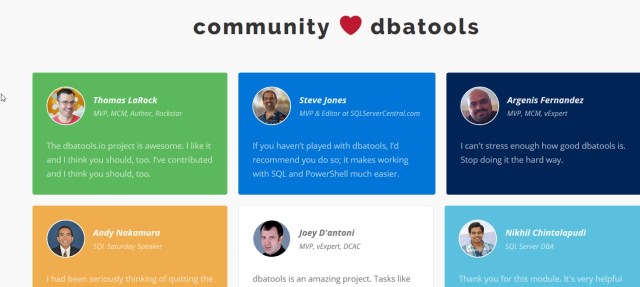
    I made the front page of dbatools, as a part of the community that is supporting this project. Along with quite a few others, I’m happy to be there and doing my part to make SQL Server administration and scripting easier.


    Maybe I’ll even write a cmdlet some day.  Since I keep working on my PoSh skills and playing with the various cmdlets.

  • IoT Pros and Cons

    The Internet of Things is coming, or maybe it’s a wave that’s growing underneath us right now. It certainly hasn’t crested if that’s the case, and I expect that we’ll see more and more devices, sensors, and applications coming in the next decade. We’ll get larger and smaller devices, commercial and industrial tools, some amazing innovations and some silly ones that will make most people roll their eyes.

    I ran across an article with some pros and cons from the general perspective. Certainly security is a huge concern, and one that isn’t well addressed by many organizations. In fact, many of the demos of the Azure IoT hub don’t do a great job of showcasing security. I think the Azure IoT Hub is a great idea, with some well thought out security measures, but developers need to build in habits early, and certainly include them in their applications. Let’s leave aside security for a moment and stipulate that it is, and likely always will, be a concern and issue.

    What about the data perspective of IoT? The age of new sensors and devices mean a glut of data, perhaps an overload. We may get a scale of data that we don’t expect and need to plan for more TB or PB sized databases. Those are serious challenges for any organization, and likely we’ll need archival plans to remove old data, or at least ensure we don’t have to scan it for queries. We might even need some sort of governors that prevent the errant “select * from table” queries that try to query 100 billion rows.

    We also may see crazy rates of data acquisition as well. One of the strengths of some NoSQL platforms is that they handle quick streaming sets quicker than relational engines. In fact, in some domains we might not even want to bother storing all the data we can and may need to process this as we get the data, only storing certain samples or ranges. I worked with a stock market application once and the streaming of prices was enough to overwhelm our SQL Server until we learned to limit the data we actually needed to store in the system.

    There’s also the chance we’ll get new, or different types of data that we aren’t sure of the value. Data that might not seem like there is an obvious use for it, but we’re just gathering the bits because a sensor or device captures them. This is where I see more intelligent analysis, more of the “data science” being used. Most of us won’t know how to create these queries, but we certainly will know how to implement and run them, which is a much simpler process. This also means we might need to learn more about to partition, archive, or otherwise move some data of OLTP type, transactional systems to help manage our loads.

    I think IoT is somewhat scary, but also very exciting. New types of data, new applications, new uses for data, which will make our jobs very interesting in the coming decade.

    Steve Jones

  • Finding the Service Name–#SQLNewBlogger

    Another post for me that is simple and hopefully serves as an example for people trying to get blogging as #SQLNewBloggers.

    A quick one today, and this one I remembered without looking anything up.

    I recently needed the service name to kill it for a test. I was using the sc.exe command line and couldn’t get it to give me the SQL Agent service name. I could have hit Windows, typed services, scrolled down, found the Agent, right clicked it, selected properties, and gotten the name.

    Or I could do this:

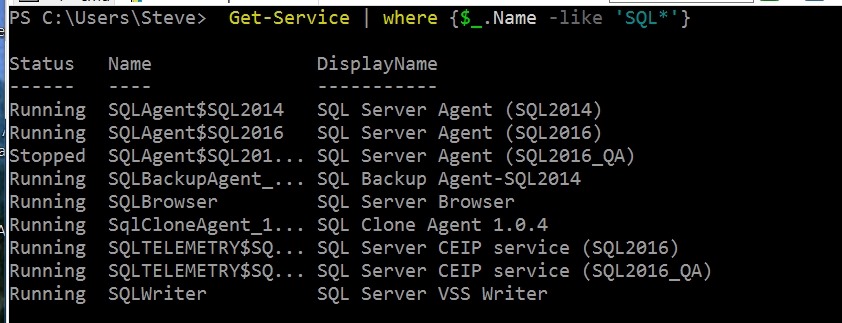
    Get-Service | Where {$_.Name –Like ‘SQL*’}

    That worked and I could quickly see all the names.

    2017-04-18 11_19_49-cmd - powershell (Admin)

    The only thing that threw me was I forgot the hyphen before “like”. One of these days I’ll actually remember that.