Author: way0utwest

  • T-SQL Tuesday #88 – WTF

    tsqltuesdayIt’s T-SQL Tuesday time again, and this is a good one. The host this month is Kennie Pontoppidan, who I had the pleasure of running with one morning in Copenhagen. His theme is The daily (database-related) WTF.

    You can read about T-SQL Tuesday at tsqltuesday.com and see all the archived invitations. Join in the fun by watching the site, or the #tsql2sday hashtag on Twitter. If you want to catch up on old invites, feel free.

    WTF

    I’m not sure if I have a great story, but I certainly have had a few “WTF” items in my career. Some of them caused by me, some by others, and often not a good thing.

    The one item that I’ll relate here goes back quite some years in history, but it was one that affected me for many years in my career. I do quite a bit of work with DevOps and software development these days, trying to help people build better software.

    Part of that is ensuring your code, including your database code, is in a version control system (VCS). I’ve worked in a variety of environments, using different source code control methods, and I have to relate a story that taught me how important it can be to manage code and track the versions in production.

    A long time ago I went to work for a small startup. The company had been in business for 5 or 6 years, and had a number of customers that depended on our service. However, our developers and admins were a mess. I was brought in to try and straighten out the the database and infrastructure side of our codebase.

    One of the first things I found was that all our stored procedures in the production server were encrypted. I wasn’t sure why, since we hosted our machines, but that wasn’t a big deal.

    Until it was.

    One day we had an issue on one of our SQL Server 2000 servers (we had two, supposedly identical). In troubleshooting and putting some sample data in both systems for a fake customer, we got different results. Hmmm, not what I wanted to see.

    I checked the VCS (SourceSafe at the time) and checked out the code. I then loaded my test data and … got a third, different result. Now I was concerned as this was a production bug that was delaying work for a customer.

    This was early in my tenure at the company, so I asked the other DBA for some information. He had been passed over in favor of me by management and wasn’t a great deal of help. He told me that he likely had the source code for server 1 on his machine.

    You might start to guess why this is a WTF post. Rather than get upset, I wanted to see the code, which he produced. His version was one one of the servers, but not the other. Where was that code? He thought it was on the lead developer’s machine, who conveniently, was on vacation. We checked, and it wasn’t in his checked out folder structure.

    What about our former developers, who had moved out of state? We still had their machines, which were supposedly going to be shipped to them so they could continue working for us. The checkout folder wasn’t right, but we found 2 other folder structures, copies of the source code tree, with different code. At this point, I just needed to fix the issue, and managed to find a copy of the stored procedure that matched my issue, built a correction, and deployed it to both servers. Unencrypted.

    Detective Time

    At this point, I paused some work that the DBAs were assigned. We spent a day or so pouring over all developer’s machines, finding 6 or 7 different copies of source code (plus our SourceSafe install). Multiple files were different, and we essentially had no idea what was running in production.

    Apparently our developers had decided that when they checked in code, they would leave it on their machines. If they wanted a branch, in essence, they’d copy this folder over, make changes, and sometimes copy things back, but mostly just assume they knew what was good, and leave the updates on disk, uncommitted to the VCS.

    I couldn’t come up with a rational reason for this. Back then, we didn’t have any sort of integration like SQL Source Control and we checked code in and out of the VCS manually. I had previously set all my machines to remove the code from my local disk, ensuring I’d go to the VCS to get code when I needed to change something. I suspected this was one way of creating ”job security” by a few developers and DBAs. Hint: it didn’t work with me.

    Solving the Issues

    This necessitated a complete reboot of our system. Together with a new lead developer (you can guess where the old one went), we paused development for 3-4 days. I found a routine to decrypt SQL Server 2000 stored procedures, and we all spent time decrypting the stored procedures from both instances and committing them back to a new tree in SourceSafe. If we had an discrepancies, then we had at least two developers examine the code, merge the differences and commit code.

    After a week of lost work, we had a clean source code tree of what was running in production, and both database servers synchronized. From there, we could start new development. Learning from the issues, I also would only deploy changes from the VCS (manually back then), which ensured the developers had an incentive to commit their changes and not just alter the database objects on the development server.

    Of course they still did, and we had numerous deployment issues. If only we’d had a few better tools back then for CI and CD in the database world.
  • GUI or CLI

    There’s a debate over on Scott Hanselman’s blog about the GUI v CLI in the comments for his Azure CLI post. It’s a blend of people complaining about one or the other, mixed with a few (I think) rational people that recognize the GUI and CLI are both valuable. In fact, there’s one person that mentions SQL Server and the SSMS GUI that can generate scripts for later use.

    I like the command line, but sometimes it’s hard. I don’t remember the syntax for a variety of commands, including various T-SQL ones, because I don’t use them very often. I may find myself depending on Google or BOL for a quick refresher, but often I’ll just use use SSMS if I can to pick some items in the GUI, click Script, and then examine the code before executing it.

    I really don’t mind someone wanting to use the GUI the vast majority of the time they’re working, but someone should be comfortable with a CLI interface. If there is a task that need repeating multiple times, then I really want everyone using the GUI. It doesn’t matter how you’ve written the code, executing something from a CLI is much more reliable than having to click around a GUI, consistently and quickly, over and over.

    I’d like to think that most computer professionals these days are able to use a CLI, even if they aren’t too comfortable. The growth of PoSh as a wrapper around so many features and functions in the MS stack certainly contributes to this, as well as the showcase of much code as code, not as images from a GUI. Github and collaboration, as well as more and more samples of code should mean that many people are comfortable working with code and executing it from some CLI.

    I’m sure there are plenty of exceptions. Someone that works mostly with SQL Server might be happy running code in a query window, but use SSMS for everything else, and maybe not even be aware that they can build things like SQL Agent Jobs from a CLI. I get it, the GUI is quick and easy. I use it for jobs, for Extended Events, and various other tasks where the code is complex and cumbersome. However, if something is easier from a command line, I like using it. Perhaps that’s why my console of choice, ConEmu, is always just a CTRL+~ away.

    Steve Jones


  • GUI or CLI

    There’s a debate over on Scott Hanselman’s blog about the GUI v CLI in the comments for his Azure CLI post. It’s a blend of people complaining about one or the other, mixed with a few (I think) rational people that recognize the GUI and CLI are both valuable. In fact, there’s one person that mentions SQL Server and the SSMS GUI that can generate scripts for later use.

    I like the command line, but sometimes it’s hard. I don’t remember the syntax for a variety of commands, especially PowerShell where I use tab completion constantly. I don’t even remember options for many T-SQL functions, because I don’t use them very often. I may find myself depending on Google or BOL for a quick refresher, but often I’ll just use use SSMS if I can to pick some items in the GUI, click Script, and then examine the code before executing it.

    I really don’t mind someone wanting to use the GUI the vast majority of the time they’re working, but someone should be comfortable with a CLI interface. If there is a task that need repeating multiple times, then I really want everyone using the CLI. It doesn’t matter how you’ve written the code, executing something from a CLI is much more reliable than having to click around a GUI, trying to be consistent and quick, over and over. The CLI just works better.

    I’d like to think that most computer professionals these days are able to use a CLI, even if they aren’t too comfortable. The growth of PoSh as a wrapper around so many features and functions in the MS stack certainly contributes to this, as well as fact we seee so much code as code, not as images from a GUI. Github and collaboration, as well as lots of code samples in articles should mean that many people are comfortable working with code and executing it from some CLI.

    I’m sure there are plenty of exceptions. Someone that works mostly with SQL Server might be happy running code in a query window and use SSMS for everything else. They might not even be aware that they can build things like SQL Agent Jobs from a CLI. I get it, the GUI is quick and easy. I use it for jobs, for Extended Events, and various other tasks where the code is complex and cumbersome. However, if something is easier from a command line, I like using it. Perhaps that’s why my console of choice, ConEmu, is always just a CTRL+~ away.

    Steve Jones

    The Voice of the DBA Podcast

    Listen to the MP3 Audio ( 3.7MB) podcast or subscribe to the feed at iTunes and Libsyn.

  • Getting the tSQLt Run Adapter working in Visual Studio 2017

    Last year I heard about the tSQLt test Adapter for Visual Studio from Ed Elliot. I’ve been wanting to try it, but various items got in the way. Finally I had the chance to play and it worked well in Visual Studio 2015, but I needed it in VS 2017. Fortunately Ed had a tSQLt Run Adapter beta for Visual Studio 2017, but I had a few issues. This is a debugging post.

    I downloaded the file and ran setup. Since this can cause issues with VS 2015, I unchecked that box. Unfortunately, I think I messed up my VS 2015 project. No matter, we’ll forge on.

    I had a Readyroll project where I was doing some work. In following some of the work at Redgate from a developer, I set up a new test project according to the tutorial. I got through and no tests.

    Hmmm.

    The .runsettings file is set in the root of my solution, as shown here:

    The contents are:

    <?xml version="1.0" encoding="utf-8"?>
    <RunSettings>
      <TestRunParameters>
        <Parameter name="TestDatabaseConnectionString" value="Data Source=.\SQL2016;Initial Catalog=PartsUnlimitedDB;Integrated Security=True;" />
        <Parameter name="IncludePath" value="Tests" />
      </TestRunParameters>
    </RunSettings>

    My local instance is .\SQL2016, a named instance, and I have a PartsUnlimitedDB database on this instance.

    Here the file is selected:

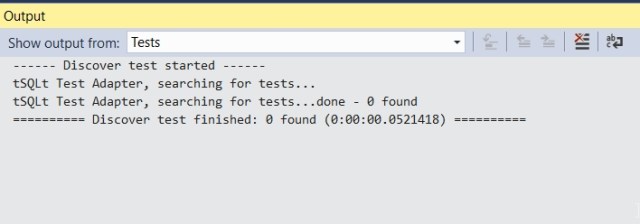
    When I run all tests, I get this:

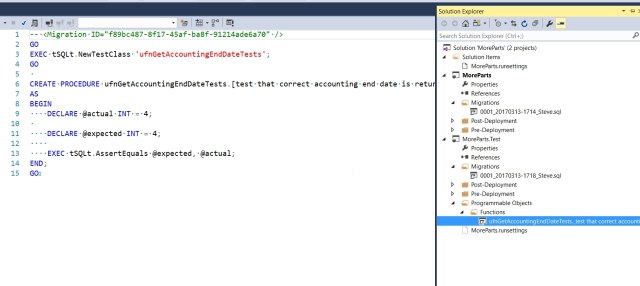
    I heard from Ed that I needed to have the name “tests” in the filename, so I changed that. Here’s the test and the file name

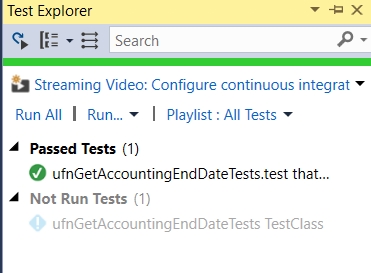
    Now I see my tests in the test explorer. Success!

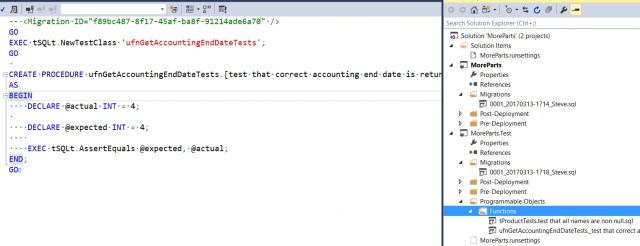
    Just to check a few things, let’s try another file. Here I’ll use a shorter name, though still descriptive.

    And again, success.

    That felt strange, but some back and forth with Ed showed me that the IncludeFile filter in the .runsettings file needs to be set to some value. In the default file I used, it’s set to “tests”. If I change it to test, and include a new test, then I things still work: