Author: way0utwest

  • Questioning the Interviewer

    This editorial was originally released on Oct 14, 2012. It is being republished as Steve is out of the office.

    When you are in a job interview, it’s almost inevitable that near the end the interviewer will ask you what questions you have. As noted in this post, a large number of people have no questions. It’s certainly possible that the interview covered all the questions you would want to have answered, but do you have a list of questions before the interview starts?

    You should. I think it’s important that you ask questions in an interview, especially questions that are important to you. Many times each of us wants a job, needs to get a job, and don’t want to do anything that might jeopardize our chances. However taking a job that’s a bad fit, or has some aspect that will bother you every day is a bad idea. You spend a lot of time at work and a poor work environment can make your life miserable.

    In the piece, the person makes a good point that your questions reflect your priorities and can result in an unfavorable impression. I think you can ask about topics like telecommuting, but do so in a way that shows you are interested and excited about the job. I’ve noted long commutes and the time they take in an interview, asking if I can better use that time to solve problems by working at home a day or two. The way you bring topics up can matter, so make sure that you word your questions in a way that shows you are interested in doing a good job.

    I do think that asking questions which show your enthusiasm or interest in the position are good questions to ask. However you should think about those questions before you go to the interview and determine if what impression they make. Write down your questions, and if they are answered during the interview, mark them off and ask any remaining questions at the end.

    The interview is your best chance to determine if the position is a good fit for you and the company, so take advantage of that.

    Steve Jones


  • Rename a Server with PowerShell

    I’m sure many people are experimenting with VMs and SQL Server. If you’re like me, many of you just default to installing Windows 7/10 or Windows Server xx Standard for your testing. Those systems work fine, but I’ve been trying to build slimmer systems, which means looking at Server Core. Installing Server Core is much the same as other versions, though you end up with only a command line. If you’re like me, using VMWare, you also might end up with a server name like “WIN-LKR3R4FfL5T”.

    I want to change that. It’s a fine name if I’m working locally. It’s not to much fun connecting across a network. This post looks at how to rename that machine.

    Get the Name

    The first thing is to get the name. I’ve always just right clicked the Computer in Explorer, but that’s not possible in Core. Instead, I decided to use PowerShell, since I know how to do that.

    First, start PowerShell, which is simple.

    2016-10-02 12_39_57-SQL2016Alone - VMware Workstation

    Next, use the environment variable, $env:computername, to find the name. You can see me do that here:

    2016-10-02 12_42_20-SQL2016Alone - VMware Workstation

    Rename-Computer

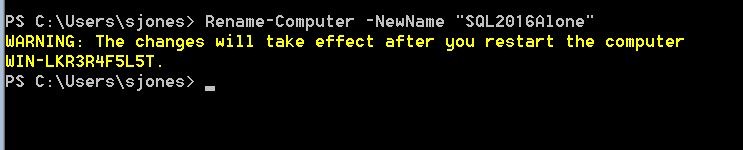
    Technically I don’t need the name to rename the system, but I wanted to know what it was. Plus, I’ll want to verify things work. There is a cmdlet, Rename-Computer, that does exactly what you’d expect. It renames a machine.

    There are various parameters, but the only one I really need is “NewName”. I haven’t joined a domain yet, so no reason to worry about that security. I could include the Restart parameter, but I wanted the screenshot below.

    2016-10-02 12_45_09-SQL2016Alone - VMware Workstation

    That’s really it, other than a restart. Intuitively enough, Restart-Computer works fine.

    And on restart, I log in and can see my rename worked fine.

    2016-10-02 12_48_37-SQL2016Alone - VMware Workstation

    Now, on to SQL Server installation.

  • Coming Attacks

    The pieces by Bruce Schneier related to security are fascinating. One of his latest posts looks at potential coming attacks to our Internet infrastructure, which could potentially take down parts of the worldwide network. Whether you think this is a valid concern or not, it bears thinking through the issue a bit. If something did happen, your organization could be affected.

    Imagine what would happen to your production sites if they, or their clients, couldn’t resolve a DNS address. Or if there was a DDOS against your domain, perhaps just as a test by attackers to see where you might be vulnerable. What would be your response? For most of us, there isn’t much we could do, but I’m sure your management would want some answer, so do you have a way to respond? Would you worry if there were a targeted attack against your database servers using SQL Injection, cross site scripting, or some other technique?

    What about your development efforts? So many people have started to use services like Slack, Trello, cloud hosting of repositories and more. Could you continue to develop software if the Internet went down for your company? I’ve certainly thought about this for my work, and some things would be off-line, and I could have potential scheduling issues. However, I don’t work on mission critical systems, so I could work on something off-line and push production schedules by a day or two.

    Certainly control systems, embedded systems, and more are vulnerable to these types of attacks. If they depend on data, could they be attacked with fake or compromised data? I hope that some of these companies that have critical system, get serious about security in the event that an attack is targeted at their infrastructure. I don’t know if that will happen, and I really hope not. The Internet is a wonderful, collaborative resource, and will be for a long time if the criminals don’t fundamentally ruin our trust in it.

    Steve Jones

    The Voice of the DBA Podcast

    Listen to the MP3 Audio ( 2.6MB) podcast or subscribe to the feed at iTunes and Libsyn .

  • Intelligence from Data

    There is an incredible amount of data in the world, and all that data is changing the way industries work. That’s the opening to a keynote talk from Jim McHugh at the O’Reilly Artificial Intelligence conference. The talk is short, 12 minutes, and interesting to listen to as Mr. McHugh looks at autonomous cars and healthcare, talking about the impact of artificial intelligence on advancing these industries. There are examples showing how data and AI systems are already being used to change the way the transportation and medical fields can work.

    Whether you want to see more robot help in our world or not, I suspect some level of this is coming, and it’s being driven by data. We have more and more data, and as companies have success in analyzing this data with various types of AI and machine learning systems, there is pressure for other companies to join the trend and build their own systems. We certainly see that with the push from Microsoft that emphasizes the R Services in SQL Server. At the recent Data Science Summit, there was a demo in the keynote (around 17:00) of over 1 million classification queries per second running inside SQL Server. You can even try this yourself on SQL Server 2016 Developer Edition (for free).

    I’m sure that a few of you will start to get more complex analysis projects inside of your organization. Maybe you’ll help develop some sort of prototype, or maybe you’ll just be responsible for helping get the data to the data scientists. I’m also sure that some of you won’t be thrilled with the results. After all, throwing a bunch of data at a few algorithms and expecting some rapid development isn’t likely to work great.

    At least not the first time.

    One of the thing I’ve seen from many people as I study data science, machine learning, and related topics is that this isn’t a simple process. Building a useful and successful machine learning system requires experimentation, and really, ongoing experimentation, as you examine, clean, discard, and make decisions on your data. In fact, the data preparation might be the most difficult and time consuming part of the process. That’s great, since many of us are the people that will work with the data, but it’s bad in that our management might not want to have the patience to experiment, evaluate, and re-tune their systems, much less wait for data to be well prepared.

    I do have high hopes for many complex problems to be assisted with machine learning and artificial intelligence in the future. I’m glad that companies are experimenting, and I think it’s great that so many data professionals are getting excited by the possibilities. Remember that this field is hard, and requires lots of work. Keep learning and growing your skills, and above all, remember that the scoring against your data is more likely to be closer to a baseball game than a bowling match. A 30% success rate might be amazing and those perfect games are likely very close to impossible.

    Steve Jones