Author: way0utwest

  • BYOD

    This editorial was originally published on Jan 18, 2012. It is being re-run as Steve is on vacation. Some minor edits were made

    As laptop prices have plummeted over the last few years to the point where most technical people can afford to purchase their own machine for around $500. Unless you want a really high end machine, in which case you’ll be looking at something over $1000. I have even used Macbooks for my work. There are quite a few people working with SQL Server on OSX, however, so if you want one for work, you can make the switch, and here are a few blogs for you (Aaron Bertrand, Brent Ozar, Joe Webb)

    As computers become a commodity, and we use them more and more to live our lives as well as work, does it make sense for workers to purchase their own machines and use them in a corporate setting? I know some companies give workers a computer allowance and the workers can take the machine with them if they quit, presumably if they work at the company for longer than a few months. Other companies give their employees money for technology, which can be exciting for technical people that might want to upgrade their monitors or other accessories regularly.

    There are definite security and data concerns, but with cheap memory, disks, and hypervisors, it’s possible to get around those issues, and allow employees to work with the tools they are familiar with. I ran across this blog that talks about workers owning their own devices in the future, even being required to provide them. Just like many other professions where the workers must own their own set of tools.

    On one hand this seems crazy. Employers should provide computers, and as a young worker in this business, I would have struggled to purchase a $1500-2000 laptop. Or maybe I wouldn’t have. Maybe I would have seen it as an investment in my career, just like college was. These days, we have even more devices, and while IT departments struggle to secure them, that doesn’t stop people from using them, or wanting them. I think I’d like to provide my own smartphone and laptop, and get some sort of allowance from my employer each year to offset the cost.

    I don’t know how we’d handle the data/security pieces of this scenario, but I’m there would be no shortage of ideas from the various software vendors.

    Steve Jones

     

  • High DPI Test

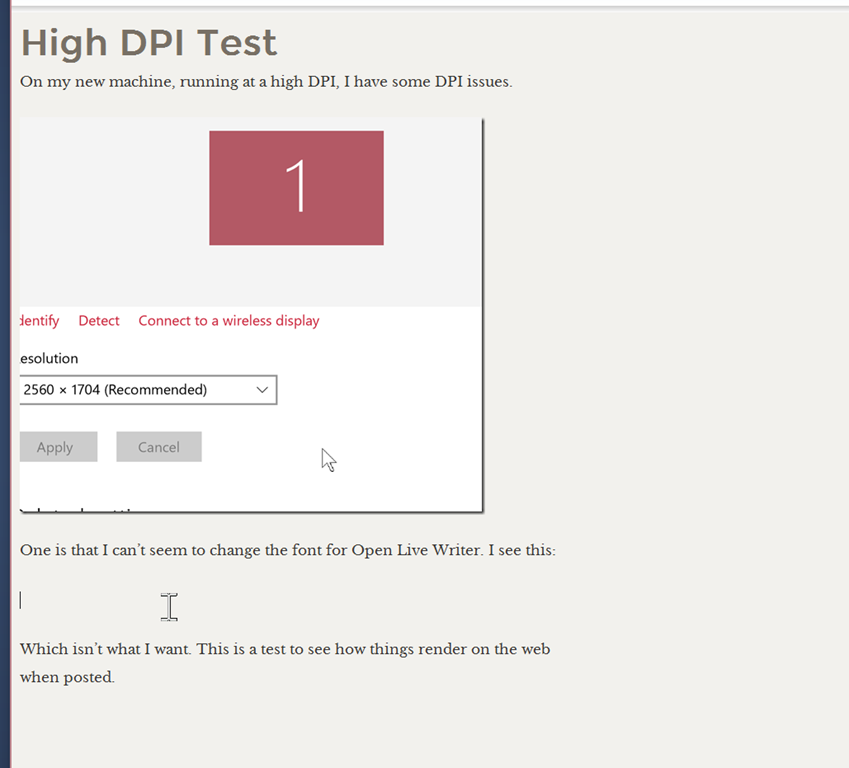
    On my new machine, running at a high DPI, I have some DPI issues.

    2016-03-17 11_52_25-Settings

    One is that I can’t seem to change the font for Open Live Writer. I see this:

    2016-03-17 11_52_56-High DPI Test - Open Live Writer

    Which isn’t what I want. This is a test to see how things render on the web when posted.

  • What Database am I in?

    Another post for me that is simple and hopefully serves as an example for people trying to get blogging as #SQLNewBloggers.

    I saw someone trying to get the database context recently and they were confused. They had some code referencing @dbname, but received an error with this code. I thought maybe they meant @@DBMAME, but when I looked, there isn’t a variable tracked by SQL Server.

    A quick search (really experimenting with SQL Prompt) showed me there is a DB_NAME() function. Without a parameter, this returns my current context. That’s useful in programming systems.

    If I pass in a database ID, I get the name.

    I haven’t typically had an issue here. In code, if I doubt anything, I issue a USE statement to set context, but if you are looking to take actions in a generic script based on the database, this can help.

  • The Matrix

    Do you want the red pill or the blue one?

    Many of us know the famous scene in The Matrix where Neo decides if he will come out of his dream. We also see the exciting moments in the movie where he has various martial arts downloaded to his brain, and discovers he “knows kung fu” in a small fraction of time. Certainly he doesn’t ever need to physically practice the art, but much of learning is comprehending and understanding a subject in our brains.

    We aren’t at the point of desiring a skill and purchasing a download. Yet. However there is research into using various types of stimulation to actually help improve learning and training. Using pilots and flight training, a complex and varied skill involving both physical coordination and mental understanding, the researchers think they can affect learning. Which is amazing.

    This is barely scratching the surface of learning directly in the brain, but it is interesting to see people researching the topic. After all, this is an area that ought to be of great interest to those of us working in technology, where the acquisition of new skills is important. Few of us do it well, and any improvement that could dramatically improve our capabilities to adapt and grow as technology rapidly advances, would be welcome.

    Unless it involves electrical shock potential. In that case, I’ll stick with my slow read-and-practice method for learning new skills.

    Steve Jones

    The Voice of the DBA Podcast

    Listen to the MP3 Audio ( 2.2MB) podcast or subscribe to the feed at iTunes and LibSyn. feed