Author: way0utwest

  • The Digital Woes of Public Records

    Researcher Chris Vickery, discovered that 191 million voter records are available to the public. The information was in a database on the Internet, which seemed to be a collection of voter records and information compiled from public sources in various US states. While no Social Security numbers were present, names and dates of birth, as well as address and voting scores were in the database.

    That’s scary, though potentially not a problem. A number of states publish voter data as public records. A few might have restrictions on the use of that data, but the fact that the data is available means it could be used maliciously, with overburdened authorities unlikely to prosecute anyone even if they’re caught.

    This is one of those areas where our understanding and control of data hasn’t caught up to the digital age. It is one thing when public data is available to those that must physically search for it, or even query for singleton records. However data can reveal much more information, or even be used in new ways when large volumes of it is available. Now the ability to access every voter’s name, address, and date of birth could potentially be a problem.

    I see so much data that we might have taken for granted in the past, thinking nothing of it’s visibility, being a problem in the future. When someone can gather large amounts of data, and store is cheaply, even accessible in something like a data lake, we may find that public data is problematic. When anyone can start to gather and combine lots of data from different sources, we might find that capability quite scary as potentially lots of information about individuals can be determined. We’ve seen anonymous data sets de-anonymized with the application merge of data from different sources.

    I truly hope that we find ways to better protect and ensure privacy in the future, as all the capabilities and power that computing brings to data analysis truly has a dark side.

    Steve Jones

    The Voice of the DBA Podcast

    Listen to the MP3 Audio ( 2.4MB) podcast or subscribe to the feed at iTunes and LibSyn.
  • Creating a User Without a Login

    Another post for me that is simple and hopefully serves as an example for people trying to get blogging as #SQLNewBloggers.

    This is one of those simple things that many people should be able to do in order to build in better security for their database code. However I’m sure many people haven’t ever built one. I ran into this recently, and thought it would be a great SQLNewBlogger post.

    Creating the User

    It’s a bit anticlimactic, but creating a user in a database without a login is simple:

    CREATE USER UpdateStatsUser
    WITHOUT LOGIN WITH DEFAULT_SCHEMA = [dbo];
    GO

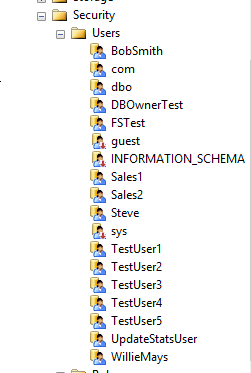
    This creates a new user in my database,

    2016-01-25 13_38_56-Start

    that is not associated wtih a login.

    2016-01-25 13_39_13-Netflix

    I can assign this user permissions, like any other user.

    GRANT CONTROL ON dbo.Authors TO UpdateStatsUser;

    I could then use these permissions any other way.

    Why would you do this?

    A short summary from Pinal Dave, which is pretty good. Essentially you want to give different permissions to a user, without using something like an Application Role, which has a name and password that must be managed. Here, you can allow a user to execute a routine as another, more privileged user, without giving the original user additional permissions.

    SQLNewBlogger

    This is a really simple post that took my longer to write than create the user. About 10 minutes. I wouldn’t expect most of you to stop here. I’d want a post that shows you understand something about how this user can be used, show me an example of reading or writing a table as a user with this impersonation in action.

    References

    CREATE USER – https://msdn.microsoft.com/en-us/library/ms173463.aspx

  • Culture and Performance

    Most people in management seem to believe that culture matters in a company. I know some don’t, and I’ve worked for a few of those people, whichi s never an enjoyable experience. As the world seems to change to more and more knowledge work for people in technology, it seems that businesses are starting to realize that the way their employees feel about the company can have a direct impact on the company’s bottom line.

    There’s an article about culture and motivation in the Harvard Business Review that I think does a good job of looking at how well people perform when they have various motivations. The authors talk about the six reasons why people work, each of which can drive motivation in a different way. Some are positive motivators, some are negative, and it’s good to be aware of the differences.

    This ties into culture in that the way your organization is built. The culture that pervades the company can really determine how employees are motivated. More negative motivators result in less performance, especially creative performance, from employees.

    I don’t think that building a great team and getting the most from people is necessarily this simple. Different people respond differently to a culture, and the same person might even respond differently at different times in their employment. However I do think that you can look to adjust the way you fit each employee in, with the work you assign, the support you give, and the demands that you make on them.

    The mark of a good manager is that they find ways to treat each employee differently, in a way that suits them best, while maintaining a core set of values and rules for the entire organization.

    Steve Jones

    The Voice of the DBA Podcast

    Listen to the MP3 Audio ( 2.0MB) podcast or subscribe to the feed at iTunes and LibSyn. feed

  • Who’s Got a Preteen SQL Server?

    This year we will have the end of extended support for SQL Server 2005. Microsoft has been reminding people they should upgrade, which may be important if your organization requires support for the running software. Personally I think if you’re still running SQL Server 2005, and it works for you, why upgrade?

    It’s been ten years since that version was released, and while it was a huge step forward with the SQL CLR, better mail, and more, it had plenty of issues. Since that time we’ve had 4 major releases with a fifth coming this year. All of those versions have built on the base of SQL Server 2005’s completely rewritten codebase and have improved many features.

    Recently I got a note from someone that noted that they have been upgrading their SQL 2005 systems over the last few years (along with SQL 2008 instances) and have made great progress. however they still have a few SQL 2005 instances that they are racing to upgrade. This person was wondering how many others are out there facing similar struggles.

    So this week I’m wondering. How many of you have those instances growing up and getting close to double digit ages? Are you working to upgrade SQL 2005 instances? Have you been thinking about those 2008 instances who are already out of mainstream support and will leave extended support in a few years?

    Let us know how you think about your aging database software.

    Steve Jones

    The Voice of the DBA Podcast

    Listen to the MP3 Audio ( 2.0MB) podcast or subscribe to the feed at iTunes and LibSyn.