Author: way0utwest

  • Maintaining High Performance When Using Encryption

    Summary: Encryption is becoming required in more and more environments, but implementing encryption can dramatically affect performance. Learn how you can maintain high performance while using encryption in your database.

    Abstract: Encryption is becoming required in more and more environments, but implementing encryption can dramatically affect performance. Learn how you can maintain high performance while still protecting your data with encryption. This session will examine communications, Transparent Data Encryption and a technique for using Symmetric Key encryption without a high performance penalty.

    Length: 75 minutes

    Slides: (coming soon)

    Code: (coming soon)

  • Speaking About Unstructured Data at SQL Saturday #287 – Madison

    I haven’t been to Wisconsin in a long time. Not since I was a little kid, going to visit family. However I’m heading up there next week for SQL Saturday #287 in Madison, WI. I’ll be speaking about unstructured data, basically Filestream and Filetable, giving a preview of the talk I’ll be doing at SQL Intersection in a few weeks.

    If unstructured data isn’t your thing, the schedule has a number of well known speakers coming for the event. Brent Ozar, Jes Borland, Bill Fellows, Joe Sack, Michelle Ufford, and many more covering all sorts of topics from SSIS to AlwaysOn to Powershell. You’ll have a chance to make some hard decisions during each time slow, trying to determine which sessions you’re willing to miss to see some other great presentations.

    There are also some great pre-cons available on Friday from David Klee (virtualization), Jes Borland and Ted Krueger (Tuning), and Dan English (BI). These are some of the most affordable all day training you’ll ever find, so take advantage if you can.

    If you’re anywhere in the area, which might mean almost anywhere from Minneapolis to Des Moines to Chicago, consider making the trek for a fun, informative day with the #sqlfamily. I hope to see you there.

  • How Many Passwords?

    How many user names and passwords do you have? If you’re like me, you have a lot of them. Actually I don’t have too many user names, sticking with “Steve Jones”, “sjones” or my well known “way0utwest” for my logins. However I do try to have as many passwords as I have logins. Using my Password Safe utility, I count 265 items in my personal safe and 176 in my business one. Some of those are old and dead, but quite a few of them I use on a regular basis.That’s similar to what Keith Combs notes in his blog post on IDs and passwords. He has 172, though I’m sure that number has crept up since he wrote the post. The piece links over to a few identity discussions from others at Microsoft that are trying to make identifying users and managing security easier. In the Microsoft world I think that works well, but the larger world outside of Microsoft software requires a bit more work for most of us.

    The original piece was written awhile back, and since that time, I’ve come to find that more and more of my logins are authorization links from one of the large companies (Microsoft, Google, Facebook, Twitter), with some sort of token that allows me to login. I have my Live account working on a number of Microsoft based services, but my Google account crossing their platform to Gravitar and StackExchange. My Twitter and Facebook accounts are linked to a few places, though I’m careful about which one of those I link to which application or service.
    Using passwords, moving to application links from a platform, and even now adding two factor authentication with a mobile phone makes me think that we are not necessarily finding a better way of managing authentication. Perhaps we are making things much more complex without creating any more security.

    I don’t know what the future will bring, but I suspect that many of our current methods of providing security will prove to be inadequate. I’m hoping that we find out on some services like Funny or Die or ESPN, and not because people find ways to jump from external applications to internal servers like Exchange or SQL Server.Steve Jones

    The Voice of the DBA Podcast

    Listen to the MP3 Audio ( 3.0MB) podcast or subscribe to the feed at iTunes and Mevio . feed

    The Voice of the DBA podcast features music by Everyday Jones. No relation, but I stumbled on to them and really like the music. Support this great duo at www.everydayjones.com.

  • Virtual Lab – The Domain

    This is part of my series on building a virtual lab for use with SQL Server and Windows. You can see the entire series here: Building a Virtual Lab with Hyper-V.

    The big thing in setting up a domain is to enable you to connect multiple machines together, experiment with things like Powershell Remoting, AlwaysOn, etc.

    There are a couple things you need to do here. The first is to install a domain controller on one of the VMs, and then you need to join the remaining computers to the domain. This isn’t that hard, and I’ll show you two ways to do this: the GUI and PoSh.

    Create a Domain Controller

    I followed instructions to build a domain from TheSQLPro, since that was the first, and simplest instruction I had. I connected to my ServerCore installation named DenverDC and ran this:

    Install-windowsfeature -name AD-Domain-Services

    Then

    Install-ADDSForest –DomainName “SSCLAB.LOCAL” -DomainMode Win2012 -DomainNetbiosName “SSCLAB” -ForestMode Win2012

    I entered both of these from Powershell and restarted the VM.  I then ran a

    Get-ADDomain

    and as you can see, I have a domain set up on this machine.

    ad

    Joining the Domain from the GUI

    The first step is to be sure that you have connectivity between your machine and the DC. I had to ensure I could ping back and forth, both by IP and computer name. I also made sure to set my DNS to the domain controller. In my case, this was the DenverDC at 192.168.1.200.

    Once I was fairly sure I had networking down, I went to the control panel on one of the machines. I went to the computer properties and clicked the "Change Settings" link.

    virtlab_af

    From there, I had the basic properties. As you can see below, I was in a workgroup. The first thing to do is click the "change" button.

    virtlab_ag

    Once that’s done, you have the workgroup/domain set of radio buttons. I clicked the domain item and entered the name of my domain.

    virtlab_ah

    You get a credential box where you need to enter credentials. I believe these are the DC level credentials. For this lab, I have the domain and local administrators all using the same user/password (Administrator/mypassword) and entered that.

    virtlab_ai

    If networking is working, it should take a minute and then you’ll get this:

    virtlab_aj

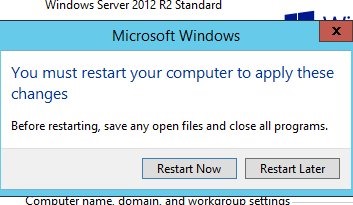
    As soon as you click OK, you’ll get told this requires a reboot. It does, so restart.
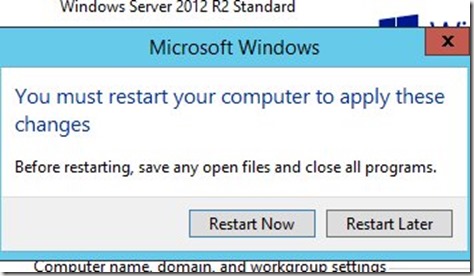
    virtlab_ak

    Once you restart, if you go back, you should see that you are in the domain in the computer properties.

    virtlab_al

    Joining from Powershell

    I found this cmdlet that worked for me.

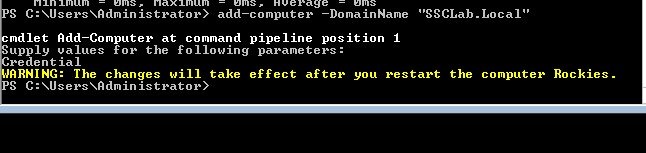
    Add-Computer -DomainName "SSCLab.Local"

    Once I typed this in, I got a dialog box asking me to enter the administrator credentials. I did that and it worked. I had to reboot with a restart-computer.

    virtlab_an

    And we’re working

    virtlab_ao

    Errors

    I did get an error on one of my VMs. It was error 0x21C4 on a Server Core installation. When I looked that up, I got a duplicate SID error. I had sysprep’d the machines, but perhaps I broke something. In any case, I re-ran sysprep, reset the network config, renamed the computer, and then joined the domain as noted above.