Author: way0utwest

  • It’s not the platform

    I agree with Brent. Actually, I’ve felt this way for years when I’ve been asked the SQL Server v Oracle question, or even earlier in my career when I was asked about Windows v Unix. The choice doesn’t matter that much and it’s not really the platform; it’s the people.

    Oracle is often seen as the top platform in our industry for handling relational data, but if you give a copy of Oracle 12C to many of the SQL Server staffs that read this newsletter, and it likely won’t scale too well. At least not until they learn a bit about how the platform works. The same is true of SQL Server, which is often given to many under-trained and under-qualified people with the idea that they’ll just make it work.

    We should all be aware that while platforms can be expensive, they really pale in comparison to the cost of the people that will build software on the platform. You certainly might save money with a cheaper platform if you’re buying software, but don’t forget that additional platforms do need additional training for your staff. As I told a friend recently, anyone can setup SQL Server and get it to run. Until it doesn’t.

    Education and investment in knowledge is one of the most important areas that technologies and their employers can spend time and money on. However, it takes both of them working together to ensure it pays off.

    Steve Jones

    Video and Audio versions

    Today’s podcast features music by Everyday Jones. No relation, but I stumbled on to them and really like the music. Support this great duo at www.everydayjones.com.

    Follow Steve Jones on Twitter to find links and database related items and announcements.
    Steve Jones Windows Media Video ( 13.1MB) feedMP4 iPod Video ( 15.5MB) feed

    MP3 Audio ( 3.3MB) feed

    Feeds are available at iTunes and Mevio

    To submit an article, rant or editorial,
    log in to the Contribution Center

  • Merry Christmas and Happy Holidays

    No matter what you celebrate today, I hope you have a wonderful day.

  • How Do You Find a DBA?

    This editorial was originally published on May 11, 2009. It is being re-run as Steve is on vacation.

    You’d think it would be easy, but I saw this post about looking for a DBA and I can certainly appreciate the problem. I’ve been in the situation of looking for someone to hire and getting hundreds of resumes for a position. In that case, I hate to say it, but I’ve sometimes only looked at the first 40 or 50 resumes I receive, sending the rest to a circular file. That’s not the way to find the “best” person for the job, whatever that means, but it certainly means that the early bird has a chance at the worm.

    But where is a good place to look? That really depends on where DBAs go to look for jobs, so where do you look?

    In the past, when I was looking for a job, I used Monster and Dice, getting slightly different results from each. There were a few other sites I tried, but I’m not sure that any of these other sites do a better job of listing jobs. Since you need to have a lot of jobs and traffic to be useful, the larger the site the better. Also it seems that many consulting companies or recruiters post jobs to multiple sites (usually Monster and Dice), so I’m not sure you can find more jobs on any one site over another.

    Today, however, I think I’d take a different approach to looking for a job, using the people I know, or my network, to see what’s available. If I were hiring someone, I think I’d do the same thing. I posted in the thread that using your local user group, the people you know, contacts on LinkedIn, Facebook, etc. to post the job and let those people pre-filter for you, might be the best solution.

    Hiring someone and finding a good employee is a hit and miss affair. I’m sure most people wish they had a better process, and a better way to evaluate someone’s skills. I think by looking for recommendations from people, people that you will see again, you have a better chance of finding someone that fits the position.

    Steve Jones


    The Voice of the DBA Podcasts

    Everyday Jones

    The podcast feeds are available atsqlservercentral.mevio.com. Comments are definitely appreciated and wanted, and you can get feeds from there.

    You can also follow Steve Jones on Twitter:

    Overall RSS Feed:  or now on iTunes! 

    Today’s podcast features music by Everyday Jones. No relation, but I stumbled on to them and really like the music. Support this great duo at www.everydayjones.com.

  • Quick Tips – SQL Prompt with SSF

    I love SQL Prompt, and think it’s a great productivity tool. Even before I worked at Red Gate, I love the tool and had a copy before Red Gate bought the technology from the original developer. Recently I’ve run into a few people that weren’t aware of some of the ways in which it can help you. This is a quick look at one of the ways I use SQL Prompt.

    SSF

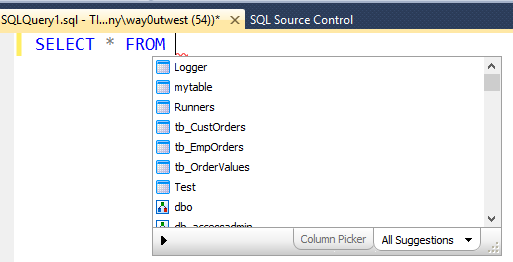
    I probably type SSF more than any other character combination in SMSS. With SQL Prompt installed, I usually quickly type “SSF” and hit “tab” and get this:

    ssf1


    SQL Prompt has expanded my “SSF” into “Select * From” and then popped up a list of tables in this database. I could down arrow to select one, or use the cursor, or start typing.

    This is a quick way to get data from a table back to your SSMS client without worrying about the columns or rows you need from a table. I use this constantly, though I’ve edited this command to return the top 10 rows only. Here’s how I do that:

    Snippet Manager

    There’s a dialog for managing these snippets of code, called the Snippet Manager. You can access that from the SQL Prompt menu

    ssf2

    Once you select this, you get a dialog that shows all the snippets installed on your system. I scrolled down to the “SSF” snippet that I often use.


    ssf3

    If I click the Edit button, then I get a small editor where I can paste in code or edit what’s there. In this case, I add the “TOP 10” keywords, and I also reformat the code slightly. I like my code formatted, so I ensure it’s formatted here.


    ssf4

    Once that’s done, I click “Save” and then “close” for the Snippet Manager. Then the next time I type “SSF” and tab, I get this:


    ssf5


    Note that there is an st100 snippet that does the same thing I edited with 100 rows, but I find ssf easier to type, so I just edit this snippet.

    I’d encourage you to play around with snippets, and also adopt this in your daily work. If you don’t have a copy of SQL Prompt, download the evaluation and I’m sure you’ll realize it’s worth the cost of the tool in time savings quickly.