Author: way0utwest

  • Interesting Culture

    A post from Alex Maccaw, programmer at Stripe. He talks about some things he likes about the company, and overall I think there are good ideas in here. In fact, a number of them remind me of my time at IQDestination (my thoughts), and some remind me of things that I think the Investment Advisory Network failed to do.

    I don’t agree with everything, and I think the cc to email lists, while a good tracking tool, can get people to drop into the rabbit hole and get lost. If you have good people, you trust them not to do that, but it will happen sometimes.

    I really like a couple things.

    1. The dream machine.

    2. Paper reading

    I think the first welcomes the employee into the company and gets them highly motivated and appreciative from the start. The second is a good way to build the habit of learning.

  • More CPU Means More Data


    sailors
    Better modeling requires more CPU and a lot more data.

    Moore’s law has held true for computer resources for a long time. I don’t know how long it will continue to work in the future, but I am interested to see if it can continue to work for the rest of my career. I don’t know that it will, with our newer CPU designs approaching the limits of physics, but I’m sure that research is under way to find ways to vastly improve our processing capabilities. Look how far we’ve come from the Apollo guidance computer, which landed 3 men on the moon, and had a fraction of the power of almost all of today’s cell phones.

    I ran across an article that talked about modeling sailing conditions to help sailors design faster and more stable boats. Just like many other types of modeling, this is a way to use computer simulations of various real world events to test designs of new products. This can save lots of time and money as fewer prototypes can be built and many more design ideas can be tested before a final design is chosen. More intensive modeling means more processing power is needed, but it also means more data is needed.

    We see this more and more in business. We want to get answers faster, often by running more complex business simulations. To get our answers faster we need more processing power. However as we upgrade our machines and enhance our CPUs, we also add more and more data to our databases. The additional data, while beneficial to making better decisions, also slows down our queries. The additional data is also a challenge to load, manage, and store, which is something we need to ensure we are learning to do better.

    Processing costs are going lower and lower. These days with the large clusters in the cloud that anyone can rent for a few thousand dollars, extremely complex simulations can be run. The code to run them, however, is still something that we need to produce. Just as the scientists  have developed complex models that accurately test new designs, each of us must learn how we can write more efficient queries that analyze our business data and take advantage of the constant improvement we see in processing capabilities. Otherwise the advances in CPU power might be negated by rapid data growth.

    Steve Jones


    The Voice of the DBA Podcasts

    We publish three versions of the podcast each day for you to enjoy.

  • Finding DDL Triggers

    Triggers are the types of objects in SQL Server that are easy to lose track of. There isn’t an obvious way to tell that a table has a trigger on it and since most tables don’t have triggers, this is one of the things people often miss when troubleshooting unexpected results.

    DDL triggers are worse, since they aren’t tied to particular tables, but rather events. How can you find DDL triggers in your environment?

    There are a few ways. I’ll show you visually and in code.

    The GUI

    I like the Management Studio GUI to find information, and to quickly get code written. With SQL Prompt installed, I can get great intellisense that makes it easy to find parameters, names, objects, etc. I don’t like to run the actions from SSMS, but rather use the Script button and save the code, and execute it in a query window.

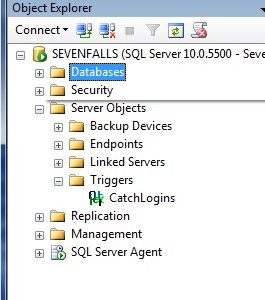
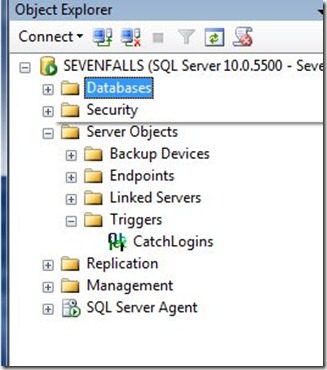
    In looking for server-side triggers, there is a “Server Objects” folder in the tree.
    ddl3

    Here is where you find your backup devices, endpoints, linked servers, and server level triggers. In this case, I can expand the folder (shown above) and find the trigger I created recently.

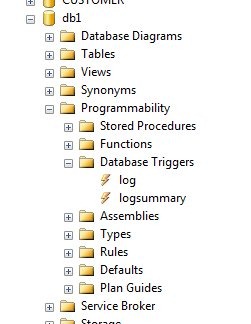
    At the database level, there’s a similar structure. Inside of a database, we find there is a programmability folder, which contains all the code items I can create in a database.

    ddl4

    In here we can see there is a Database Triggers item, and inside there are two triggers that I setup inside this database.

    You have to go look for these triggers, but if you’re wondering if they exist, you can find them here.

    Code

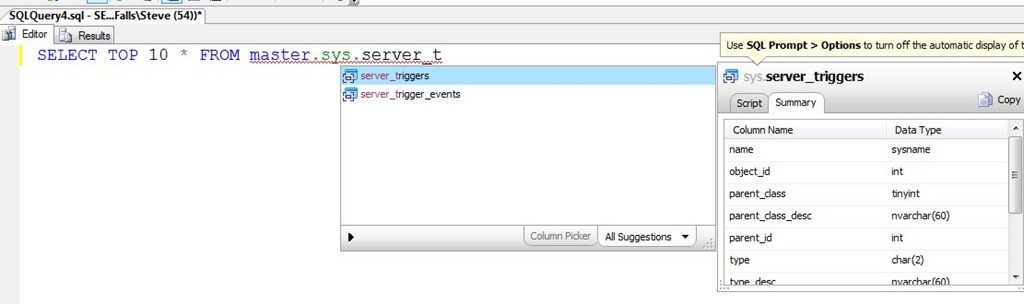
    The best way to look for triggers quickly is with code. Without resorting to BOL, I suspected there was some DMV that contained trigger code. As you can see below, I was right as typing SSF (a shortcut in Prompt), followed by “master.sys.server_t” got me this result:

    ddl5

    If I then examine the results from the server_triggers table, I get my one trigger at the server level.
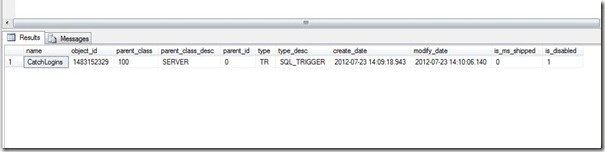
    ddl6

    This is only part of the information needed as the server_trigger_events table has the events that will fire this trigger. I can query that to see I only have one event here:

    ddl7

    If I join in the events, then I can clean this up and get this:

    select
      t.name
    , t.object_id
    , t.is_disabled
    , te.type_desc
     FROM master.sys.server_triggers t
       INNER JOIN master.sys.server_trigger_events te
         ON t.object_id = te.object_id

    Which shows me the trigger, its ID, and the event’s.

    ddl8

  • Labor Day Bloopers

    The raw footage of all the mistakes I’ve made since the Fourth of July.

    Part 1

    Part 2