Author: way0utwest

  • Turning 40

    I turned 40 a few years back, and it wasn’t that big a deal for me. In some ways my wife thinks I’m a little old for my age, and when I hit 40, it wasn’t the milestone it is for some people. I think the night I turned 40 I was at a Cub Scout meeting with my son, delaying a sedate, quiet family dinner for a day or two because of that commitment.

    Last week I was in Cambridge, at the Red Gate offices.

    English phone boxes
    Not in Kansas (or Colorado) anymore.

    Every year I go over once for twice for meetings with my team at Red Gate where we brainstorm, do some evaluation on where we are, and look forward to the future. Most of my time is away from the office, but I do spend a little time at our building (Red Gate has a building!!) and say hi to a few friends.

    On Thursday morning, I was there for a surprise, and a rare event. The entire company, some 200 odd people gathered in the first floor (floor zero for you non-American, counting-building-floor-challenged people), with everyone in a Red Gate shirt.

    Red Gaters wearing red shirts
    A sea of red

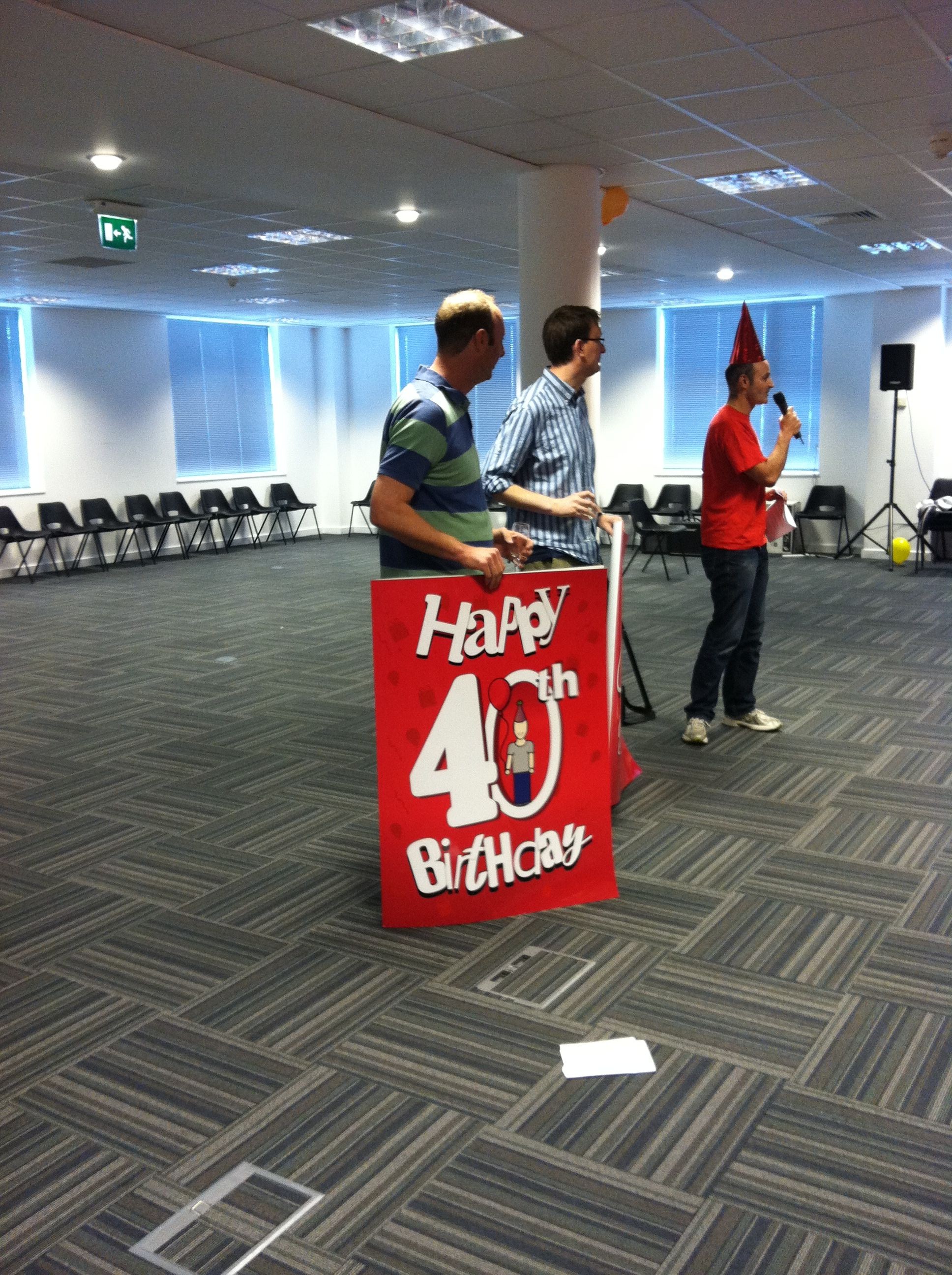
    The two founders of Red Gate, our co-CEOs, Neil Davidson and Simon Galbraith, both were turning 40 within a few weeks of each other. A few people in the company had organized a celebration with sweets

    This was less than half of the treats available.

    cards

    Large 40th Birthday cards signed by everyone.

    and a large rendition of Happy Birthday from the employees.

    It was quite a celebration, with a funny “roast” speech given by one employee, a video Happy Birthday tribute, and even a parody of “Never Gonna Give You Up” from the Red Gate Chorus group.

    A nice break in the day, and quite a celebration. Simon and Neil have built something rather amazing at Red Gate. It’s the kind of company I’d want to build if I every started another venture. Successful, hard working, respectful, fun, and very supporting of employees.

  • Social Media and Interviews

    Will You Get Fired Because of Facebook?
    Too much time on Facebook during work is a bad idea

    When I first saw this story, I was a bit disturbed. In an interview, for a statistician, the candidate was asked for his Facebook username and password. The interviewer wanted to view non-public parts of the candidate’s profile on Facebook, and the candidate refused and withdrew his job application. I’ve heard of this in the past, with the city of Bozeman asking for credentials, but it appears the practice is growing. College athletes are asked to “friend” coaching staff, and some public sector workers must connect with their superiors.

    If I were asked in an interview, I would politely decline and state that I have set up privacy for a reason. There are things I post to share with friends and family that are not meant to be available for the general public. In my mind, these are akin to photo albums or letters I’ve written that I store in my house. Anything that I post publicly I take responsibility for, but private posts are private. I would suggest you do the same.

    On one hand companies are free to ask and candidates are free to decline, and that’s the free market. At some point, however, if all companies were to ask for this, employees would essentially have no choice but to comply, which feels like an intrusion into employee’s lives at a higher level than I feel should be allowed. It strikes me as a little too 1984-ish for my own comfort.

    Part of the problem is that the laws we’ve written for the real world frame the way we interact. Those laws, however, don’t necessarily translate and apply to the digital world, which means that we struggle to apply them in this new frame of reference. I think that we also aren’t always sure exactly how we would want to have our privacy or rights preserved in the digital world, and all too often we have companies, and criminals, taking advantage of that fact.

    I suggest everyone make an effort to separate your public and professional posts and profile online. Point employers to a professional profile, and let them know this what they should expect from you at work. Your personal thoughts and ideas are separate, and you’ll keep them that way at work, just as you do in the digital world.

    Steve Jones


    The Voice of the DBA Podcasts

    We publish three versions of the podcast each day for you to enjoy.

  • Small Management

    Steve on a horse
    I’m on a horse

    This editorial was originally published on June 21, 2007. It is being republished as Steve is traveling.

    I saw this article on server management from a handheld and it’s always seen like something that’s very cool and handy, but I’ve almost never been in a situation where I really needed to manage my server while stopped on the side of the road or eating dinner. There’s times I got called away from something to go into work, but usually it’s not something I think I could have solved, or even wanted to solve, on a 320×240 screen.

    But recently while I was at TechEd, I saw some really cool new handheld devices. The capabilities of handheld devices, usually PDAs converged into phones, is really amazing. So I wanted to know:

    How many of you can, or would, manage your servers from a handheld?

    I’ve never had a phone with a keyboard, like a Blackberry. I’ve been a candy-bay Nokia guy for a long time, though my updated Startac, errr Razr, adorns my belt these days. Not by choice, but for another 6 or 7 months I’m stuck with it.

    Years ago I also had a small form factor laptop to test for my boss. It was aCasio Cassiopeia A-10, and it ran CE and limited applications (this was circa 1997). I run pcAnywhere on it and actually logged into a workstation at work and tried to manage our SQL Server and other applications. It didn’t work, at least not without frustration. Granted that was over dial-up, but it was way worse than my laptop because of the small form factor.

    Recently I saw APC giving a self-guided tour of their new racks using PDAs. You could pick up a Dell Axim, click a button to start the video or move to the next section, and watch the tour while you walked around the rack. With headphones you could get the sales pitch and pause or move forward as you wanted. And it actually worked pretty well.

    That’s not quite typing in a T-SQL command and I’m not sure how difficult it would be to try and navigate SSMS thorough a Terminal Services screen, but it gave me some hope that it might be something I’d try down the road.

    So let me know if you think it’s something you might do.

  • Social Data Analysis

    Tufte Poster
    A great visualization from an Edward Tufte seminar.

    Today we have an editorial originally published on June 24, 2007. It is being republished as Steve is traveling.

    I haven’t been a big proponent of BI as a technology that I think will catch on and become the focal point for many businesses. It’s not that it doesn’t work, but it’s expensive, it’s complex, and it requires a long term investment. While I’m not sure what to do about the last two with today’s IT folks and executive management, I do know that Microsoft and others are helping with the first one. So when I was this item about social data analysis using a new tool from IBM, I became a little intrigued. It’s an interesting idea for the amateur BI person that may be looking for an easy way to examine their data. It’s certainly better from the manual calculations I did in Economics to do regression analysis of data. We often didn’t even have graphics. That is if you don’t count my pencil and graph paper.

    This is a good outgrowth of the open source ideas of programming. It’s often said that many eyes on a program in the community model, produce a better piece of software. After all, developers work harder if they know hundreds or thousands of people will look through their code and more bugs are likely to be found because more people are working on the problem. I think that’s what IBM is trying to do here: get many people to examine data.

    While the sample visualizations tend to look like something just thrown together by people, I can see as graduate students, government officials, and others looking at lots of public data, and data that doesn’t necessarily need to be secure, you could possibly get some real help on problems.

    And maybe the most important thing, this gets a lot of people using the same tools. From what I’ve seen of many BI tools, they’re expensive and there are lot of choices, so trying to facilitate a wide reaching data analysis program could be hard, even among universities, each of whom might have their own software.

    While I’m not sure about BI catching on as a mainstream, every company has it, technology, I do think it’s very cool and it’s application to a wide range of problems is likely to give us some new solutions.