Author: way0utwest

  • SQL Server 2012 Beta Exams

    I signed up for a few of the SQL Server 2012 Beta certification exams, and have been going through them over the last few days. The exams I signed up for are:

    I took the first one on Monday, and the second on Wednesday. I have the other two scheduled for Friday and next Wednesday.

    I can’t really comment on what was in the exam, but I did see some evolutions of the testing software, which was nice. I like a few of the changes, and they should help people demonstrate a few more skills than the old multiple-guess exams. There are still multiple choice questions, but some new ways to ask someone to show knowledge.

    I’m not really worried about being certified, but I do like to see how the certification process works, I might write some stuff to help people (I’ve worked on three cert books in the past) and most importantly, I get a rough idea of what I know on the exams. They’ll ask me a few things I might not have looked at in depth, and I certainly found a few holes in my knowledge over the last few exams.

    If you have the chance to take a beta, I’d encourage you. They’re free, and the time they take can be a valuable aid in helping plan your future learning.
  • Using 2008 Features in a 2000 Compatibility Database

    I saw a note recently from someone asking if they could use CROSS APPLY on a SQL Server 2008 instance with an older database in SQL 2000 compatibility mode. You can.

    CREATE DATABASE sql2kCompat
    ;
    go
    ALTER DATABASE SQL2KCompat 
      SET COMPATIBILITY_LEVEL = 80
    ;
    go

    Once I have a database, I can access any of the newer views and DMVs. For example:

    USE SQL2KCompat
    ;
    go
    SELECT 
     * 
      FROM sys.dm_database_encryption_keys
    ;
    go
    

    This doesn’t return anything because I don’t have keys, but I do get the headers. Now let’s add some data.

    CREATE TABLE [Department](
       [DepartmentID] [int] NOT NULL PRIMARY KEY,
       [Name] VARCHAR(250) NOT NULL,
    )
    ;
    GO
    INSERT [Department] ([DepartmentID], [Name]) 
     VALUES (1, N'Engineering')
    ;
    INSERT [Department] ([DepartmentID], [Name]) 
     VALUES (2, N'Administration')
    ;
    INSERT [Department] ([DepartmentID], [Name]) 
     VALUES (3, N'Sales')
    , (4, N'Marketing')
    , (5, N'Finance')
    ;
    GO
    CREATE TABLE [Employee](
       [EmployeeID] [int] NOT NULL PRIMARY KEY,
       [FirstName] VARCHAR(250) NOT NULL,
       [LastName] VARCHAR(250) NOT NULL,
       [DepartmentID] [int] NOT NULL REFERENCES [Department](DepartmentID),
    )
    ;
    GO
    INSERT [Employee] ([EmployeeID], [FirstName], [LastName], [DepartmentID])
     VALUES (1, N'Orlando', N'Gee', 1 )
    ;
    INSERT [Employee] ([EmployeeID], [FirstName], [LastName], [DepartmentID])
     VALUES (2, N'Keith', N'Harris', 2 )
    ;
    INSERT [Employee] ([EmployeeID], [FirstName], [LastName], [DepartmentID])
     VALUES (3, N'Donna', N'Carreras', 3 )
    ;
    INSERT [Employee] ([EmployeeID], [FirstName], [LastName], [DepartmentID])
     VALUES (4, N'Janet', N'Gates', 3 ) 
    ;
    go

    I create a few objects, which are standard, but notice the third insert statement for the Department table. It uses the new insert syntax for multiple rows in one statement. That’s not legal in SQL Server 2000, but it works here.

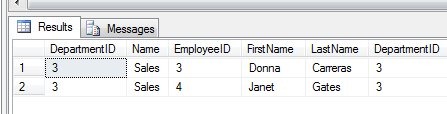
    Now I can use CROSS APPLY

    SELECT * FROM Department D
     CROSS APPLY
       (
       SELECT * FROM Employee E
       WHERE E.DepartmentID = D.DepartmentID
       ) A
    ;
    GO

    This returns me results, just as it does in a SQL Server 2008 database.

    compat1

    It appears that SQL 2008 functions work, which is what I’d hope would happen. However for the purposes of backwards compatibility, the functions that are from SQL Server 2000, should work as expected in SQL Server 2000.

    The thing to be aware of is something that wasn’t legal in SQL Server 2000

    SELECT
      q.sql_handle 
    , t.text 
     FROM sys.dm_exec_query_stats AS q
      CROSS APPLY sys.dm_exec_sql_text(qs.sql_handle) AS t

    you get an error. Passing a column into a function wasn’t allowed in SQL Server 2000, so this is a problem.

    And a little cleanup

    USE MASTER
    ;
    GO
    DROP DATABASE SQL2KCompat
    ;
    go
  • My Little Friend

    Say hello to my little friend:

    script button
    I love this button!

    This button is my favorite part of Management Studio. It’s on every dialog that I’ve seen in the 2012 version of the tool and I’ve begun using it quite liberally. At a recent talk, I told the audience that they should never click “OK” in SSMS again, and should instead click script and then cancel whenever they were making changes.

    Someone asked me why, and I had a few reasons, all of which seem to me good reasons to make use of my little friend. First it’s easy, Apple/iOS easy. When things aren’t easy, we tend not to do them, but clicking “script” is painless, it doesn’t interrupt you, and it produces the script you need in a new query window. That alone ought to be a good reason to use it.

    However there are other reasons as well. It’s a chance to see the exact code being run and making sure it’s what you want. If you aren’t sure, and you shouldn’t be running code without understanding it, this is a good way to learn. It’s also a great logging tool. One of the things that has made me successful as a DBA over the years is documenting what I do. Many of my colleagues haven’t done this and then spent hours trying to determine what changed on a particular system. If I script out the code I run, I have something I can easily drop into a log for future reference.

    To me, this is one of the tools that should improve the knowledge of SQL Server professionals everywhere, by increasing their awareness and knowledge of what’s happening on their instances. I’d be happier if the “OK” button would just produce the script and never run it, but I’m not sure we’ll get Microsoft to agree to that change.

    Now if I only had a “Powershell script” button right next to it…..

    Steve Jones


    The Voice of the DBA Podcasts

    We publish three versions of the podcast each day for you to enjoy.

  • Too Many Bricks, Too Much Data

    Bricks
    Too many bricks are hard to keep straight

    At one point in my career I was working on a new application and we were debating about storing certain metrics related to the application usage and customer’s behavior. My boss asked for my opinion and I said that more data was better than less and we could always delete the data if we found it was not being used.

    However we rarely delete data. We seem loathe to remove old data, even when we find it’s slowing down our systems. Worse still, there aren’t great methods for even stripping out, and preserving older data other than custom work in each system. I ran across a piece that talks about the tremendous amount of data that we are constantly acquiring, a deluge that overwhelms us in so many scientific areas. There are some endeavors collecting so much data that they must restore to storing data in networked systems, making the data sets available only through software that can combine the information from various databases.

    In the corporate world of data we usually don’t deal with such large amounts of data, but we are often dealing with hardware that constrains our ability to work effectively with the data we have. We find that our disparate systems are spread across so many places that it can become hard to aggregate the bits together and extract information.

    I do think that we will start to feel the stresses of dealing with so much data and finding the meaningful information from it. The people that learn to do this well, and filter their bits effectively will become very valuable to their companies in the future.

    Steve Jones


    The Voice of the DBA Podcasts

    We publish three versions of the podcast each day for you to enjoy.