Author: way0utwest

  • The Code Review Checklist

    Early in my career as a developer, I was required to follow a formal process to get the code I’d written deployed to production environments. Each time I’d written code, I had to document what I’d tested and then print out the relevant sections of the codebase. I needed to find two other developers to spend 10-15 minutes with me in a meeting, going over my code, each of us with our own paper copy. Almost like a dissertation, I had to answer questions and defend my work, with problems being marked on paper for me to go fix.

    Over time, I learned that different developers reviewed code in different ways. Some spent more time on standards and formatting. Naming and the visual structure were more important to them, so if I wasn’t confident in my work, I’d pick them and spend time ensuring the formatting was correct. Or sometimes, I’d mis-format it, so they would tell me to go fix that and not look at what the code actually did. Others were better at examining algorithms, and I often used them to help me learn, with them digging into my logic and helping me understand whether I’d included enough error handling, considered edge cases, or written code that performed well.

    Often the mood I was in, and the pressure to meet a deadline might have me leaning one way or the other. Of course, there were plenty of times I just had to go with whichever two developers had time to review the code.

    There was an inconsistency in code reviews, and I breathed a sigh of relief in future jobs where we didn’t formally review code. In fact, in quite a few positions where I wrote C++, VB, or FoxPro/Clipper, my code was never reviewed, nor was there formal testing. Other developers and I often had to rework sections of code regularly, which led me to implement better testing of my own code. I didn’t adopt formal frameworks for some time, but I did save off test scripts for code in our Visual SourceSafe repository to ensure I could test code.

    These days pull requests and code reviews are commonplace, at least among many software developers. Not so much in the database world, but I do find customers that believe in testing and I regularly preach this to others. I’m also glad that Redgate has built-in static code analysis and linting into its products, though I wish we had better (and easier) unit testing support for database code.

    For those of you out there writing code, do you go through any sort of code review process? Is it consistent? Is there a checklist of sorts? I have found that different people have their own internal checklists, but I rarely see anyone with a more formal checklist, or even a set of lists for what to check in different types of code. Even in unit testing, I don’t often see people approaching their tests in a methodical manner.

    Checklists have been shown to be beneficial in the healthcare field where staffers are overworked and handoffs are frequent. Using a set of checklists can improve patient outcomes. I suspect that a good set of checks for code might do the same thing. However, I find that a lot of database developers are reluctant to adopt any formal testing practices.

    A view that reminds me of .NET and Java developers in the early 2000s.

    Do you have a checklist (actual or mental) that you go through for your own code? For anyone else’s code? Or do you think formal testing of SQL code is even worth the effort. Let me know today.

    Steve Jones

    Listen to the podcast at Libsyn, Spotify, or iTunes.
  • SQL Saturday Boston 2023 Slide Decks

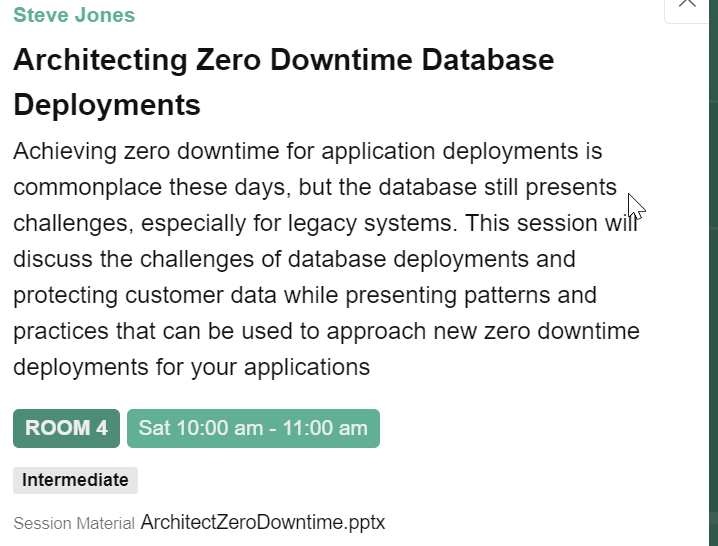
    Thanks to everyone who came to my sessions at SQL Saturday Boston 2023. I’ve added the decks to the schedule, so you can click my session and will see the download there. You can see this below, and all speakers can edit their sessions and upload the deck. See the download below:

    2023-10-14 13_43_08-SQL Saturday Boston 2023 (#1046)

    I’ve also copied the links here for slides:

    For the first session, Architecting Zero Downtime Database Deployments, there is also a GitHub repo here. Clone the repo down (or fork) and you can follow the sessions along. The repo is at: https://github.com/way0utwest/ZeroDowntime

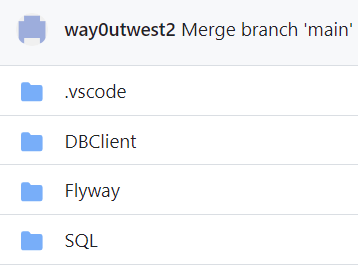
    In here, there are a few folders, as shown here:

    2023-10-14 13_45_44-way0utwest_ZeroDowntime_ Code for my zero downtime presentation

    The two items from the session are the DBClient, which is a Visual Studio 2019 project, and the SQL folder, which has all the setup (and teardown code). Each script is numbered, and you can run them in order. There are also some comments in each for when to flip feature flags.

    If you find issues, please submit an issue in the repo.

  • A New Word: Harmonoia

    harmonoia – n. an itchy sense of dread when life feels just a hint too peaceful – when everyone seems to get along suspiciously well, with an eerie stillness that makes you want to brace for the inevitable collapse, or burn it down yourself.

    I don’t want to burn things down, but I do like a little chaos in my life. I struggle to sit still and when things go too well, I worry about what will go wrong.

    It’s funny, but so much goes well in my life. I find great weather traveling, I get upgraded on flights or in hotels, events go smoothly, it’s somewhat amazing. I stop and think about this and appreciate the things that go well.

    However, sometimes life has gone a bit too well and I do think that something bad, or relatively bad, is likely to happen. I have no good reason, but I think harmonoia is something many people feel and it’s a good combination of harmony and paranoia.

    From the Dictionary of Obscure Sorrows

  • You Always Have a Software Pipeline

    I was working with a customer recently and they said they didn’t want to set up a pipeline. Somehow they wanted magically to see changes that developers made to their database appear in their production database without making any effort to build or configure a pipeline in a tool like Octopus Deploy.

    As I was thinking about how to find them a solution they would accept, I realized that I’ve always had a pipeline for software. Early on, this was a copy of all the files in a folder sent to the client for Clipper and dBase apps. Later, my pipeline was copying around all the VB6 files from a .zip file and executing a few SQL scripts that were sent to me in emails.

    At one point, I had developers just tell me the software pipeline was them copying files to a server while I had to move all the changes from the QA server to production. I didn’t like that one for two reasons. One was that the developers would sometimes forget to move a change from dev to QA, despite claiming they’d tested the application. Two was that the developers sometimes moved too much to QA, and had changes to the schema that they hadn’t finished in their app. SQL Compare couldn’t help me in either of those cases.

    Over the years, I learned that a slightly thought-out pipeline is better than nothing. I wrote my scripts to simulate what Flyway does today, executing the scripts I’d placed in a folder. I added logging that would capture output results and save them for later review. I learned how tools such as Team City or Jenkins could execute the same thing I could but in a more repeatable, reliable manner. After all, my reliability at 4:55 p.m. on Friday isn’t as good as it is at 2 pm on a Tuesday.

    DevOps is about learning and taking advantage of tooling. Look at what works in your pipeline and find repeatable, reliable ways of accomplishing those tasks without humans doing more than clicking a button to approve something. It’s about using your creativity to improve the process and codifying it in a way. It’s about being better than we were last week while ensuring the process isn’t dependent on any particular person. After all, I might leave for vacation.

    Or find another job.

    Steve Jones

    Listen to the podcast at Libsyn, Spotify, or iTunes.