Author: way0utwest

  • The Survivors

    The last year has seen a number of large tech companies lay off large numbers of staff. The list for 2023 includes large companies, like Google (12,000), Amazon (9,000 this time), Microsoft (10,000), and Meta (10,000 this time), but also small companies like Zoom (1,300), Rapid (115), and Roku (200). It’s not just tech companies, however, as Disney (7,000), Gap (500), 3M (6,000), and David’s Bridal (9,236) are letting people go. There are plenty of other companies who have let people go, which is interesting to me as the economy has grown in the US, though profits were down. It’s hard to know whether these layoffs are really important for all these companies or whether these layoffs are management’s decision to group their bad news with everyone else’s and take advantage of the opportunity to shrink labor costs.

    In any case, layoffs are sad and stressful. Certainly, the people being let go are traumatized and I don’t want to minimize the impact to their lives, but this can be hard for the survivors as well. This isn’t just a Silicon Valley situation, but one that affects many employees all over the world. Whenever there is a large staffing change in an organization, those that remain can be traumatized and unproductive. This is one reason that public companies must notify and disclose layoffs to investors.

    This article looks at how some tech company employees react after surviving a layoff, and it reminds me of some of the layoffs I’ve been through. While I haven’t been let go in a layoff, I have had to deal with the aftermath of some friends losing their employment while other friends try to cope. I’ve felt sad, angry, upset, concerned, frustrated, and more. Even as one of the lucky people that kept their jobs, I found myself unable to cope with the changes on the fateful day and for some time after. I struggled to focus during the next few weeks, while also being stressed as I realized the workload grew unexpectedly. There was still lots of work, but less staff to do it.

    Anytime you survive a layoff, I think it’s natural to question whether you want to continue working in the same organization. Is business that bad that we need to let people go? Will there be another layoff? Is our leadership actually doing a good job or have they made mistakes by hiring unnecessary people? Am I unnecessary? Are managers appeasing investors who care more about their return or even worried about their own bonuses? All of these thoughts swirl through my head and others’ heads as we move forward. I don’t want you to feel bad here, but to think about your situation as someone that might get laid off or survive one.

    Most of us don’t experience layoffs, and if we do, it’s not often that these happen. However, they are always possible, which is why I advocate for all of you to keep learning, regularly grow your skills, keep your resume up to date, and be aware of how your organization is operating. It’s good to work as if you’ll continue in this position (if you enjoy it), but my motto is: hope for the best, plan for the worst.

    Of course, if you don’t like your job, you should be working to find another one. The best time to find a new job is while you already have one.

    Steve Jones

    Listen to the podcast at Libsyn, Stitcher, Spotify, or iTunes.
  • Why Learn PostgreSQL?

    At Redgate, we’ve spent a lot of time adding PostgreSQL functionality to our DevOps tools. We’ve also hired an advocate, Ryan Booz, to help us spread the word and educate everyone about the platform.

    How important is this? It’s hard to know. I know all the major vendors offer flavors of PostgreSQL. Azure has Azure Database for PostgreSQL, AWS has Aurora and RDS, and Google has AlloyDB. I also see plenty of customers using PostgreSQL in some way.

    On Redgate.com, there is an article on What is PostgreSQL, and why do businesses need to know more about it? This is a general, high level article that highlights a few things from perspective of business usage. While there aren’t a lot of details, I do find more companies embracing PostgreSQL and other platforms outside of Oracle/SQL Server.

    I also noticed a webinar coming tomorrow, PostgreSQL 101: Why PostgreSQL in 2023?, that I am going to try and watch.

    I’ve been working with PostgreSQL lightly, and it’s in my Flyway PoC series. I find it both interesting, and in many ways, the same as working with SQL Server. Much of my knowledge transfers, so I’m not worried about learning to use it more in depth if needed.

    If you’re worried about your company leaving SQL Server, maybe you want to spend time working with another platform, if for no other reason that you can build some familiarity with tools. However, I don’t know I’d recommend many SQL Server spend time here without a pressing need, and I don’t know that I would advocate for my company to switch. There is a lot to learn, and I think the time spent converting knowledge could outweigh licensing costs.

  • Creating Documentation

    Who should create documentation for software? In many companies, it’s the developers. In fact, in Redgate, often our developers are tasked with updating articles for products on our documentation site. We do have a streamlined process that has developers can submitting changes in some format (markdown? ) and an automation process that automatically updates the site as part of a release.

    However, we also have marketing people who are in charge of external articles and communications. They ensure that our product learning and university content is updated. They work with technical people to produce, edit, and publish content. These could be developers, advocates such as Grant or Ryan, or even partners. Our Friends of Redgate also help with content.

    Who should write and update documentation? Developers might best know how software changes, especially for new features. I know that developers also hate this chore, and I think they often don’t have the best perspective because the documentation should explain how I use things, not how I built them or just how I expect them to work. Developers sometimes just want to document how they expect the software to work.

    At the same time, marketing or some other area might not be aware of changes, necessitating more handoffs from the development teams. That can be a bottleneck in a DevOps flow. Of course, some of this process could be automated, like sending release notes to marketing. However, there is also the need for someone technical to review changes, which can require more resources. It could also mean marketing people ask developers to review changes, taking up their time anyway. If developers are like me, then they might just want to handle it themselves than communicate changes and still have to review someone else’s writeup.

    There probably isn’t a hard and fast rule. Not everyone communicate the same, or even that well. Writing is a skill, and while I might ensure all developers work on this skill, I might also try to lean more on those people that communicate well to ensure docs are updated for our clients.

    If you are building internal software, perhaps you forgo documentation entirely. I could see developers having a meeting with either QA staff or perhaps a business person to teach them what is changing. Then this person gets tasked with training others on the software rather than ensuring any formal documentation exists. Tribal knowledge might be the best solution here.

    If you’re a developer, would you want to control documentation or avoid it like the plague? Let me know today in the comments.

    Steve Jones

    Listen to the podcast at Libsyn, Stitcher, Spotify, or iTunes.

  • Exporting SQL Data Compare Results to Excel

    I had someone ask recently about getting SQL Data Compare results in Excel. It’s easy to do and this post looks at the process.

    Exporting a Comparison

    I won’t go into the details of making a comparison. I have another post that looks at this with joins, but the tool is fairly intuitive (ingeniously simple) to use.

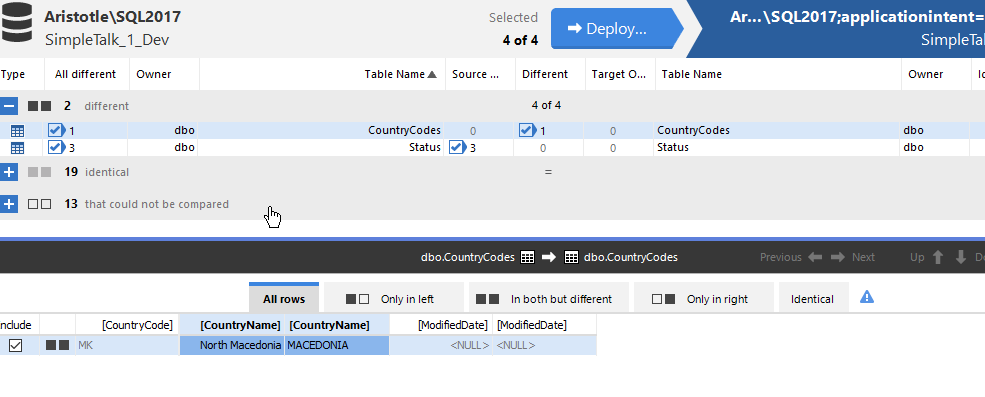
    Once you have a comparison, you should see something like this image. Here I have two tables that are different (I selected all tables). The first, dbo.CountryCodes, has a difference in a row, different values in the name.

    2023-04-14 13_47_56-SQL Data Compare - E__Documents_SQL Data Compare_SharedProjects_(local)_SQL2017.

    The second, dbo.Status, has some rows in the source (left) that are not in the target.

    2023-04-14 13_48_02-SQL Data Compare - E__Documents_SQL Data Compare_SharedProjects_(local)_SQL2017.

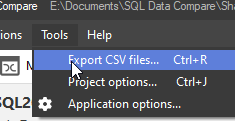
    To export these results, I use the Tools menu. There is an option you can see below:

    2023-04-14 13_48_08-

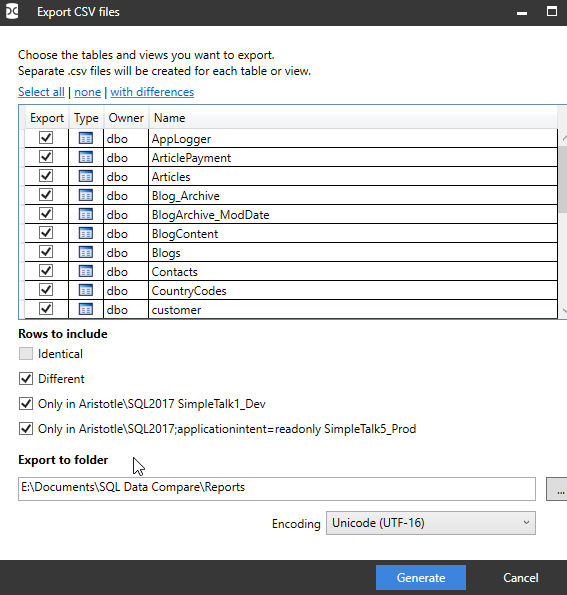
    Once I pick this, I get a dialog with options. I can pick certain tables, or all. The defaults are all tables, and only show differences. Note the identical button is not selected.

    2023-04-14 13_48_17-Export CSV files

    If I open the folder in the dialog above (after clicking Generate), I see my files. There are separate files for each table and one with a summary.

    2023-04-14 13_48_24-Reports

    If I double click the dbo.CountryCodes.csv file, Excel opens, but not the way I like it. I see this:

    2023-04-14 13_58_46-dbo.CountryCodes.csv - Excel

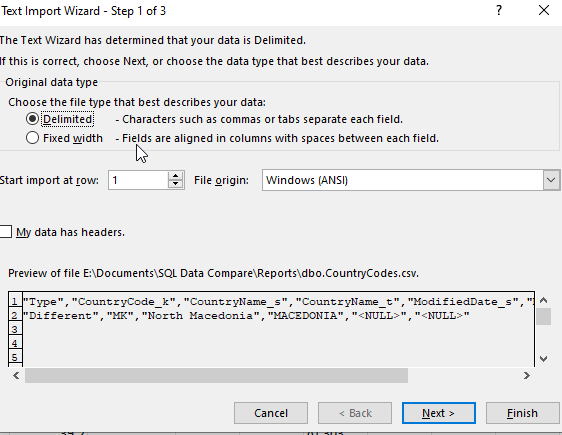
    However, if I File | Open the file, I get the wizard for delimited files.

    2023-04-14 13_59_00-Expenses 2023.xlsx - Excel

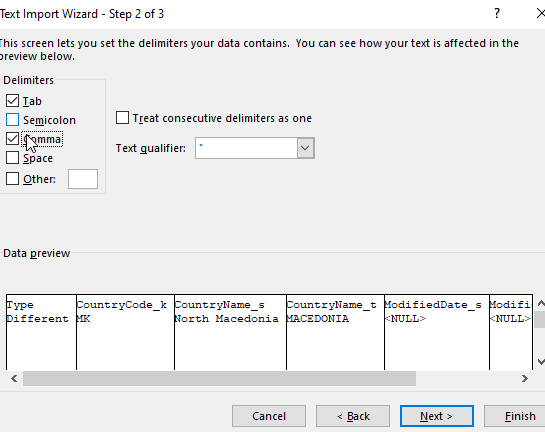
    When I go to the second page and click “comma” as the delimiter, I see a better preview.

    2023-04-14 13_59_05-Text Import Wizard - Step 2 of 3

    I can finish this and I see my data. In this case, the first column lets me know this is changed data that has the same row with the same PK in both databases.

    2023-04-14 13_59_22-dbo.CountryCodes.csv - Excel

    Similarly, I get open the Status table file and see this. Here the first column lets me know this data is only in the first database, the source or left database, that I set in my SQL Data Compare project.

    2023-04-14 13_59_50-dbo.Status.csv - Excel

    The summary also needs the same open process and this shows me all tables, with lots of zeros. However, for my two tables, you can see there is 1 row noted in the Different column for CountryCodes and 3 rows only in the source (SimpleTalk_1_Dev) database.

    2023-04-14 14_00_35-Results Summary.csv - Excel

    I can then save these in Excel format if I like and send them around to colleagues.

    Summary

    You’ve seen how you can review SQL Data Compare results in Excel. I don’t know if your Excel will open the CSV with values in separate columns, or if you need to perform a File | Open as I did.

    This is useful for sending to a business user that might need to make decisions about what data needs to be synched where. The hardest part here is explaining the _s and _t names for source and target.

    SQL Data Compare is very handy for single GB data sets to compare. I wouldn’t recommend this for > 10GB, but under that, with good hardware, you should have success comparing tables or views.

    If you’ve never tried it, download an evaluation today.