Category: Blog

  • Daily Coping 29 Mar 2022

    I started to add a daily coping tip to the SQLServerCentral newsletter and to the Community Circle, which is helping me deal with the issues in the world. I’m adding my responses for each day here. All my coping tips are under this tag.

    Today’s tip is to notice what is going well, even when things are difficult.

    Overall my life is amazing. The problems I have are just minor annoyances, really, and I try to remember that. I’m not always successful, but my wife helped me remember that recently.

    We took a trip to see my daughter recently. This was a long weekend, leaving Thur, returning Monday. A snow storm was scheduled for Monday, so my wife was concerned and wanted us to change and come back Sunday. My daughter has been having a hard time and didn’t come home for Spring Break, so I wanted to see her, support her, and get some time.

    All of this was on my mind when we boarded a plane for a 945a departure at 910, and more on my mind when the 12 of us that got on packed up and left at 915. There was some issue with the toilet being broken, so we needed a new plane.

    Not the end of the world, and as I fly a lot, usually a couple times a year there’s some issue. In this case, we had to change gates and wait for a plane. It was scheduled to depart now around 1110. The plane didn’t arrive at the gate until about 1045, and after unloading and cleaning, we didn’t load until around 1130. We moved away from the gate, went to de-icing, and things were looking up. Slightly stressed as I had a 2 hour drive on the other end and wasn’t sure we’d get dinner with my girl, but that’s a minor issue.

    We got to the runway and then turned around and returned to the gate. Some sort of brake issue. I like brakes on planes, so I took it in stride. A little stressed, but OK. At the gate, they announced this might take some time, so they let people get off. I’d been upgraded (again, my life is easy and amazing), so my wife drank mimosas while I read a bit. I tried to relax, but it was hard.

    They announced it was a sensor, so they brought people back on. Then this wasn’t the sensor, so more mechanics, and people off the plane again. We stayed on again, more mimosas for me wife, but stress for me. At this point I was wondering if we’d leave. If we pushed to Friday and left Sunday, that would start to feel silly.

    My wife reminded me that we were getting time together, whatever happened. We could find a way to go out another week or have my daughter come home. We didn’t have any big commitments, so I should relax.

    I tried, and it was a good reminder that things were going well. I was in a first class seat. I could have a drink (I declined, citing my diet), and I was with my wife on a trip. I didn’t relax much, but I did at least see the good things.

    We did manage to finally go, six hours late, and we arrived at the AirBNB at 1130. Too late for dinner, but we had a great weekend with my daughter, and we stayed through Monday. Everything worked out.

  • Starting LocalDB–#SQLNewBlogger

    Another post for me that is simple and hopefully serves as an example for people trying to get blogging as #SQLNewBloggers.

    Lots of people have never worked with LocalDB, which is an in-process version of SQL Express. No service account, just a SQL Server instance running with your app. It’s a nice lightweight way to get SQL Server running quickly without a hassle.

    This is a SQL Server Express version, but the bare bones for development. This post looks at how you can get this running.

    This version of SQL is installed with SQL Express, and with Visual Studio. If you look in this path: C:\Program Files\Microsoft SQL Server\150\Tools\Binn, there is a SQLLocalDB.exe. You can see that here.

    2022-03-03 09_08_00-Binn

    This is my SQL Server 2016 version of LocalDB. I can start a new instance by calling this with the CREATE option. I can give this a name as well, as I might want to stat multiple instance for different apps. Here I’ll create an instance called app1.

    SQLLocalDB create app1

    I then call the same command, but use START instead of CREATE. You can see this reports as started from the CLI. I also add the INFO call to get status.

    2022-03-03 09_10_35-C__Windows_System32_cmd.exe

    Now I can connect. I use (LocalDB)\app1 to connect:

    2022-03-03 09_11_39-Connect to Database Engine

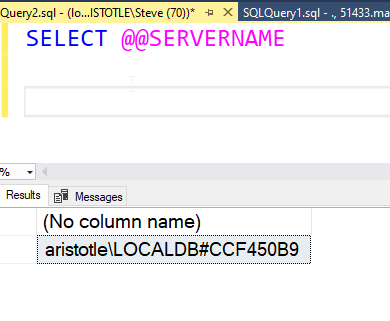
    I see I’m connected to a version of LocalDB then:

    2022-03-03 09_12_03-SQLQuery2.sql - (localdb)_app1.master (ARISTOTLE_Steve (70))_ - Microsoft SQL Se

    Now it’s just an instance of SQL Server I can use.


    SQL New Blogger

    I needed to check something for a customer and realized I hadn’t started LocalDB in a long time, so I needed to check the docs. I spent 10 minutes putting this post together.

    An easy type of post for any of you out there. Learn something, try something, write something.

  • Daily Coping 28 Mar 2022

    I started to add a daily coping tip to the SQLServerCentral newsletter and to the Community Circle, which is helping me deal with the issues in the world. I’m adding my responses for each day here. All my coping tips are under this tag.

    Today’s tip is to listen to a piece of music without doing anything else.

    I saw a list of acoustic guitar songs recently and on it was Babe I’m Gonna Leave You by Led Zeppelin. I listened to a lot of their music as a youth, and I’d forgotten about this song. So, I pulled it up on Spotify, closed my eyes, and just listened.

    Like many of their songs, there is some beautiful, peaceful guitar part that moves into a rock opera. An interesting lick that quickly gets buried inside of a heavy bass and drum part. At times, the loud singing is at odds with the guitar.

    An interesting piece.

    Another one, which I actually heard while swimming recently, was Starship by Kanye West. I was moving along and found myself distracted by this tune, actually hearing the words. I know I’d heard the song before, but I don’t know I had listened to the words, but enjoyed that one, completely distracted from the effort of the monotonous laps.

  • Would You Want to be on the Red Team?

    In the world of cybersecurity, a red team is a team of hackers that try to infiltrate a company, but at the request of the company. The idea is they look for vulnerabilities and issues and find them before criminal hackers do. They are the opposite of the blue team, who is trying to stop the red team and create defensive measures that prevent the red team from accessing data.

    Many large companies use red teams. Microsoft maintains a red team (and a blue team) that are constantly competing to break into their systems and defend them (depending on which side you are thinking about). I’m sure Amazon, Google, and other large companies do the same thing. It’s an interesting idea, though I bet this is a lot of repetitive work where you constantly repeat similar attacks with slight variations. There certainly is some creativity and research as well, and some acting if you social engineer situations, but it’s not the type of work I would want to do. I doubt it’s as exciting as Hollywood movies portray hacking.

    An organization could assemble a red team from external resources and use them to evaluate the security of your software, your infrastructure,  or even your people. There’s an article this week on getting started with a red team. Since companies are seeing more and more attacks against their systems, I would expect more to be proactive and either assemble or hire someone to test them. In fact, I bet there will be lots of cybersecurity people setting up their own companies to help here.

    Many of us might feel we are careful with security, and that we check for issues. I’m sure we do some of that, and many of us know how to secure things well. However, it’s easy to make a change and make a mistake. It’s easy to forget to include a group, or include the wrong group, in a security ACL. It’s easy to forget to check a setting or leave access open while we test and forget to go back and secure it properly.

    Attackers think differently. We can learn to do this, but it might be helpful to have someone else doing the attacking and then giving us a report on what to fix.

    Steve Jones