Category: Blog

  • Getting Started with Spawn

    I’m excited that the Redgate Foundry is working on some cool projects. The Future of DevOps is one and part of that work is with Spawn. I’ve played with this a little, and I wanted to write about a few adventures I’ve had.

    First, you need an account as Spawn is hosted and there is a login. The idea here is that the service (hosted now, but could be on premise) handles all of the complexity of databases in containers, spinning them up and managing them, with you just connecting to an endpoint to use the database. We can spin up SQL Server, PostgreSQL, MongoDB, MySQL, and Redis in this fashion. It’s truly a Database-as-a-Service (DBaaS).

    Spawn on Windows

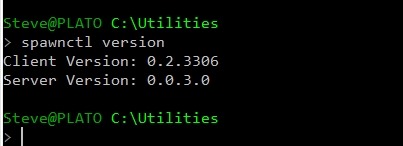
    For once, this is easier, or I think it is. I downloaded the spawnctl.exe CLI and then put it in a folder in my path. For me, I have a “utilities” folder where I drop stuff and that’s where this lives. I can check this working with a version parameter.
    2019-06-21 14_30_24-cmd

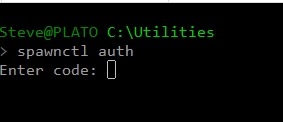
    So far, so good. Now we need to log in. I like integrated authentication schemes, and this one works well. I start with a “spawnctl auth” call from the command line.
    2019-06-21 14_32_40-cmd - spawnctl  auth

    This pauses and opens a web browser window. It’s here I need to log in. We support Github and Microsoft, but have mostly been using Github for our demo work.
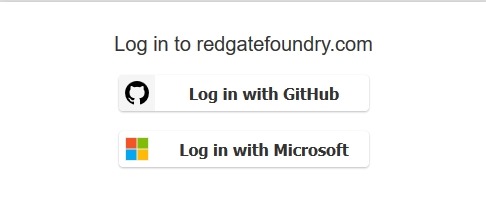
    2019-06-21 14_32_46-redgatefoundry.com

    Once I click that, since I have a Github session elsewhere, I’m logged in and I get a code back.
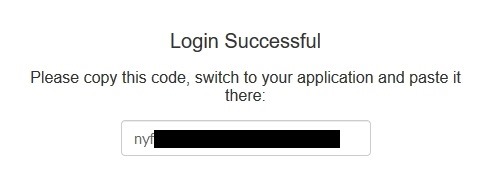
    2019-06-21 14_33_08-redgatefoundry.com

    I paste that back in the cmdline and I am authenticated. From here, I can then see what images I have. As you can see, there are both MSSQL and PostgreSQL images for me.
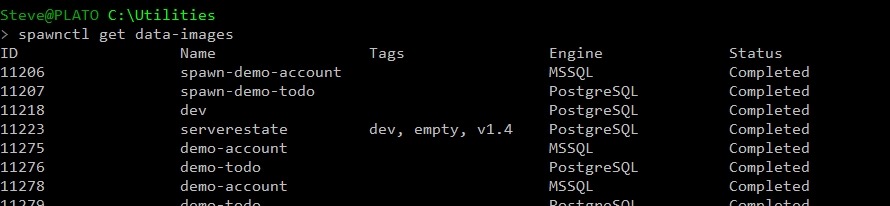
    2019-06-21 14_33_55-cmd

    I also have a few containers from my demo work.
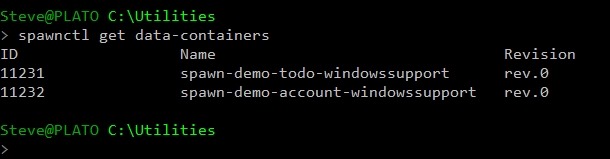
    2019-06-21 14_35_10-cmd

    Let’s make a new container and connect to it. I’ll use Azure Data Studio, since I can connect to both SQL Server and PostgreSQL.

    Logging In

    To get a database, I’ll use a CREATE verb and the DATA-CONTAINER noun, along with an image. When this runs, I get a note this container is being created, then I get a response with login information.

    2019-06-21 14_42_51-cmd

    Let’s put that in ADS. I can copy/paste my credentials into a connection dialog and then hit Connect.
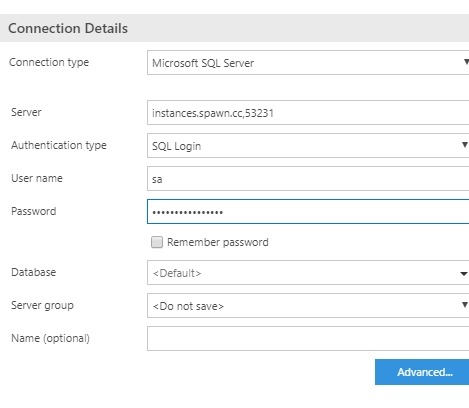
    2019-06-21 14_43_52-SQLQuery_1 - disconnected - CoolADSNotebooks - Azure Data Studio

    As you can see, I’m connected.

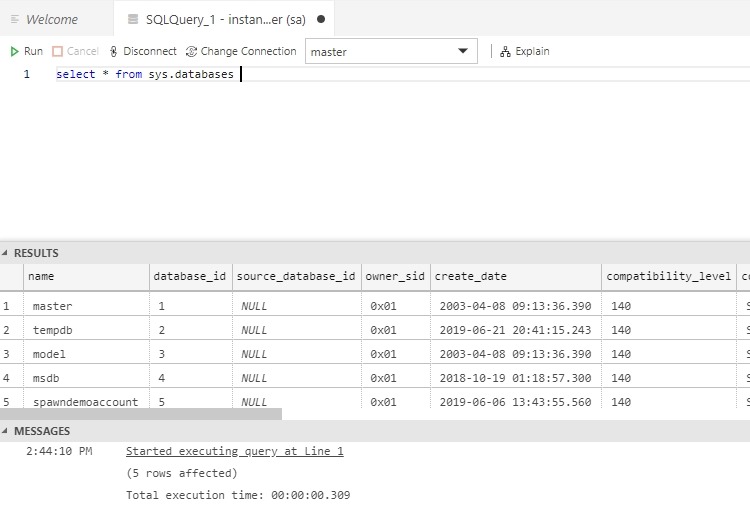
    2019-06-21 14_44_21-● SQLQuery_1 - instances.spawn.cc,53231.master (sa) - CoolADSNotebooks - Azure D

    I see the demo database we’ve been using and the tables in there. How this works is worthy of more posts, but for now, this is pretty cool.
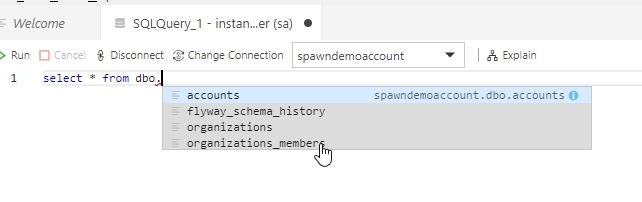
    2019-06-21 14_45_04-● SQLQuery_1 - instances.spawn.cc,53231.master (sa) - CoolADSNotebooks - Azure D

    I can do the same thing with PostgreSQL. Create a container.
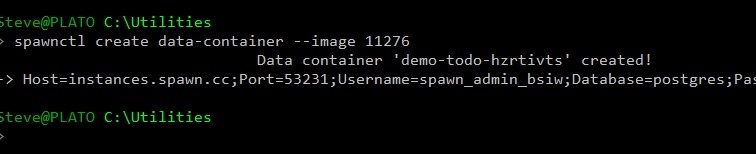
    2019-06-21 14_48_00-cmd

    Then connect (need to specify the port in Advanced)
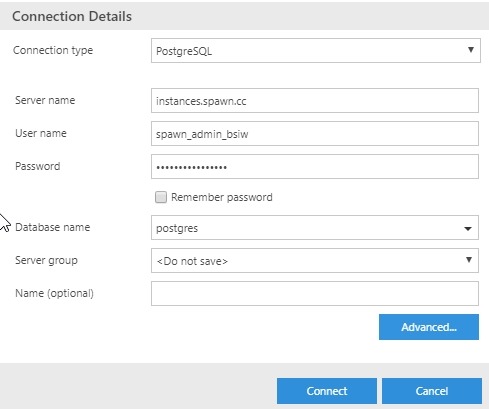
    2019-06-21 14_51_57-Window

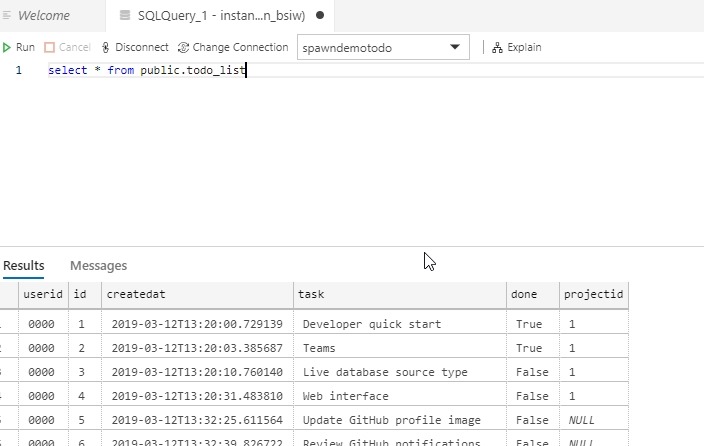
    And query:

    2019-06-21 14_52_59-● SQLQuery_1 - instances.spawn.cc.postgres (spawn_admin_bsiw) - CoolADSNotebooks

    Pretty cool. Simple, easy, and I think about as fast and easy as any other cloud database. Here, though, I am spinning up a container from an image template. That’s valuable for dev work, and I’ll talk about that in the future.

  • Honored to be a Microsoft MVP

    Today is the renewal date for Microsoft MVPs. I received an email a short while ago informing me that I was being awarded again for the July 2019 – June 2020 timeframe. This is my twelfth award, and I’m quite honored that I was chosen again.

    If you don’t know about the award, you can read more on Microsoft’s MVP site. This is a community award for your efforts to promote and help others work with Microsoft products. I’ve spent a lot of my career in this area, as have many others. Often these are the people that write and speak often, and are friends I get to see at various places all over the world.

    Microsoft wants to recognize people that do a great job, but there’s a limited budget for doing so, and they pick who they feel are the top contributors, even though there are many more that don’t get recognized.

    I want to congratulate all those awarded the MVP designation, whether today or in the past. I also want to thank those of you that answer questions, speak, write articles or blogs, and more to help the community. Many of you have taught me something over the years, and I appreciate all your efforts.

  • Basic User Functions in R

    As I’ve been learning more about the data platform, I’ve been exposed to some R language code. This makes sense, as more comprehensive data analysis needs something other than SQL. Or at least, some people think that and it behooves me to better understand what they do with R. I’ve also had to build questions for SQLServerCentral, so I’ve spent time working through different R language items.

    One of those items is the function. I first found this strange, but the more I think about it, the more I like this. Rather than some code that is a “create function double”, I actually assign a variable, which is really just some token in memory, to the function. I could do this as:

    double <- function(x) { x * 2 }

    This means the variable double contains a function, and I can call this as I would any function.

    i <- double(4)

    At this point, i would have the value 8.

    Simple and easy, but powerful. This can get more complex, and I’ll experiment more in future posts.

  • Watch the State of SQL Server Monitoring tomorrow

    Tomorrow Redgate is running a webinar on the State of SQL Server Monitoring with Grant, Chris Yates, Annette Allen, and Tony Maddonna. You can register now and attend on June 25, at 4pm BST/11am EDT/8am PDT.

    What has Redgate’s latest survey revealed about the state of SQL Server monitoring in 2019? Each year we contract for a survey on monitoring and produce a report (similar to and in addition to the State of Database DevOps). This is the only industry report to benchmark monitoring in the SQL Server community, now in its second year.

    Join our panel of SQL Server experts as they discuss the key findings of our industry-leading report, that includes insights such as:

    • Getting to grips with growing estates
    • Issues caused by migrations
    • Which tooling is being used
    • Staying on top of multiple database systems
    • What is the next big challenge facing the industry.

    The report has data from over 800 participants across a range of sectors and from all around the globe. The key findings include: Estates are continuing to grow, migrations is predicted to be the biggest challenge facing database professionals this year, adoption of cloud technologies is increasing and Redgate’s SQL Monitor is the most popular third-party tool (even when we remove out customer base).

    The report will be available after the 25th June. Look for a link, or attend the webinar and we’ll send you the link.

    Register today.