Category: Blog

  • Making VSTS Deployment Changes to Databases without Breaking Your Application

    One of the things that I do a lot is demo changes to databases with CI/CD in a DevOps fashion. However, I also want to make some application changes to my sample app without breaking things. As a result, I’ve built a few ideas that work well for both situations. I found recently these ideas can help me when I need to actually upgrade or change my CI/CD pipeline.

    Note: DevOps isn’t a thing, it’s a set of principles, ideas, and culture that produces results. I will endeavor to ensure I call out the specific principles I use to adhere to DevOps ideas. In this case, automation and CD.

    Release On Your Schedule

    One of the principles of DevOps is that we use feedback loops to ensure information moves from right (operations) to left (development).  One way of doing this is to release more often, though this isn’t required. What we really mean is release on your schedule, when you want, and allow developers to get feedback on their work quickly.

    If a developer takes a month to build a feature, they don’t need hourly or daily releases. They need a release after the month is over (assuming testing, review, etc. has taken place). If releases occur on the 5th of the month, and the developer finishes on the 6th, they must wait a month before they get feedback. What I want to ensure is that we can release on the 5th, and also on the 6th if I need to.

    Upgrading my VSTS Pipeline

    I wrote in another post that I planned on upgrading my Redgate DLM Automation tasks in VSTS. I was doing this on a trip to a conference, and I didn’t want to start making the demo changes I’d make as I’d have to undo them, and it’s possible that I’d forget to clean something up. I hate making that silly mistakes, so I needed a way of testing my build and release without breaking demos.

    I decided to use a technique that I use in presentations when I’m talking process and not code. In those cases, what I deploy doesn’t matter, but if I change random objects, sometimes I break the application using the database. As you can see here, I needed to do a bunch of tests, and repeat some.

    2017-04-01 11_52_03-ST Pipeline_Mobile - Visual Studio Team Services


    Deploy Often

    When I talk with Redgate clients, and they are starting to get comfortable with the idea of deploying on their own schedule, they will sometimes make innocuous changes that trigger a deployment they can test, without breaking things. For example, a user might take this stored procedure (partially shown):

    ALTER PROCEDURE [dbo].[GetEmailErrorsByDay]
      @date DATE = null
    /*
    Description:

    Changes:
    Date       Who         Notes
    ———- —         —————————————————
    2/14/2017  WAY0UTWESTVAIO\way0u   
    */
    AS
    BEGIN

    IF @date IS NULL
      SELECT @date = DATEADD(DAY, -1, GETDATE())

      SELECT Errcount = COUNT(*)
       FROM dbo.EmailErrorLog
       WHERE EmailDate = @date


    and make a small change. Perhaps they add SET NOCOUNT ON, or maybe they’ll add a comment. I’ve even see someone add this code:

    AS

    BEGIN

    SELECT 2 = 2

    These aren’t big changes, and certainly choose which stored procedure to change (one that isn’t used a lot or is critical). These are changes to test your process, gates, approvals, deployments, etc.

    I decided to try something else. I tend to write this code when I want to test changes, since I can be additive with a procedure like this:

    CREATE PROCEDURE Get7

    as

    SELECT 7

    Or I can modify things with this:

    ALTER PROCEDURE Get7

      @plus int

    as

    SELECT 7 + @plus

    In either case, I can see if my changes go through. Since I often deploy to multiple environments (QA, Staging, UAT, production, etc.), and I don’t always have deployments go all the way through (see my image above), I will usually end up creating Get7, Get8, Get9 as subsequent procedures. This way I can continue to commit new changes to the VCS, get new builds, and get new releases.

    I can also do this with tables. My favorite is MyTable, MyTable2, etc. I usually just have an integer MyID column, but I can add other ones to test the ALTER process. I can even use this to test data movement, static (reference/lookup) data, or anything else to do with tables.

    Eventually (hopefully) I get clean deployments all the way through to all environments.

    Cleanup

    I sometimes get collissions, where a test will return the error that “Get10 exists”, and I’ll move on to Get11. However, I don’t want to leave those objects in all environments. After all, likely I’ll find a way to improve things in the future and I’ll want to repeat this testing.

    This usually is one last deployment for me. I’ll delete these objects in dev, and then deploy the changes all the way through to production. This allows me to test my checks to prevent data loss, if I have any. Including if approvers actually read scripts Winking smile

  • T-SQL Tuesday #89–Changing Times

    tsqltuesdayThis month the invitation is from Koen Verbeeck and it has to do with the cloud changes coming to the data world, especially SQL Server. That’s an interesting topic, not necessarily technical, but it is an interesting one to think about.

    I’m going to be a little short because life is busy, but I think this is an interesting item to keep an eye on for many people. Not necessarily at your current position, but what if you need to move on?

    If you’re interested, I host all the T-SQL Tuesday topics at tsqltuesday.com.

    The Cloud is Changing Things

    I sat in a talk at SQL Bits from Conor Cunningham of Microsoft. He’s one of the principal architects of SQL Server and Azure SQL. In the talk he talked about some interesting ideas in how SQL Server engineering has changed in the last decade. Victoria Holt wrote a short piece on some of the things Conor talked about.

    There are a couple interesting things that the cloud is enabling. First, Microsoft runs their cloud without any Ops team, really having developers be responsible for things in production. This is 1.7mm databases, without any DBAs. Why? They gather lots of data, so they learn when things are broken, unstable, or problematic. They do this with the 600TB of telemetry they gather every day.

    Of course, you and I won’t have that much information, but the cloud does enable Microsoft to think about how to make SQL Server more stable, and also how to add automation capabilities into the product. We haven’t seen much of this change in current versions, but the Query Store is the start of one thing, and Adaptive Query Processing (coming in v.Next) is another. I wouldn’t be surprised to see more, and that means our jobs as DBAs will change.

    I think there will be less, check, configure, verify, maybe even some less tuning work for DBAs. There will always be developer needs, especially with more complex reporting, visualizations, and just understanding large data sets. There will also constantly be the need to write better SQL as the optimizer can only do so much with bad queries.

    The cloud interests me and excites me. There are issues, concerns, and challenges. However, I also find working with Azure through Powershell, being able to access different services from various places, keeping some data there (non PII) and avoiding the need to manage infrastructure to be key.

    I don’t know if it will happen, but I would hope at some point that the Azure cloud, the AWS cloud, the Google cloud would license their service, or even allow others to resell and manage portions to encourage competition and give us some choice in who we might choose to deal with. If so, they I could see more and more companies just considering moves to the cloud for more data, especially when there could be different levels of service and protection for different needs.

    The cloud is changing things, even if you aren’t in the cloud. That can be opportunity if you take advantage of it.

  • Upgrading VSTS Redgate Build Tasks

    I’ve been putting it off, but in prepping for SQL Bits demos, I decided this was a good time to just upgrade my original build and release tasks on VSTS from v1 to v2 for the Redgate tasks.

    The first step was to go into the marketplace and find the new tasks. If you browse the marketplace (click the shopping bag icon in the upper right of VSTS) and search for “redgate”, you’ll see the tasks.

    2017-03-31 16_42_13-Search results - redgate _ Visual Studio Team Services , Visual Studio Marketpla

    I picked the two on the right, the build and release tasks v2. The v1 tasks aren’t in the marketplace, but if you’ve added them to your account, they’re still there and they work in your build and release pipelines.

    Once I installed them, they appear in my list of extensions.

    2017-03-31 16_44_56-Manage extensions - Visual Studio Team Services

    Now I can edit my pipelines.

    I’ve got a release pipeline that looks like this. Note that these are the v1 plugins, because there’s no v2 on the name.

    2017-04-01 11_25_17-SimpleTalk Release Pipeline 1 - Visual Studio Team Services 

    My plan is to upgrade these to the new extensions, however, there are lots of settings. If you look to the right for any of the tasks, for example the Create task, there are lots of boxes to fill in.

    2017-04-01 11_26_34-SimpleTalk Release Pipeline 1 - Visual Studio Team Services

    This is expected as if I were doing this manually, I’d expect to have  along set of commands or switches to programs or parameters, that I’d need to pass in to a process. After all, the mechanics of implementing CI or CD aren’t hard, but they do have lots of moving parts.

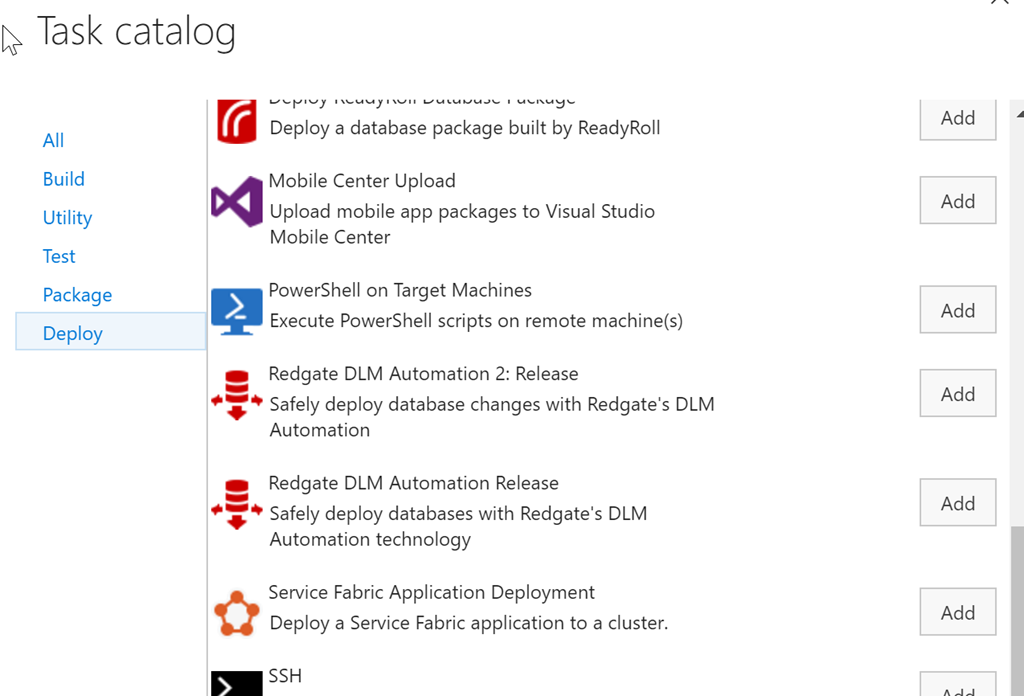
    My first step in making this easier is to add a new task. To do that, I click on the “Add tasks” button above. This will default me to the set of tasks for me particular function, in this case, release (deploy). I scroll down to see the v2 tasks.

    2017-04-01 11_29_23-SimpleTalk Release Pipeline 1 - Visual Studio Team Services

    Here I see the v1 and v2 tasks because they’re both listed in my set of tasks because I’ve installed both into my account. In this case, I’ll pick the “2” version of this task.

    Once this is added, I need to configure the task. In my case, the easiest way to do this was to click on the v1, copy the contents of a text box, and then click on the v2 task and paste the values in there.

    Once I had done this, I have both tasks listed. For this particular pipeline, I had actually added a new Agent Phase, separating my tasks out. There wasn’t any great benefit to this, though I can then just delete one whole phase and all the tasks in it (once things are working).

    2017-04-01 11_33_41-ST Pipeline_Mobile - Visual Studio Team Services

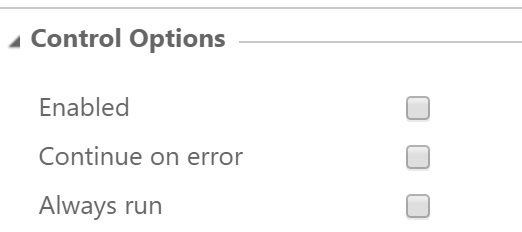
    After copying all the settings from one to the other, and checking that v2 was configured the same, I was ready to test. I first went to each of the v1 tasks and unchecked the “enabled” box. This means those tasks won’t run, but they’re still in the definition.

    2017-04-01 11_33_52-ST Pipeline_Mobile - Visual Studio Team Services

    After that, I created a release and deployed it. Not every deployment worked. My first ones did, but when I tried to hit the production environment (the far right), it failed early on. This list is from newest to oldest, so I had a few things to work out here.

    2017-04-01 11_36_20-ST Pipeline_Mobile - Visual Studio Team Services

    As you can see, this isn’t necessarily a simple, easy process. In my case, the v2 tasks have some additional path items, and I had to sort those, I also had firewall issues to production as I was traveling between the tests, which meant forgetting, and then needing, to reset the firewall rules.

    However, it’s all good now.

    2017-04-01 11_38_21-ST Pipeline_Mobile - Visual Studio Team Services

    I would encourage you to upgrade your DLM v1 tasks to v2. There are a few bug fixes, some of the deprecated cmdlets are removed, and these work slightly better. I know have pathing options to separate my environments on the agent and can easily see the code being run.

    I’ll talk about my test procedure for upgrading in the next post, because I think trying to do too much at once is how I’ve gotten into trouble and created stress for myself in the past. Now I have a better idea. 

  • Margaritas and TexMex at VS Live

    takes place in a few weeks and I’m excited. Austin is one of those cities I enjoy visiting, with a few friends, now a Redgate office, and some great good and drink. I’m hoping my wife will come along and we can enjoy a few days there.

    However, I’ll also be speaking at VS Live in May, which is a great conference for many of us that wear mixed hats. So many people these days don’t get to just work with SQL Server, or perform software development without having to understand more about deployment or networking or something else.

    If you’re trying to get, or being forced, to think about DevOps, VS Live is for you. Tell your boss, this is the chance for you to expand your skills, add development skills if you’re a DBA, or add DBA (or cloud, or Windows) skills if you’re a developer.

    Register for VS Live in Austin, which has to be one of the best locations. Good conference and content, good weather, great food, cold drinks, and plenty of music to enjoy at night. Register today today and

    I hope to see you there, and let’s talk SQL Server and DevOps.