Category: Blog

  • Quick Audio Switching

    I’ve got a semi complicated desktop setup, with multiple monitors, lots of USB stuff, and a few ways to record and listen to sound. I hadn’t thought of things as complex, especially with regards to audio, but between recording podcasts, having regular video conferences, and the speakers I added to my machine, I found the need to control where my audio goes in and out of.

    The other day I was waiting for a conference call to start on Skype and was listening to an interview through my computer. I’d plugged in a USB headset for the call, but the interview (Flash-based web page), came through the speakers. I’ve gotten used to redirecting audio easily from the speakers to headphones to Bluetooth devices, but I wasn’t sure how to do this in Windows. I messed with the audio mixer a bit, but didn’t see anything.

    I did a bit of searching and ran across this post on Superuser. I decided to blog briefly in the hopes that I’ll remember this process for next time.

    The long and short of it was that I needed to right click the audio speaker icon.

    recorduadio1

    I could then select Playback devices. This allows me to see the setup, not just the volume. I got the Control Panel app, with all my devices listed. I can also see the recording devices.

    recorduadio2

    From here, if I right click a device, in this case, the USB headset, I can select "Set as Default".

    recorduadio3

    Once I did this, the audio for the interview came through on the headset. I could listen and when my Skype call came in, it cut out and I could continue on with work.

    This is especially handy for recording, as I’ve had the wrong device setup for recording at times because I’ve expected the default to be used.

  • SQL Konferenz

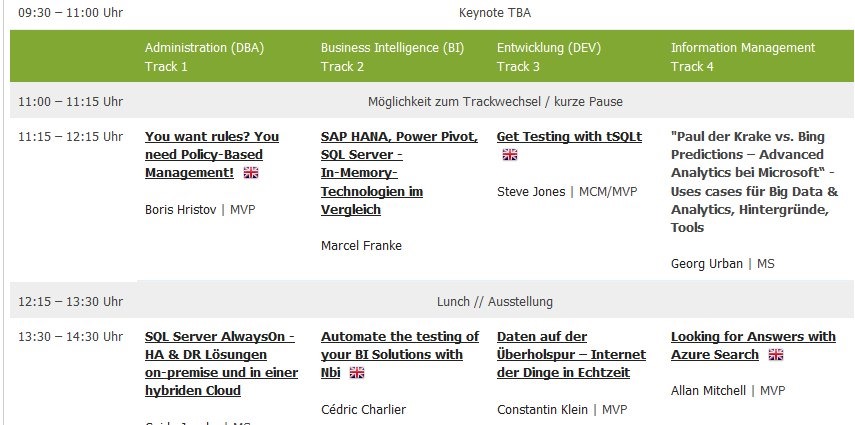
    I’ve spoken at lots of events, but all in the US and the UK. Next year I get my first talk outside of those locations, going to the SQL Server Konferenz near Frankfurt, Germany.

    The agenda is up, and I’ll be talking testing and tSQLt there, and it’s cool to see my name up there. I’m also glad to see the UK flag there to note I’ll be presenting in English.

    konferenz

    Fingers crossed that things go well.

  • Load Balanced IIS Machines

    I noticed a contest this week while working on the Database Weekly newsletter. It’s the Cloud Hero contest, with the chance to win a Surface Pro 3. I could always use another device, or at least a device I could give away, so I decided to enter.

    There are a few things you can do, all of which are interesting to me in terms of a direction that I, and Red Gate, want to move. I don’t know if Azure works everywhere, but we are considering moving SQLServerCentral, or perhaps parts of it, to Azure, so this was a good chance for me to try out some new Azure stuff.

    I’ve messed with a few things in Azure, but mostly on the PaaS side. That interests me more, and I’ve done little with IaaS. I certainly haven’t really worked with IIS much in Azure. I decided to go through the VM setup, to create two IIS machines, load balanced on the same URL. I used this blog post with a cartoon and demo to run through the process.

    It was a bit more than 10 minutes, mostly because some of the allocation stuff in Azure took time, and the responsiveness from the VM in Azure was slow. From the time I connected to the time Server Manager popped up was over two minutes for each machine. Since I was going through some of the steps sequentially, that meant it was slow to get going.

    The video and the portal bring to light some of the issues of Azure. It’s a great tutorial and I was able to get the two machines load balancing IIS in 20 minutes (or less). It was surprised how quickly it went, but I also had to stop and think. The load balancing and cloud services are different now than they were when the post was written.

    I’m sure that’s the case with lots of Azure content. In some sense, this means that we will have lots of issues with people trying to learn how to use Azure as they’ll find content and information that is woefully out of date, sometimes quickly. I wonder if we need to think about having some code on blogs for Azure that marks the content as potentially out of date after it’s been out for 6 months.

    It’s a challenge to keep the content up to date, and luckily the changes weren’t too different in the portal.

    I am glad that I was able to get to IIS machines up and load balanced, delete them, and bring them back. That makes me think I may find some use for this Azure stuff, yet. I have a few projects in mind, including rebooting my personal site. Perhaps Azure will be the place I give it a go.

  • RegEx Those Dates

    This is a series on SQL Data Generator, covering some interesting scenarios I’ve run into. If you’ve never tried it, SQL Data Generator is a part of the SQL Toolbelt. Give it a try today with an evaluation today.

    Recently I was working on transforming some dates, and wanted to generate a large n number of dates for testing. I decided to use SQL Data Generator, and a little RegEx to meet my needs.

    The format I needed was CYYMMDD, which is the century as a 0 or 1 (1900 or 2000) and then the yymmdd format. While there are some pre-made expressions to build dates, there wasn’t an easy one to handle the century like this. I could have used a date expression in T-SQL and randomly allocated a century, but I decided to play around with RegEx.

    I know that the brackets allow a choice of values to be used. The regular expression can choose any of the values to match. An example is for the first part of my date, the century. It can be zero or one, so I can do this:

    [01]

    When Data Generator runs, it will randomly build expressions that match this pattern, which in my case results in
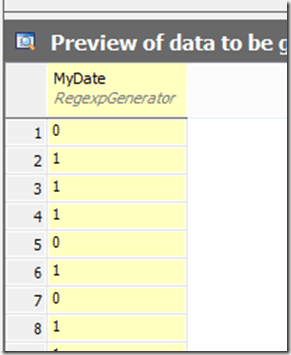
    regex01

    That makes it easy for me to pick numbers, and I could do something like this for the years:

    [01][0-0][0-9]

    That works, as any number from 00, as in 2000, up to 99, as in 1999, is valid. That gets me this:
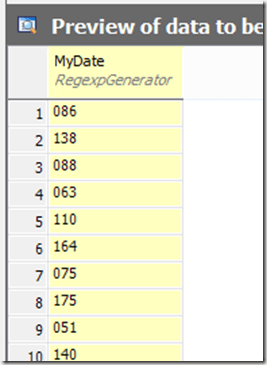
    regex02

    Months

    However that causes issues when I get to the month. I need a two digit month, but I can’t have some combinations of two digits. If I were to write [01][1-9], I’d get months like 18, which aren’t valid. Instead, I need a pattern that only matches a 0 with 1 to 9, and only allows a 1 with a 1 or 2.

    To do that, I’ll use an OR. That’s a pipe (|) in regular expressions. I’ll say (in pseudocode), give me a (01 to 09) OR a (10-12). The easy way to build that is like this:

    (0[1-9]|1[0-2])

    This says that if we match the first half (before the pipe), then we literally have a 0 there, with a second character in the range 1-9. That gives us 01 to 09. The second half, after the pipe, does the same thing, but it matches a literal “1”, and then a 0, 1, or 2. As you can see, I have random months (only showing this expression).

    regex03

    Days

    Now the hard part: days.

    Days are strange in the calendar because the possible days depend on the months. Years and months are consistently in ranges, but the days are not. Let’s start with the most common days: 31.

    I have 31 days in months 1, 3, 5, 7, 8, 11, 12. In order to match these up, I’ll need to combine the month and day items. Let’s first change our months to be just those particular months. That gives me:

    (0[13578]|1[02])

    With these months, I am going to allow up to 31 days. The patterns for the first 29 days of the month are the same. A 0, 1, or 2, with any combination of 1-9. Putting that together gives me:

    (0[13578]|1[02])([012][1-9])

    This handles the first 29. The next two, 30 and 31, are an OR expression like the months. I’ll use a literal 3 and a choice of zero or one. That gives me:
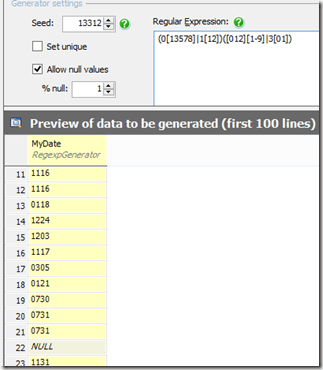
    regex04

    Whew! This is a lot of work, but it matches things up well. Now I need to handle 30 days. I’ll do that the same way, but I’ll now OR both expressions together. The expression is:

    ((0[13578]|1[02])([012][1-9]|3[01]))|((0[2469]|11)([012][1-9]|30))

    And the data:

    regex05

    That gets me almost all the months. The last part of February, the hardest. Now I could worry about leap years, but I’m not going to. Proper handling here means verifying the year (and century here) and doing math to ensure a leap year is viable. Instead, I’m going to just ignore the 30s and manage days 1 to 29.

    ((0[13578]|1[02])([012][1-9]|3[01]))|((0[2469]|11)([012][1-9]|30))|((02([012][1-9])))

    Now I have a nice set of random dates if I put everything together.

    [01][0-0][0-9](((0[13578]|1[02])([012][1-9]|3[01]))|((0[2469]|11)([012][1-9]|30))|((02([012][1-9]))))

    regex06

    References

    I leaned on a few examples to decode a few of the expressions and also to check that I wasn’t messing up.