Category: Blog

  • Schizophrenic Windows 8

    I’ve been using Windows 8 almost exclusively for about 3 weeks. I got a new desktop a couple months back, which has only had Windows 8 installed on it. My new laptop arrived about 4 weeks ago and a week later I finally abandoned my Macbook Air and moved fulltime onto the Windows 8 platform.

    Overall I like Windows 8. It boots quickly, so quickly that I don’t mind the occasional restart when an update requires it. It’s gotten to where I get annoyed at the length of time it takes for me Windows 7 VMs to restart. The restore time from sleep when I open my laptop is OSX-esque. Almost immediately after I open the machine, I can log in.

    There are improvements that make my life easier, like duplicating my taskbar across both my monitors. I’ve learned the Windows+I shortcut, which is really the only one I need. I’ve gotten used to the charms/settings bar on the right, and I rarely invoke it. Overall, this feels like a faster, more complete version of Windows 7.

    Except.

    It’s schizophrenic.

    I know that’s not what I mean. Really I mean it has a split personality, but I like the word schizophrenic.

    Updates

    When I want to update Windows, I need to run Windows Update. I know that this is supposed to be automatic, but I don’t like things breaking, and so I need to run Windows Update and select the updates I’ll apply. If I go to the Start menu and type “windows u”, here’s what I get:

    win8_schizo_a

    That seems strange, because I know there’s an application of sorts for Windows Update. Fortunately I know that Windows+I, and then selecting Control Panel gets me to the main panel. I’ve learned to use search, which I can do:

    win8_schizo_b

    If search is the way to do things, and lots of recommendations say it is, why doesn’t a search on my start menu find "Windows Update? I can search in every Explorer Window. The Start screen starts searching as I type. The Store searches.

    Schizophrenic.

    What’s even worse is that apps I’ve installed from the Windows Store, of which there is a dearth as of this writing, are updated separately. I get a note on the Start Screen for the “Store” tile:

    win8_schizo_d

    Or in the upper right corner if I select Store. I actually missed this a few times when looking for updates. That might be me, and I’m not complaining about updates being here.

    win8_schizo_c

    I’m complaining they are in two different places.

    This is endemic of poor design. Not because of the Start Screen, or the tiles, or the movement of items around in the OS. Because of the lack of integration between the old, desktop style view of the world and the Windows 8 Metro/Tile interface.
  • Starting with Git for Database Development

    One of the tools that Red Gate Software makes is SQL Source Control. It’s a plug in to SSMS that allows you to hook your database up to version control. I’ve used it a few times in the past in conjunction with Subversion to demo the product. However I hadn’t really used it for my own scripts since it’s primarily a single server system and not distributed. My own demos were on VMs with limited connectivity to the world.

    A few weeks back, I was flipping through the https://www.simple-talk.com/Simple Talk newsletter, and saw an article on Continuous Integration for SQL Server using Red Gate Tools, Atlassian Bamboo, and Github. I’ve had many people over the last few years ask me about Git support for SQL Source Control and I was curious to see how well we supported things. I read the article and started downloading things.

    The first thing I downloaded was GitHub for Windows. I installed it and wasn’t thrilled to see it not working. However what was unclear in the article and the installation was that this is just a GUI for your Git installation. Since I hadn’t installed Git, I needed to do that. Once I had done that, and set up a Github account, things worked fine.

    I have numerous databases that I use for talks, but I usually create and destroy them with scripts during the talks. Not quite the way that SQL Source Control is designed to work. It works with objects, not scripts. However I wanted to test things, so I decided to build a database with the objects in it already. I wasn’t sure this would work for demos, but it would be a good test.

    git_a

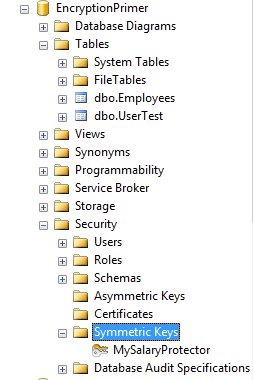
    As you can see above, there are a few objects in my database.

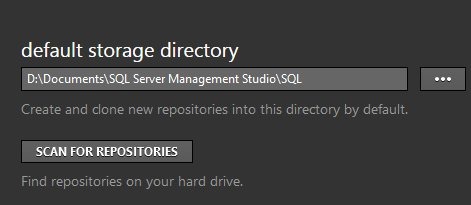
    My next step was to pick a place on my local drive where I could store my Git data. Since I do a lot from Management Studio, and use quite a few VMs, I wanted a standard location I could use easily and chose a folder under my SSMS installation.

    git_b

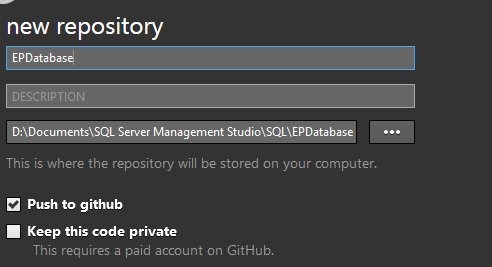
    Once this was setup, I created a new repository on my drive.

    git_c

    This was the place I’d keep all my code. With a free GitHub account, you can’t keep your code private, but that’s OK for this project since I give all my code away after talks.

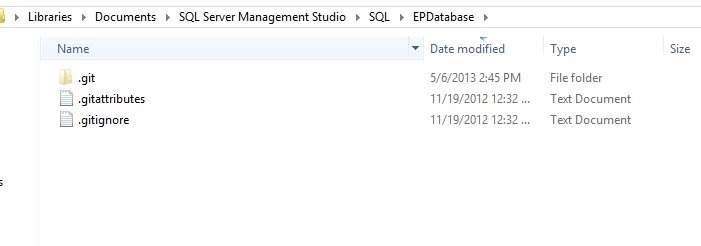
    Once I’d created this, Git put the folder on my drive.

    git_d

    Inside the folder was nothing, just a few Git files.

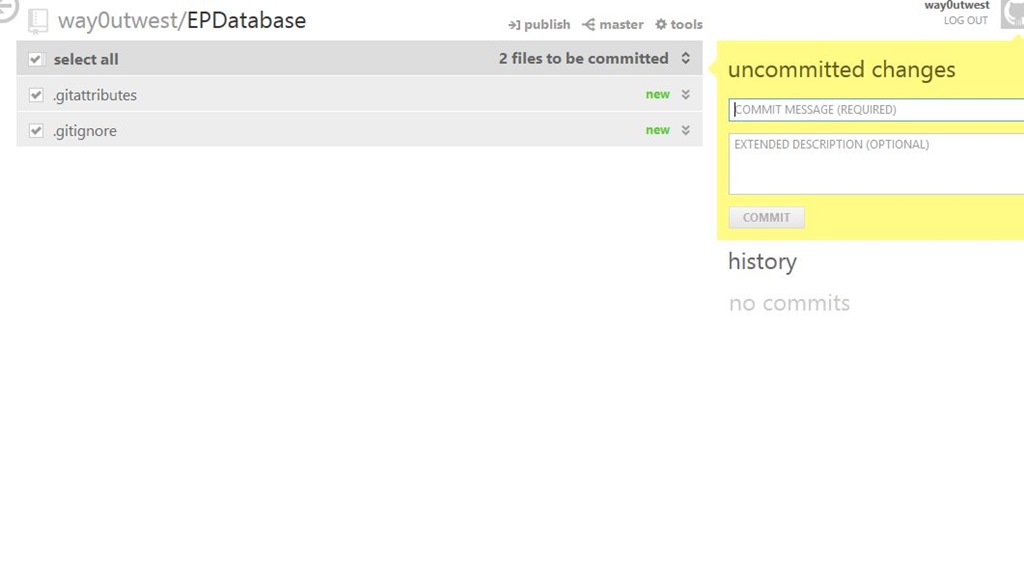
    git_f

    And in my Github interface, there was nothing to commit.

    git_e

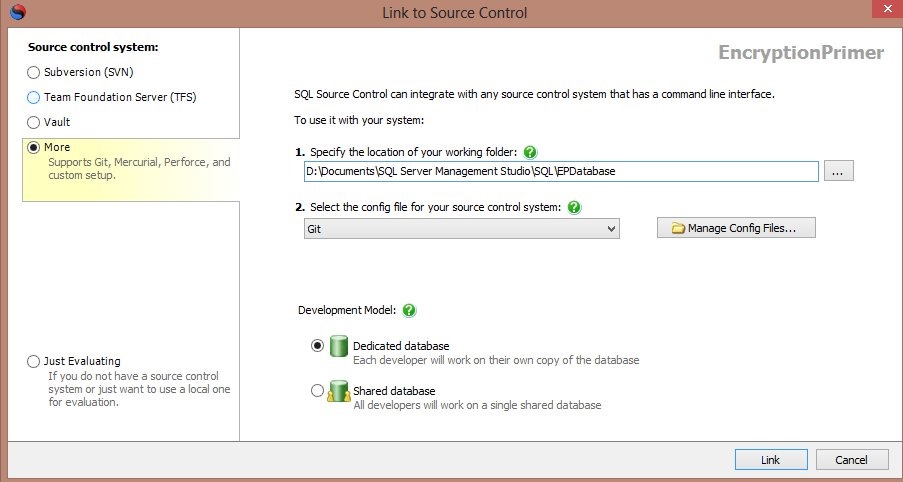
    The next step was to link this with Git. After selecting my database in the Object Explorer, I switched over to the SQL Source Control tab to link my database to source control. I entered the path of my Git folder (from above) and selected Git as my VCS.

    git_

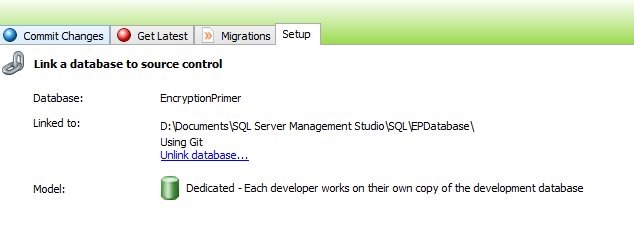
    I chose a dedicated database, meaning this is just my database. The Shared database model can work, but I don’t like it for teams, or even solo.

    Once this was done, I could see my database linked in SSMS.

    git_h

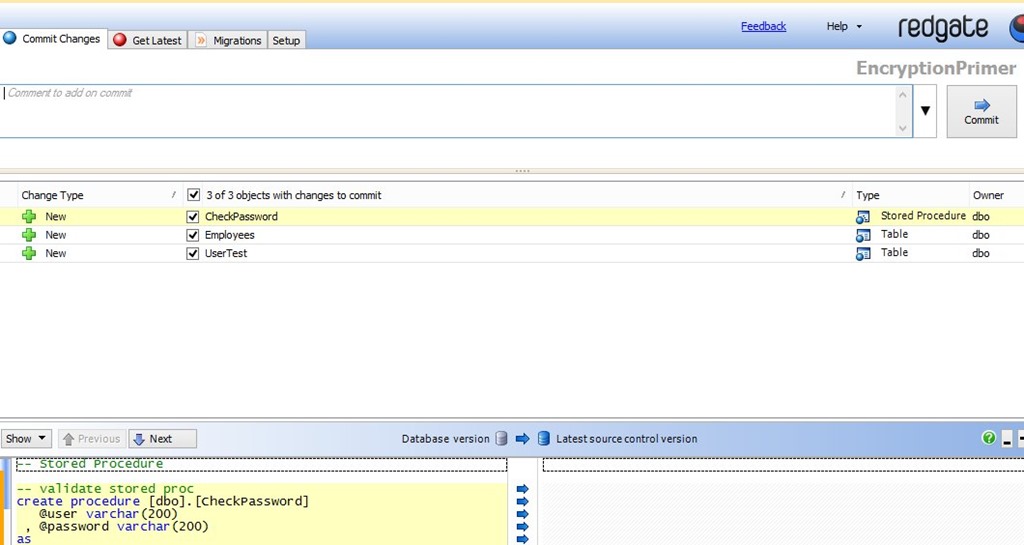
    I clicked the “Commit Changes” tab, and could see my three objects listed there as new items to commit.

    git_i

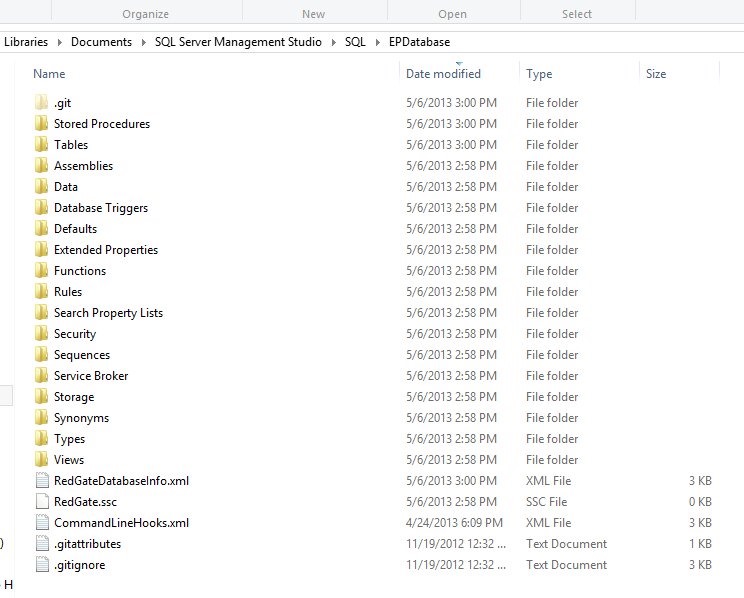
    If you have an existing database, this is the situation you’ll find yourself in most of the time. You link it, and commit all the changes. Once you enter a comment (please enter real comments you’ll understand), and press Commit, the objects are added to your folder. If I look at the folder, I see more stuff:

    git_j

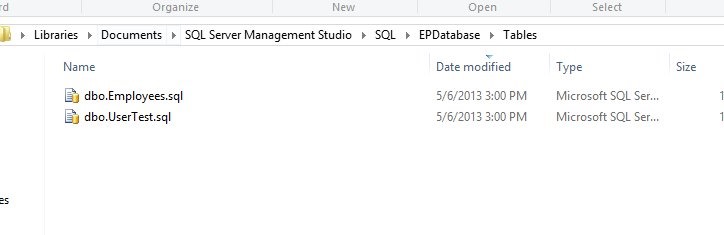
    Only a few folders have objects, and those contain the .sql files for those objects.

    git_k

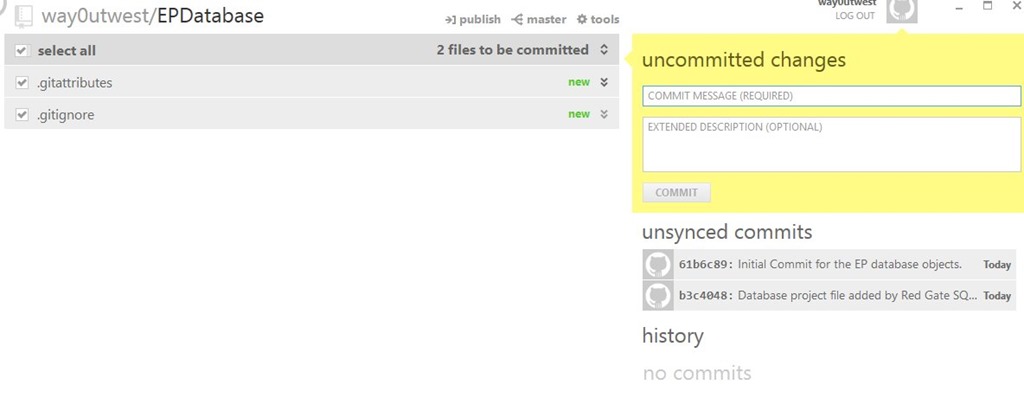
    If I look at Github, I see my comment and the changes are committed, but unsynced. If I press the “publish” button at the top, these are sent to Github.

    git_l

    That’s it. Any changes I make to objects, which I’ll show in another post, will commit to Git, and I can sync them to GitHub.


    Come learn more about these topics on the SQL in the City 2013 tour.

    sitc

  • Donating for a little kid

    One of my authors sent me this note:

    I know you only know me as a writer for SQLServerCentral, but I have a friend whose son is really bad. He is at the hospital and the cannot pay it. It is very expensive. The family is desesperate. They live in Bolivia.

    I am collecting some money for the Family. The sickness is: multiple sclerosis or disseminated sclerosis.

    If you would like to donate: http://cuentitosdeltio.blogspot.com/2013/04/donacion-alejandro.html

    I created a form in one of my blogs to receive donations. 10 $us or whatever donation is welcome.

    Thanks for reading this email

    I doubled the author’s payment out of my account and donated. If you feel like doing so, please feel free to participate. If not, please think about others in your life that might benefit from some charity and give back to the world when you can.

  • Fun at SQL Bits

    Last week was the eleventh SQL Bits conference and it was a fun time in Nottingham. I traveled over to the Red Gate offices for a few days before driving to Nottingham for the event. This is my second SQL Bits and it’s one of my favorite conferences. It’s a little bigger than most SQL Saturdays, with more amenities, but it’s a low cost and it retains the charm, casual atmosphere and fun that many of the larger events have lost. Spouses and children typically have little problem attending with the data professionals, and the less formal proceedings seem to make this as much of a social event as a professional one.

    The format is a little different from many events in that there are paid days (a nominal fee for a conference event) and a free day. You can attend part of all of the conference, and all of the sessions are filmed and available online. The event moves around the UK, and I’ve been to the Liverpool, and now, Nottingham, events. The East Mindlands Conference Center was a very nice facility, nice conference rooms and facilities, one of the better venues I’ve seen. The highlight of the event was the Friday night social, with a medieval theme. It was very surprising how many people participated.  I had expected the organizers to dress up:


    20130503-DSC07175

    However I was surprised to see many others, including the Red Gate staff

    20130503-DSC07208


    And dozens of others. As I was leaving the Red Gate office on Thursday, someone gave me a bag and told me to wear it. I hadn’t checked it until Friday afternoon, and I was a good sport in just putting it on.

    fpwll

    I had fun walking around throughout the evening, seeing the various costumes, some of which were amazing. The Lego costume was really stunning. I’m not even sure how I’d make that one. I haven’t seen a picture yet (and forgot to take one), but it was incredible.

    You can see more pictures here or check out the Facebook page.

    I delivered my Searching Binary Data talk, and it went well (I think). I also attended Matijah Lah‘s talk on semantic statistics and learned a few things. I saw an amazing advanced DR/HA talk from Christian Bolton, and a few more interesting sessions. I also marked a few more to watch later.

    I love most events, but typically the smaller ones, however I am looking forward to the chance to come back.