Category: Blog

  • Thirty Hours at Home

    This is a busy travel week for me, and one of those times that stresses out everyone in the household. I attended SQL Saturday #197 – Omaha over the weekend, arriving home Sunday morning from my trip. I had a good time at the event, my first time to Omaha, and would like to go back again sometime.

    However it’s a quick turnaround for me. Fortunately I have packing down to a science since I’m leaving today at 2:00 for Las Vegas and the first SQL Intersection conference. I have two talks to deliver on Tuesday and a few sessions I’d like to see Wednesday before I head home again.

    Back in time to cook a couple meals (and extra leftovers) for the family and spend a day with everyone before heading back out of town. These are tough times, and it’s a lot of support from the family that allows me to do this.

    I’ll have the same type of turnaround at the end of the month between SQL Saturday #175 – Fargo and SQL Bits.

    I may have to limit some trips later in the year after this month, so please don’t be offended if I decline any offers to speak.

  • The Windows on a Mac Experience

    I’ve had a Macbook Air for almost two years now, getting one in the fall of 2011. It was the first Mac I’ve had as a professional in the IT world, and I thought it was a great machine. I had read reviews from Brent Ozar, Joe Webb, and Aaron Bertrand. I had seen these gentlemen speaking and working on their machines at various events and finally decided I’d had enough plastic and cheap construction from vendors.

    Over the last decade, I’ve had as my laptop:

    • 2 Dell Dimensions
    • Toshiba Qosmio
    • Lenovo W510
    • HP Netbook

    Of these, the netbook is still in use by my daughter. One of the Dells, from 2003 actually, still works though the wireless radio is almost dead. The others have all died with various motherboard or power issues. Actually the other DELL may work. The battery died and I couldn’t find an adapter, so I moved on from that machine.

    When I moved to the Air, and OSX Lion, it felt like a complete switch at first. The OS works differently, and I was slightly concerned. I knew I could run Windows easily with VMWare Fusion, and that was my first purchase. After powering up the machine and getting connected to my network (a snap in OSX, despite me not knowing much about it), I downloaded Fusion.

    A Few Differences

    Installing things on a Mac is somewhat strange. It often involves a window that asks you to copy a folder into your Applications folder. That’s about it, and it starts working. Once I had things running, I could easily pin them to my dock for easy access, however the thumb-and-three-finger pinch was how I primarily found most applications, preferring to keep my dock clean.

    A few things took getting used to and re-configuring for me. The lack of a delete key might have been the most frustrating thing for me. I learned the Function+backspace works, but that was never a natural keystroke for me. Alt+tab, the cut/copy/paste commands work the same, though with the Command key instead of control. Right clicking was accomplished by configuring the two finger click to pop up the menu.

    However for the most part, things just worked. I easily worked with the machine, and even switched back and forth between Win 7 (under Fusion) and OSX without issues. My daily work of going through email, writing, browsing, all worked well. The main apps I used (Chrome, Evernote, SQL Server, twhirl) ran fine. One of the hardest things to get used to was the lack of a need to click an “OK” button once I’d made a change.

    I tried the full screen versions of some apps (Chrome, Safari, Pages, Evernote), but I found it to be annoying for me. I preferred a few windows that I could switch between easily. I never used the Dashboard thing, and for the most part this was a tool that did it’s job.

    The downsides of some software was apparent with OSX. No Live Writer, which I’d depended on extensively. I never did find an OSX replacement I liked. I also found Keynote to be a pain at times with some of my slides, especially shapes like connectors. They would be moved in Keynote, which was a pain to reformat. A few other minor software utilities I couldn’t run on OSX but found replacements for were slightly annoying, but not a big deal.

    The Things I Loved

    I have to say that I loved all the gestures and natural scrolling on the Mac. Using two fingers to move up and down through pages of text felt incredibly natural. When I borrowed my wife’s Wintel laptop and that didn’t work, it was annoying. I’ve had an iPhone for about 3 or 4 years, and that might have helped, but I instantly loved scrolling, as well as pinch and zoom. I never want a trackpad with buttons again.

    The startup routine, especially from sleep, was amazing. I could actually grab the machine from my bag in an airport, sit down, and start working inside of 10 seconds. It felt like no sooner had I opened the lid than I could type in my password. I haven’t had a Win 8 laptop, so we’ll see how that goes, but compared to all my other machines, this was one of the best things.

    Backup – Using Time Machine is just slick, smooth, and easy. Way smoother than anything I’ve seen under Windows. I could get back files much easier than I could with any Win 7 or earlier OS.

    The size – thin and light. I could grab the machine with my thumb and index finger by one corner and carry it. Haven’t found another laptop I could do that with.

    The last thing I really enjoyed was the ability of the machine to remember things. It remembers network connections, it pops up login boxes, it remembers settings with projectors. I’ve had some Wintels that did this, but none as well or smoothly as OSX.

    Conclusion

    Overall it was a fantastic laptop for me. I presented on SQL Server topics at two or three dozen events, giving probably a 100 talks with this machine and it worked every time. The one crash I had during a presentation was my VM locking up. I flipped back to Keynote and finished my talk while the machine restarted.

    This was the best built, best performing (ergonomically) laptop I’ve ever had. If I could get to 16GB with this thing, I’d still be using it.

    I guess there’s one more really annoying thing and that’s the lack of the easy ability to delete files. Right clicking and sending to the trash, or dragging there never felt right. I wish I’d have been able to highlight a few files and press a “delete” key.

  • Reminders and Rehearsal

    I’ve spoken at quite a few SQL Saturday events. I won’t hit 50 this year, like Kevin Boles, but by my count, I’ve been to 21, with 4 or 5 more coming this year.  I have no idea when I’ll get to 50, but I hope I do.

    Capture_028

    That’s in addition to other events, which will likely bring my 2013 total to close to 15 events, similar to what I’ve done the last few years. That doesn’t seem like a lot, maybe 1 every six weeks, but I end up doing multiple talks, on multiple subjects sometimes. There was a stretch late last year where I did 12 talks in 7 different areas in about 3 weeks. It was slightly confusing for me.

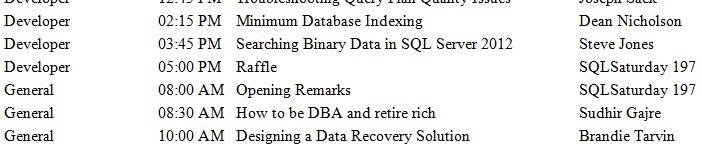
    Yesterday I received an email from SQL Saturday #197 – Omaha, which had the schedule in it. I’d glanced at it before, and had seen I was giving my Encryption Primer talk, but this time as I scrolled down, I saw my name at the end.

    sqlsat197

    Hmmm, that didn’t say “The Encryption Primer”. I’m glad I looked and double checked the schedule because I’m giving two talks. In addition to encryption, I’m talking FTS with Searching Binary Data in SQL Server.

    I’ve given the talk before, and I’m not too worried about it, but I do want to refresh my memory of the flow, and practice the demos again. I have given the Encryption talk a few times this year already, but I was planning on double checking demos again before the event. Especially as I changed the talk around and added some material for a variation I’m giving next week at SQL Intersection.

    I find it’s always good to rehearse my talks. I’m comfortable in front of people, and I know I can get through the talk, but I want things to flow and to make sense to attendees, The more practice I do, the better things go. The less “ums”, “errs” and other placeholders I use as well.

    Plus this will be good practice for SQL Bits, where I’ll deliver this talk again in May.

  • The Great Laptop Search of 2013

    It’s time for a new laptop. I don’t think it’s time, as I love the Macbook Air I bought a couple years ago. Rather some requirements for work, mainly Hyper-V, have come up and I can’t meet them with the Macbook Air. Even a 2013 summer refresh of this platform likely won’t get me what I need and I’m back to Wintel. I have a sad face, but since my daughter will likely inherit the Air, she’s smiling ear to ear.

    However that means I have work to do. Grant Fritchey went with a Lenovo W530, just getting a powerful machine. I had that form factor with a W510, and I had issues with the suspend/hibernate. However I also didn’t love the size of the machine. It was heavy and cumbersome and as much as I travel, I’d prefer something lighter.

    Ultrabooks are tempting, though I seem to only find them with 8GB of ram. The bare minimum I need. The IT group as Red Gate told me that I needed:

    • Windows 8 or Win 2012 for the Hyper-V images
    • Core i7
    • 8GB of RAM at a minimum, being prepared to give 6GB to our complex VM system.
    • 100GB of disk space
    • SSD preferred.

    That doesn’t’ give me a lot of choices in the sub 4lb range, 13” display range.

    If I was going to get a new laptop, a touch screen with Windows 8 is something that came to mind first. With that in mind, I started looking at the Lenovo X series, since I’ve had a few friends that liked those models. The X1 Carbon Touch got my first look. It’s a nice looking machine, but I’ve seen a number of complaints from people about order fulfillment for this model. That concerns me, since I would guess some of these issues are problems with the hardware. A few people I know have gotten the W530 in the same timeframes and there haven’t been issues. Besides, this machine tops out at 8GB, which is the base minimum I need.

    There were a few other machines I looked at, all in the touch screen, convertible form factor, which were interesting, but unfortunately these topped out at 8GB. That’s plenty for an ultra book or convertible that runs one operating system, even a couple virtual machines. However I don’t have control over my demo image, which others have noted really needs 6GB to run smoothly. The list I considered and rejected was:

    I suspect 8GB could work, but I don’t want to be limited if it doesn’t. We have a complex set of VMs to work with, and I think I need more RAM to be safe. After my post on the Surface Pro last week, I had a few other recommendations.

    I decided to examine each of those over the weekend and make a decision.

    I first looked at the ASUS. I’ve seen a few developers that liked this model, and it looks interesting. I can upgrade it to 10GB, which gives me a little breathing room. It’s small and thin, lightweight, and looks good. However I decided to skip this because the 10GB makes me only slightly less nervous than 8GB. I decided to check other options.

    The Toshiba is a nice machine. I used to have a 15" Qosmio, and I liked the machine. I ditched it when Toshiba wasn’t very helpful with Windows 7 drivers for my model. My son had it for about 6 months before the motherboard died, but during the 3 years it was my main machine, it worked well. The R930 looks nice, and has most of what I need. Worth considering further.

    The Sony was interesting. I’ve never had a Sony, but I’ve heard good things from people about the laptops. The Duo would have been a choice for me if it held more than 8GB. The S Series is interesting, and it goes up to 12GB of RAM. That’s likely enough for me. The display is 1600×900 and it’s under 4 lbs. It seems to meet all the criteria. A few reviews didn’t love the keyboard, and they mention going to 12GB of RAM means single channel access. I’m not sure how big a deal this is, but it’s one item.

    The Lenovo T-430 meets my criteria as well. A nice 1600×900 screen, 16GB of RAM, and it has the eraser head mouse movement. I have liked that format since IBM introduced it in the 90s. This one is a touch heaver, but it gets good reviews, and it’s a format I’m familiar with. It also has the advantage of the switching out the optical drive for a second SSD. That is what I did in my W510, and it’s what I’d likely do here as well. The T431 looks better, but since it’s not yet out, I can’t consider it.

    In weighing all the options I finally decided to get the Lenovo T431. The Toshiba was close, but I know the Lenovo product and the ultra bay that would let me stick in two drives was appealing. The Sony worries me slightly with 12GB with mismatched memory. Not a lot, but all things being equal, the T431 seems like a good fit for me.

    It’s ordered, and on the way. As soon as it comes, I suspect I’ll be looking for a new laptop bag as well, but we’ll see how this one fits in my existing bag.

    Now to learn a bit more about Hyper-V.