Category: Blog

  • Customizing SSMS – Bigger Queries

    This is a short series on some customizations in SSMS to make it visually more appealing.

    As a presenter, I’ve learned how to change the way Management Studio (SSMS) looks to make it easier for people to see the screen on a projector. I had wrongly assumed that so many people knew many of these tricks, which is a poor attitude on my part. That should be especially apparent as I saw a presentation recently where the speaker didn’t know how to make things easier to see.

    Here’s another item I saw someone struggle with recently, the query font size.

    The Default View

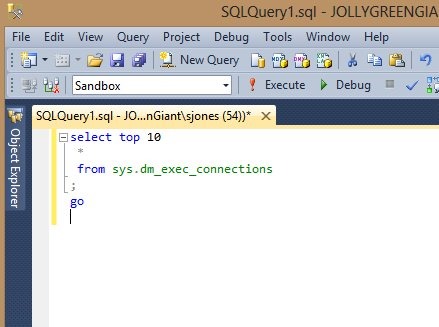
    When you install SSMS, this is what you often get, and how your queries look:
    ssms_f

    Not easy to read, especially for these old eyes. When someone uses the default settings in SSMS and presents on a big screen, I am usually struggling to see, sometimes even when I sit in the front row.

    Customizing

    You can make SSMS easier to read for yourself in a couple ways. The first is the quickest, but it’s a change for only the current SSMS execution. If you close and re-launch it, things will return back to the previous settings.

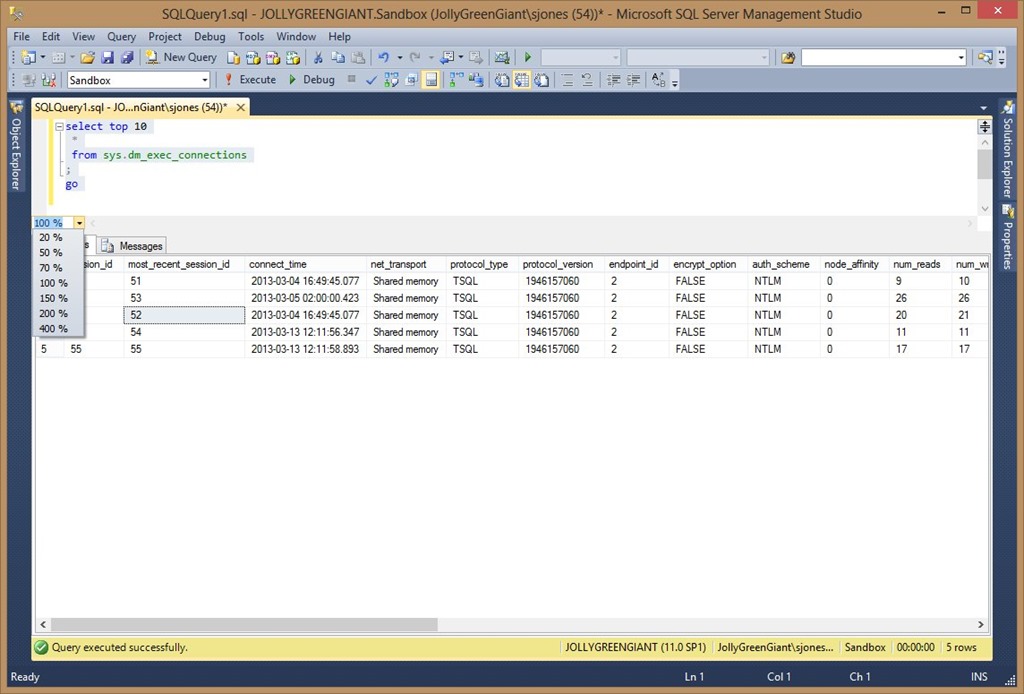
    If you look below the query and above the results, there’s a drop down that says 100% in it.

    ssms_g

    If you click that, you’ll get a drop down of some percentages you can choose.
    ssms_h

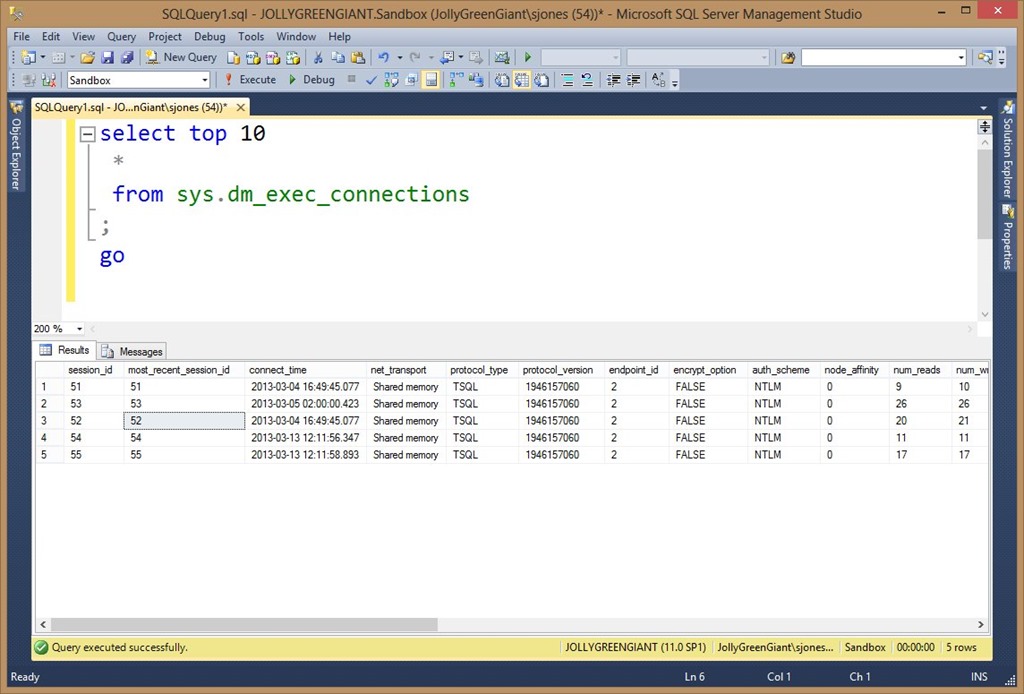
    These percentages will change the size of the query pane. For example, if I choose 200%, you can see things are much easier to read. The query pane is much better than the results. This is great for quick changes when you are presenting.
    ssms_i

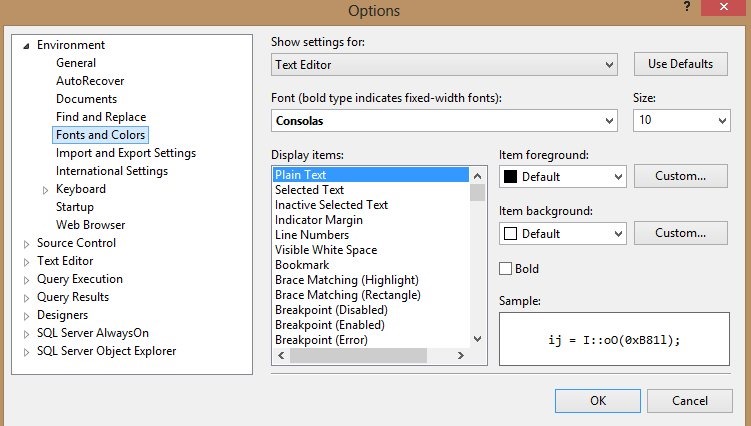
    For permanent changes, this is what I quickly do. Go to the Tools menu at the top of SSMS and select Options. You will get this dialog:
    Capture_002

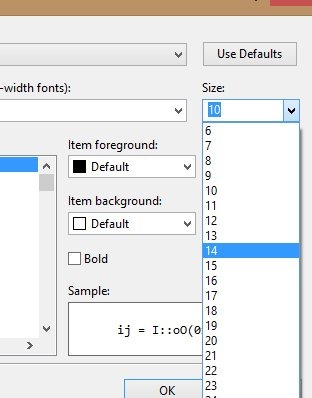
    I’ve selected “Fonts and Colors” from the left already, but once you do that, there’s a “Size” drop down on the right. Choose that.
    Capture_003

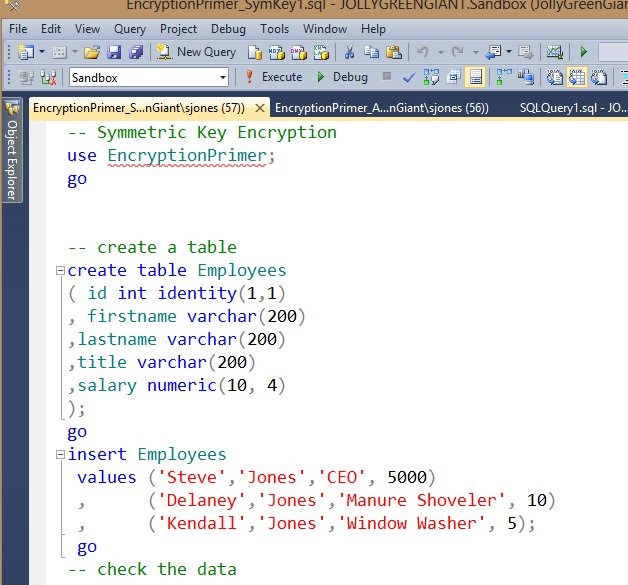
    I usually set that to 14 and it looks good for me. A balance of large size, but still being able to get lots of code on the screen.
    Capture_004

    This make it easier to read your code. In another post I’ll talk about results.
  • It’s a Lineup at SQL Intersection

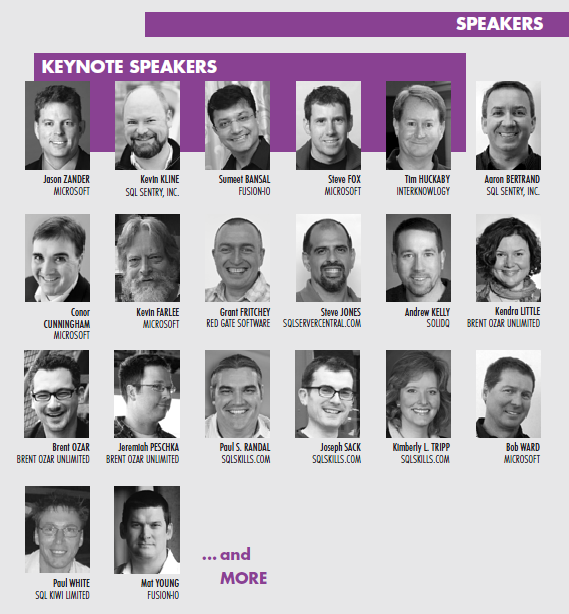
    I got this image in the mail recently, and it made me laugh. It looks like a police lineup, perhaps something from The Usual Suspects.

    Speakers

    I don’t think there are any suspicious looking characters in there (though maybe the third and fourth from the left in the second row qualify), but you never know.

    This is quite a lineup, and I’m honored to be a part if it. SQL Intersection, put together by Paul Randal and Kimberly Tripp of SQLskills, is taking place in April in Las Vegas. From the 8th to the 11th, there will be some amazing sessions being delivered to teach you about SQL Server.

    Register today (use the code “Jones” to support me) and I hope to see you there.

    NG-regbutton

  • Branding Yourself for a Dream Job – The Modern Resume

    This presentation is a career based one designed to help people better market themselves and understand how employers might view them.

    Abstract:

    Everyone wants a dream job that they enjoy going to each week. However finding that job, and getting yourself hired can be hard for most people. Steve Jones will give you practical tips and suggestions in this session that show you how to better market yourself, how to get the attention of employers, and help improve the chances that the job you want will get offered to you. Learn about networking, blogging, and more.

    I maintain a blog on this talk at: modernresume.com

    Slides:

    You can download the slides here

    Branding Yourself for a Dream Job 2013


  • Customizing SSMS – Hiding the panels

    This is a short series on some customizations in SSMS to make it visually more appealing.

    As a presenter, I’ve learned how to change the way Management Studio (SSMS) looks to make it easier for people to see the screen on a projector. I had wrongly assumed that so many people knew many of these tricks, which is a poor attitude on my part. That should be especially apparent as I saw a presentation recently where the speaker didn’t know how to make things easier to see.

    Note that I often caution writers not to assume too much from the reader, and here I took it one step further, assuming some topics weren’t worth writing about.

    Here’s one that I heard asked recently: how do you hide the side panels in SSMS?

    The Default View

    Here’s what SSMS looks like for most people.

    ssms_a

    The Object Explorer takes up a good portion of the screen on the left. For some people, they may have this:

    ssms_b

    Or even this:

    ssms_c

    In the last two images, the Solution Explorer and Properties panes are on the right. If you have these panes open, you might find yourself squeezing a query into a small space in the middle. If your resolution is 1024×768 (standard for many projectors), you might get very little on the screen.

    Customizing

    There’s a way to clean things up quickly and easily. All of these panes have this item in their upper right sides:

    ssms_d

    If you click the middle, pin icon, the “Auto Hide” will be enabled, and the panes will slide to the side. They’ll still be there, but now they’ll be in a side bar, like the Object Explorer is below:

    ssms_e

    If I hover the mouse over the “Object Explorer” button on the side, it will appear, or I can click it.

    I can always use the “View” menu at the top as well (or a shortcut) to expose any of these panes. However when I’m presenting, or want to make a quick change, the “auto hide” feature works very well for me.