Category: Blog

  • Publishing in the Future

    A few interesting ideas and experiments in this piece on 21st century publishing. I especially like the part about most of the money in publishing going to pay for these advances that aren’t earned back. While publishers make a lot of money (go peruse a few annual reports), there are definitely some issues with money being given to authors for projects that are a complete gamble.

    The idea of shorts, and potentially subscriptions, is something I’ve thought of before. If I could ever get off my duff and do more writing, maybe I’d be able to earn some $$ that way.

  • Creating a Service Master Key in SQL Server

    The basis for all the encryption in SQL Server is the Service Master Key, which is the top of the encryption hierarchy. You can see the image below from Books Online of how this is setup.

    The service master key is automatically created when you create a key that needs it, usually a database master key. So there is no CREATE SERVICE MASTER KEY command.

    This key is encrypted and protected by the Windows DPAPI and the linked to the SQL Server service account. Since it secures all other keys in the encryption hierarchy, if you regenerate it, or restore it, all other keys it protects must be decrypted and re-encrypted. That can be a resource intensive operation, so don’t do that lightly.

    You can regenerate a service master key, and you do that with the ALTER SERVICE MASTER KEY command like this:

    ALTER SERVICE MASTER KEY REGENERATE

    That’s it. If it works, no errors, no results. If an error occurs, you’d need to deal with it. However this isn’t something you should run often, and if you encounter errors while doing this, I’d suggest you immediately stop, backup all databases and master keys, and then work through the issues.

    In another post, I’ll talk a little about the alterations you can make to the Service Master Key and how to back it up or restore it.

  • How to change the SQL Server service account

    It’s easy. First you click here:
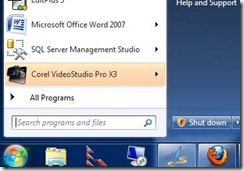
    serviceaccount1

    Then you find the SQL Server 2008 or 2008 R2 program group
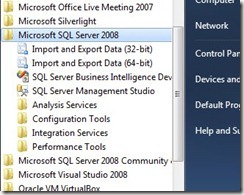
    serviceaccount2

    Open those and then pick the SQL Server Configuration Manager.
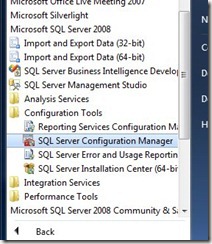
    serviceaccount3

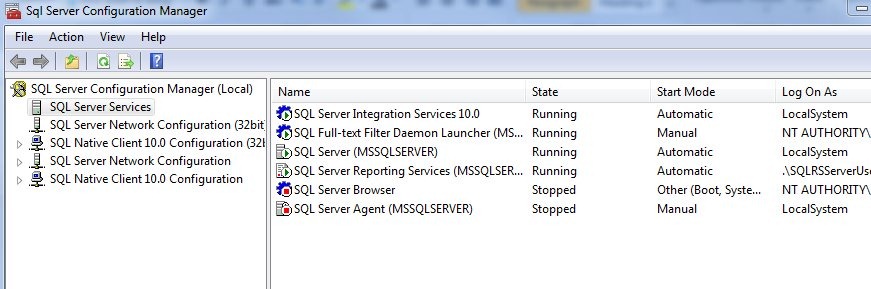
    You might get a UAC message asking if you want to make changes to the system, and say yes. This application can change service accounts, which is a sysadmin function. The screen basically looks like this:

    serviceaccount4

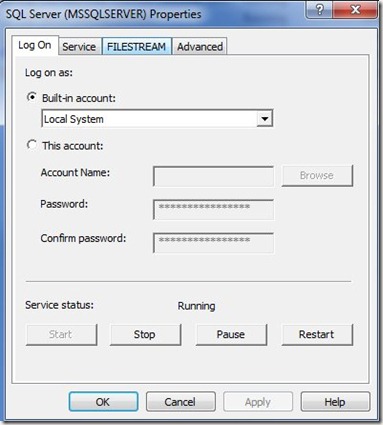
    If you right click the SQL Server entry, the database engine, you can select the properties, and you’ll get this screen:
    serviceaccount6

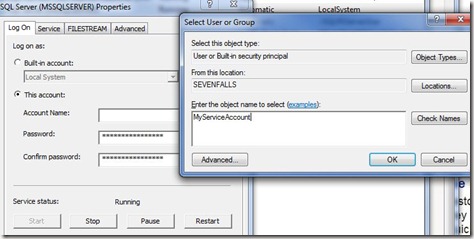
    On this screen, you can change the service account, and this is where you should change it. There are the three built in accounts in the top drop down (Local System, Local Service, and Network Service). I don’t recommend these. Instead, I recommend you create a new Active Directory Domain account (or local user account), assign it no rights, and then use the lower radio button to select the account.
    serviceaccount7

    Note that you do can search for it, and also you need to enter the user account. The password, while conforming to your domain policy, shouldn’t be one you use elsewhere. Make it a long, impossible to guess combination of stuff. You don’t need to recover this or log on as the user after you’ve assigned it to SQL Server. If you need to recover the password, just change it.

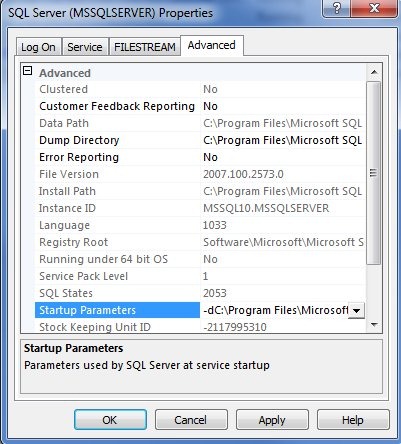
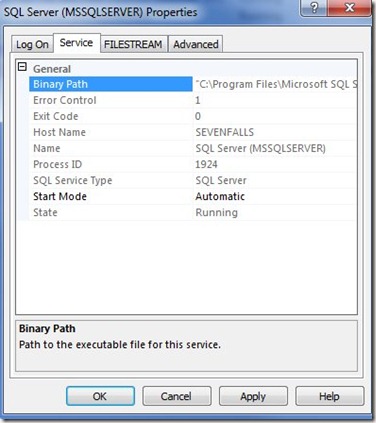
    A couple quick notes, on the Service Tab you can set the startup mode (Manual, automatic) for the database engine.
    serviceaccount8

    You can also change startup parameters here, on the Advanced tab.
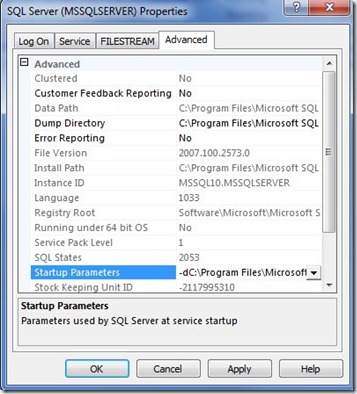
    serviceaccount9

    That’s it, it’s easy, and it’s how you should change the service account for SQL Server.

  • When in trouble, upgrade

    When in trouble, upgrade.

    That’s what I did the other day, when I found my Corel VideoStudio X2 (v12), wouldn’t play any videos. It was podcast edit day, and I was on a deadline. I know this is the worst advice, and not necessarily what you want to do, but X3 had come out late last year, and I’d even purchased an upgrade this past summer. I didn’t think I’d get any support on the old version, and the new version had proven very stable for many people.

    I hadn’t upgraded until now because the last upgrade I did, from v10 to X2 had taken me a few days to reset some of my clips, reload settings, etc. I was worried about the time involved, but after restarting my machine a couple times and trying different things with the software, I decided to try the upgrade. I searched through email to find my license key, discovered the X3 installation file in my \Downloads folder, and performed the upgrade.

    The installation was slow. Unpacking the installation files to get to the EULA took 10 minutes on my quad core desktop. From there, it was a simple matter to agree, input the serial number, and let the installation run. I have no idea how long it took because I left my desk to run an errand, and came back 20 minutes later to find it complete. Everything went smoothly, and apart from a couple of buttons I use being moved, everything seemed to function as before. It was even a little quicker when rendering video!

    Running an upgrade to fix an issue is not necessarily what I’d recommend for most people. It’s a sledgehammer fix for a potential screwdriver problem. Really you ought to work through issues with your vendor, and if you are really stuck, perform your upgrades on a test system, and actually test the process.

    In my case, I had a backup of the video files, and I also had a fallback to use my laptop to edit the video. It would have entailed a little setup and probably burned an hour, which is something I need to do, but I had a backup plan ready in case this didn’t work.