Tag: career

  • An Active Job Search

    I caught this link in a Brent Ozar newsletter. It’s a post from Alice Goldfuss noting she’s on the market for hiring. Not that she’s looking for a job, but rather, saying she’s willing to talk to you if you want to hire her. Quite a bold announcement, but she’s quite a talent that many organizations might want. I don’t know that many of us could post something and have companies come find you, but I did like the list of items she lays out for a hiring conversation.

    These are the types of questions that you might keep handy, even as notes, for your next interview. I’ve often had a series of questions like this that I ask when I go into an interview for a job. I’ve learned that I need to be curious and careful if I want a successful position for both me and the company. Both of us are trying to put our best foot forward, sometimes stretching the positives and minimizing the downsides. That means that both sides can be surprised later by how the relationship actually proceeds.

    Many of us proceed from job to job, often taking the first offer we get whenever we are looking for a job. That usually occurs because we need to make money and cover bills. The timing of job interviews and offers usually means that we can’t often consider two at once. Sometimes we can, but it’s been rare for me.

    My view has been that the best time to find a new job is when you have a job. If you are unhappy, or you feel that you want a better position/challenge/compensation/etc., then look for alternatives. If for no other reason, you should be aware of how your current job compares to others. It’s easy to get complacent and not realize that the world of employment has changed dramatically.

    At the same time, I also ask you to actively think about the things that you like and don’t like about your job. Think about what you really want from employment. It could be the compensation, the hours, the challenge, the colleagues, the benefits, or anything else. Make a real list, and then assign some weights to these factors and decide what is important to you. I actually like the Thymometrics that Redgate uses to track employee satisfaction, and I take the data I’ve entered and use that to evaluate my own satisfaction with employment. I do this every year, making an evaluation of my own position and then making a conscious decision to stay. I’ve written about the service, and I love it.

    For 14 years I’ve made the decision to stay in my position, usually because I don’t find other positions offering a better balance of the things important to me. I could make more money, but I’d have to change other things, and I haven’t found the overall value from alternatives to be worth me making a move. I hope you can say the same, but in order to do that, make sure you are actively thinking about what you want from employment, evaluating your current environment, and then actively managing your career in the way the direction that matters to you.

    Steve Jones

    Listen to the podcast at Libsyn, Stitcher, Spotify, or iTunes.

  • DP-900: What’s a Region and an Availability Zone

    This is part of a series on my preparation for the DP-900 exam. This is the Microsoft Azure Data Fundamentals, part of a number of certification paths. You can read various posts I’ve created as part of this learning experience.

    This isn’t covered per se on the exam, but it does matter for understanding some other concepts, like reliability and other HA (high availability) concepts. I decided to do a quick post on these concepts as learning them helped me better understand some other things, like LRS and ZRS.

    Geographies

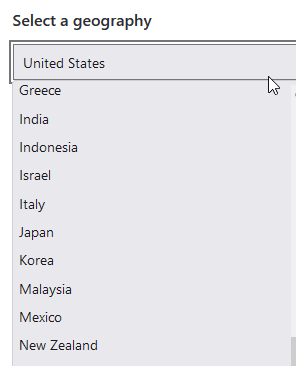
    I didn’t see this on the test, but it could be in the pool of questions. A geography is roughly a country, but not always. You can see this list in the link below:

    Azure Geographies

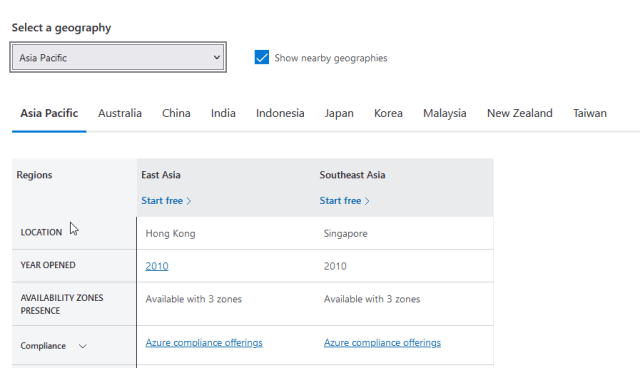
    Note there is an “Asia Pacific” geography, which is Hong Kong and Singapore listed as regions.

    2 regions in Asia Pacific

    Region

    A region is an area in a country. Regions don’t span countries, and there can be multiple regions in a country. Microsoft has a list of regions available in various geographies. As an example, if the United States is selected, you can see these regions:

    • Central US (Iowa)
    • East US (Virginia)
    • East US 2 (Virginia)
    • West Central US (Wyoming)

    and more. If you pick the UK, you will see UK South and UK West (as of Feb 2022). These are located in the London and Cardiff areas, respectively.

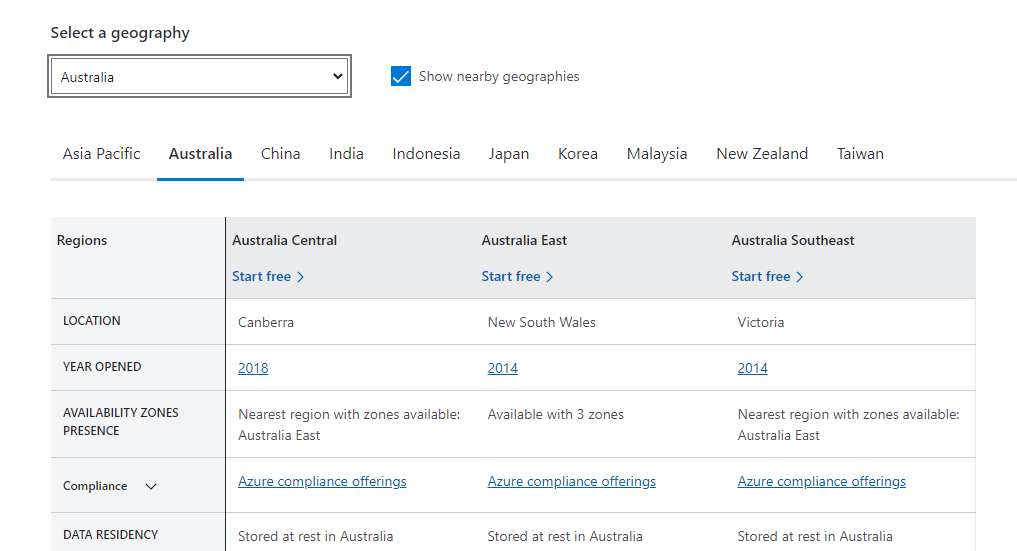
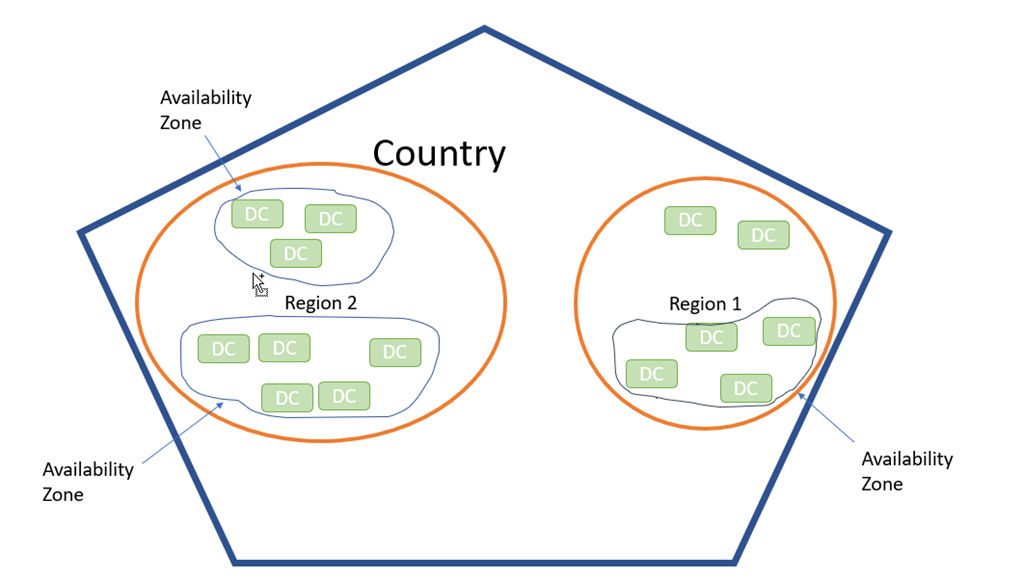
    You can think of a country as divided into regions, separately from their province/state/county governmental borders. A set of data centers is then built to make up a “region” for Azure. The Australia regions are shown in the image below:

    2022-02-04 08_59_42-Choose the Right Azure Region for You _ Microsoft Azure

    In the image we have a Canberra location,  which is a city. Victoria and New South Wales are states, and the location in these states isn’t specified. Some inconsistency here, but think of a region as an area in a country. This region provides a low latency network between the various data centers in the region.

    Regions are a unit where different services are provided. Not all regions are equal as some capabilities are deployed in some regions first. It is always important to verify a particular service or feature is in a particular region before you plan a deployment.

    Availability Zone

    The Availability Zone concept is a more ephemeral one. This is a set of data centers inside of a region. These are within a latency boundary, meaning that network communication between hosts in two different data centers is 2ms of less.

    When you have at least 3 data centers inside of this latency boundary, they an comprise an Availability Zone. This is a concept for redundancy purposes and to survive some sort of disaster in a single data center. If a single data center loses power or some other issue, the other data centers in the AZ can take over. This could be a single server or rack of servers failing as well, with servers inside another data center in the AZ taking over.

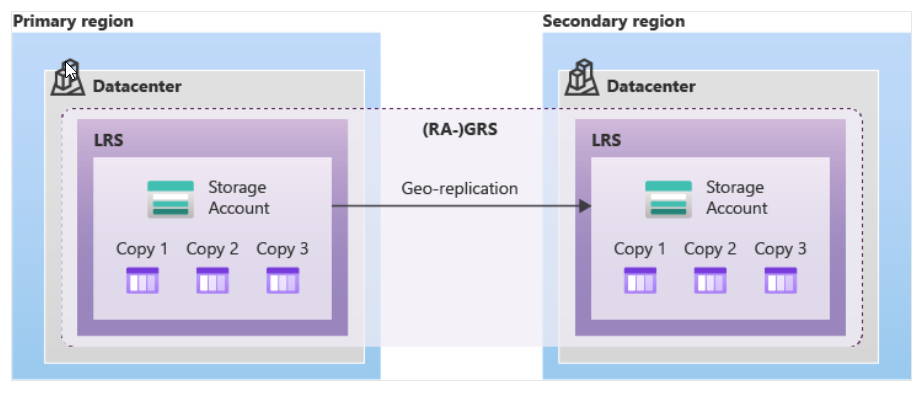
    Zone Redundant Service (ZRS) is the concept here that is used with an Availability Zone. With this, there are copies of the service in the different zones that allow a service to continue to function, despite a local failure in a DC. This is in contrast to Local Redundant Services, which have multiple nodes inside of a data center, but would be unavailable if that particular data center failed.

    Here is an image from MS Docs that shows there are three zones inside of a region that are connected together.

    2022-02-04 09_37_19-Azure regions and availability zones _ Microsoft Docs

    The documentation notes there are a minimum of 3 zones to have an AZ, and I’m guessing some regions potentially have 4 or more zones to ensure services are uninterrupted and capacity is available.

    Overall Hierarchy

    I didn’t find a great image that explains things. I made a simple one, showing a country, with regions, then AZs, and data centers.

    2022-02-04 09_36_50-Presentation1 - PowerPoint

    Note, Azure calls areas of the world geographies. So the US is a geography, which might help if there were governmental or political changes over time.

    The basic idea is to understand this relating to storage, which will be another post where I examine the different levels of protection offered by Azure.

  • The Battlefield of Your Career

    Jeff Atwood has had quite a bit of success in his career, having been a founder of StackExchange and Discourse. He’s a fellow alumnus of the University of Virginia, along with Alexis Ohanian. Both of them have had a higher profile than me, and I admire what they’ve accomplished. I also think they’ve both been advocates for the technology industry, helping and advising others on how they can succeed in their own careers.

    Jeff has been writing interesting posts about hardware and software for years, but the latest one struck me. It’s called Learning on the Battlefield, and it has a lot of the same advice that I recently gave someone. In the post, Jeff notes that approaching your software career is like learning on the battlefield. It’s like making weapons and coming up with tactics. You really need to test them on the battlefield.

    Note, I wouldn’t expect that this means we test ideas in production, but rather, that we do test them in a live way, actually using the software. In QA, of course.

    Jeff notes that the work of building software is more important than schooling. I agree. I also think that the closer you can get to simulating work, the better off you are when you interview, or even when someone examines your body of work. His advice is to get an internship, go to user groups, build OSS, publish articles, and blog.

    All of these things are raising your brand. That’s a lot of what I’ve been writing and speaking about for over a decade. It’s the advice I gave someone recently who wanted to not build software, but become a DBA. Do the work, set up a test lab at home, in Azure or AWS, and then write about it. Blog about what you learn, how you do things, what others advised you about, and even the mistakes you’ve made.

    Don’t be perfect, don’t try to show a hiring manager you know everything, but rather show them that you know some things and can learn others. We all make mistakes, even those of us that blog a lot. We can write about mistakes and still impress people.

    Make your job search, your career advancement, or your desire for a raise/promotion/project, a battlefield. Do things and share your experience. Tell us about your first year of something, and more importantly, learn to practice communication. Add this to your CV/resume as a body of work, and I am sure that you will find it helps your career.

    Steve Jones

    Listen to the podcast at Libsyn, Stitcher, Spotify, or iTunes.
  • OLTP Star, Snowflake, and Galaxy Schemas

    This is part of a series on my preparation for the DP-900 exam. This is the Microsoft Azure Data Fundamentals, part of a number of certification paths. You can read various posts I’ve created as part of this learning experience.

    There are types of schemas the exist in data warehouses. This topic is definitely on the exam.

    OLTP/Relational

    The type of schema that many of us work with is the standard OLTP or relational model. We have lots of transaction tables, most should have a PK, some of which have PKs. The schema expands to meet different needs and can have lots of entities.

    As an example, here is a view of the AdventureWorks database.

    adw_er

    This isn’t fundamentally different from the schema types below, but there isn’t a central, or two central, tables here. Instead, we have a lot of different groups of tables. The structure is designed for normalization, and usually has lots of tables compared to a data warehouse.

    Star

    The star schema is often used in data warehouses. The name comes from the fact that the table arrangement looks similar to a star. There is a central fact table, which has some details of the main data, often something like sales, and a lot of foreign keys (FK).  The fact_sales_order is the fact table below.

    Then there are supporting tables around the fact table, linked by the FKs. These are the dimension tables, and contain details about a specific dimension or area. In the image below, we have date, employee, store, and other dimensions tables.

    5690_create-star-schema-data-model-using-microsoft-toolset.028

    This is a somewhat de-normalized structure, as the primary purpose is to report on a set of facts.

    Snowflake

    This schema builds on the star schema. Here there is still one fact table (Sales below), but the dimension tables have their own dimension tables, providing more details. Essentially, the dimension tables are normalized. An example is the Employee dimension, which has a linked Department dimension.

    Capture-163

    Galaxy

    The galaxy schema expands with a second fact table. In the image below, we have the sales and purchase as fact tables. There are dimension tables, which can be linked to one or more fact tables.

    Galaxy-Schema

    It isn’t that important you know how to build these schemas or design the entities for the DP-900 exam, but you do need to recognize the structures.