Tag: career2

  • Learning C

    Head First C
    I think C is important to teach the basics of programming.

    Someone else gets it. Besides me, I mean. We should be teaching people the C programming language. An interview with David Griffiths, author of Head First C, says that learning C is a good idea. I concur, and I stand by my statement.

    It’s not that I think everyone should be a C expert, but I’d like to see more programmers spend 5 months, a semester, early in their programming careers. If you’ve written your own iOS app, this would be a piece of cake. If you’re a Python guru, it would broaden your horizons. Getting closer to hardware helps you write code in a more thoughtful way.

    I’d like to see a C programming course as a semester requirement for quite a few fields that might need to develop programs. Not only computer science majors, but also scientists that might need to deal with building their own algorithms. In the same vein, perhaps it’s worth a SQL class for everyone to better understand how to work with sets of data. A query class could also include some of the other query languages, perhaps MDX and XQuery would make sense as well.

    I know this sounds like busy work, but as we become more and more dependent on data and scripting for all sorts of jobs I think it makes sense to start setting a baseline of expected skill for knowledge workers. Those people that knew programming could potentially pass a C test,  and they would be exempt. As we evolve into the future, especially as we may move to more vocational type training, I think it would be good to still require some basics of people as they begin their journey to working with code and computers.

    Steve Jones


    The Voice of the DBA Podcasts

    We publish three versions of the podcast each day for you to enjoy.

  • Milk

    cow
    It’s amazing how much knowledge goes into selecting cows for milk production.

    I love this quote: “[we] ran it through a fairly sophisticated computing gobbledygook. It spit out at the other end predicted transmitting ability, predicted genetic values of whatever sort.”  How would you like to explain your complex analysis to a business user using those terms? In most cases, those might be the best way to describe things to most users.

    However that quote comes from a scientist that has spent a lot of time and knowledge refining models and using lots of data to try and predict the bulls whose progeny will result in the best dairy cow performance. The article is very interesting and talks a bit about the complexity of using genome data on cattle and how far it is from the experiments Mendel performed on pea plants. I still remember the dominant/recessive gene explanations from biology, though that explanation seems simplistic now. Comparing it to the work done by scientists predicting cow performance is like comparing horse drawn carriages to Formula 1 race cars.

    Big data is in the news, with so many companies building products they want to sell to help you tame, analyze, and use the data your organization has available. However as this article hints, it’s much more than managing all that data. There is a tremendous amount of knowledge and intelligence needed to use those tools and actually generate useful information.

    As data professionals, we don’t necessarily need all that knowledge, but we do need to communicate with those individuals that may have the knowledge and work closely with them to ensure their ideas are accurately applied against data in the algorithms we write. In addition to writing code and understanding statistics, strong communication skills are important to moving your career forward.

    Steve Jones


    The Voice of the DBA Podcasts

    We publish three versions of the podcast each day for you to enjoy.

  • Better Bosses Needed

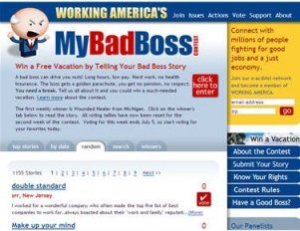
    Bad Boss Contest
    Hopefully your boss wouldn’t end up in this contest.

    Raise your hand if you have a bad boss. Now raise your hand if you’ve ever had a bad boss. I can’t quite make a count, but I’m hoping that those of you with raised hands constitute a minority of my readers. I’m somewhat afraid that you probably constitute a majority.

    That’s not such a bad thing, right? After all, many of us have had lots of bosses, starting at age 16 or 17, and continuing on through today. There’s a good chance that somewhere along the line we had a really, really bad boss. The people that used to manage paper boys, or clerks, or fast food cooks aren’t known for their superior leadership skills, are they?

    However you would think that in business that developing good managers would be a priority, wouldn’t you? So many people seem to lavish much of the success in business on management, so one would think that companies actually do spend time and money to train managers to be excellent at their jobs. Please stop laughing, you’re distracting me from continuing.

    Those of you that have been managers know that all too often there is no training. People are thrown into the job, expected to manage while learning on the job. Those that survive, or perhaps thrive, get promoted. Unfortunately that’s the theory. All too often I find those that please their boss are promoted.

    A bad boss can be rather damaging, and in these days of complex systems, short deadlines, and a struggle to to find good employees, wouldn’t you want to keep as many good employees as you can? If you can’t train great managers, can you at least train them to not be bad ones?

    Steve Jones


    The Voice of the DBA Podcasts

    We publish three versions of the podcast each day for you to enjoy.

  • A Really Good Job

    Kilt Day
    We have the best jobs in the world, but you can find a really good job if you work at it.

    I write a decent amount about career topics. In the discussions for these pieces, all too often I see comments from people that they aren’t happy with their job. They have a bad boss (which is really bad), or they aren’t challenged. They have long hours, low pay, or both. It’s sad, but I know how they feel. I’ve had some bad jobs in my life, jobs that I was forced to keep doing until I could find another one.

    I do try to get people to think about looking for other jobs, and I think there are great ones out there. I’m not the only one. Brent Ozar had a post on how you might find your first good job, that of an evangelist. It’s good advice, and I like the analogies he uses, but the key takeaway from his post is the people that get really good jobs work for them.

    They don’t study SQL Server to be the best MCM in the world. They don’t work 100 hours a week at their current job to impress future bosses. They take charge of their lives. They make a plan, perhaps a Dan Plan, and they set goals and work towards them. They make methodical progress over time. My wife and I made a plan for her, and it took years to get to the point where she could quit, but we got there, and she’s happier than she’s ever been.

    You don’t have to want to be an evangelist like Grant Fritchey or myself. You don’t have to want to even become an expert in your field. But whatever you want to do, it’s up to you to get there. Whatever a “good” job is for you, I’d urge you to set your sights on making that a reality.

    Steve Jones


    The Voice of the DBA Podcasts

    We publish three versions of the podcast each day for you to enjoy.