Tag: Cloud Computing

  • The Platform Problem

    A fantastic platform. If I had a choice of where to run it.
    A fantastic platform. If I had a choice of where to run it.

    I really like the idea of Azure providing a Platform-as-a-Service (PaaS) for applications to be built on. As I’ve evolved in my career, I’ve learned I prefer not to manage individual machines or deal with the complexities of configuring anything outside of SSMS for SQL Server. Working with Hyper-V recently has cemented the idea that I don’t become more productive by dealing with the complexity of the Windows host.

    However I can’t see many customers migrating the majority of their applications to the PaaS Azure service for one reason: there’s no competition.

    Moving to Azure means placing a big bet that Microsoft will continue to offer the same or more features, more powerful machines, and stability at a reasonable price. Moving to Azure also assumes that you are comfortable working with only Microsoft for the foreseeable future, using their data centers, staff, and products. Any code you write will be specific to Azure.

    If you were to use the IaaS services from another vendor, like AWS and their virtual machines, a migration might still require some code changes. However, I’m sure if I contracted for virtual machines from Rackspace or some other provider, I could easily redeploy my application elsewhere. Well, perhaps not easily, but certainly easier than if all my code depended on a platform I can’t run inside my own data center. A platform nobody outside of Microsoft can run.

    My view is that Azure is a great platform, and one that could explode in usage. If we have choice.

    Microsoft should sell us the code to run inside our own data centers, or at least license it for a number of large providers that might want to offer Azure services. Ultimately the success of the platform depends on people choosing Microsoft because it’s the best choice, not because it’s the only one.

    Steve Jones


    The Voice of the DBA Podcasts

    We publish three versions of the podcast each day for you to enjoy.

  • State of the Cloud

    The Azure cloud is doing well.
    The Azure cloud is doing well.

    Microsoft has joined the billion dollar club. For Azure, that is. They announced that this platform and service will generate a billion dollars in revenue. It’s been growing, and at least one analyst expects the revenue to double annually. Profit is something else, but I know from various people at Microsoft that they are working hard and investing heavily in this service, and I’m sure at some point it will be profitable, though I’m not sure how much.

    Amazon has had a very successful AWS platform, providing a wide variety of services and products. Their aim is to go for the high volume, low margin business, which makes their service competitive with the costs of buying and managing your own hardware. As long as Amazon and other competitors are out there, I suspect cloud services will be cheap enough to make many companies consider moving some of their infrastructure to this type of environment. It certainly eases the time and effort of building new machines and encourages better development habits.

    As IT departments, especially the management of those groups consider using cloud type services, they still have to be aware that this isn’t a savings that comes for free. Code changes, staffing skill growth and mindset evolutions to take into the account the challenges of working in a cloud environment, as well as the SLAs that seem to favor the cloud providers more than the cloud customers, mean this isn’t an easy decision. Add to this the potential tax implications, and the decision to move away from current IT practices is not always obvious.

    The idea of cloud computing, and cloud services, is still very immature. From the definition of what this means, to the offerings, to the architectures, the industry has a lot of growth to do before most of us will feel comfortable moving substantial parts of our infrastructure out of our own facilities.

  • Development, Operations, or Accounting

    These kinds of problems should not happen in the cloud.
    These kinds of problems should not happen in the cloud.

    I think the idea of a platform of services, such as Windows Azure provides, is a great idea. I’d love to be able to stop worrying about hardware in many cases, and even skip some of the infrastructure of networking and managing specific machines. Just having services that I could deploy to that run my database and code, would smooth out some of the hassles of Information Technology in many companies.

    However the services have to work and work well.

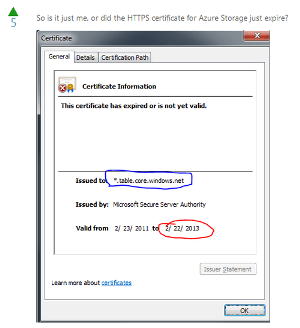
    I’ve had concerns with AWS and their outages, though Netflix has run a thriving business on that platform and learned to work within that service. I think the Azure platform is similar, and they’ve had a few outages, I do have concerns over where their outages have occurred. There was an expired certificate, then supposedly maintenance, later revealed to be heat issues.

    These issues bother me. Some are unavoidable, but some aren’t. I’m particularly concerned about the expiration of security certificates. This happened again recently to Azure, and it shouldn’t. I don’t know if this was a problem with the development groups that build applications using certificates, the operations groups that administer systems, or the accounting groups that might need to purchase new certificates, but part of what the “cloud” should bring is expertise and better qualities of service from the people doing the work.

    I can hire semi-competent people that don’t pay attention to details and suffer my own outages. At least then I know I’m to blame and I can replace them. However moving to a service like Azure or AWS means giving up a lot of control. If I can’t count on better services than I get in-house, I’m not sure there are many advantages to moving.

    Steve Jones


    The Voice of the DBA Podcasts

    We publish three versions of the podcast each day for you to enjoy.

  • A New Type of Colocation Facility

    Having a data center like this would certainly make it easy to grow your computing capacity quickly.
    Having a data center like this would certainly make it easy to grow your computing capacity quickly.

    Many of us in the technology industry have worked with a data center of some sort. It might be a closet in our employer’s building, a dedicated room with separate power and cooling, or perhaps rented space at a data center facility. In my career, I’ve worked with a variety of data centers over the years, and it’s been interesting to watch them evolve as new knowledge and technology becomes available.

    I remember having a dedicated room so cold that I kept a coat in by cube, even during the 95F summers. These days I have space in a Denver center that has hot and cold aisles. The latter still requires me to carry a coat, but any significant amount of time in the former means I’m down to just a t-shirt.

    As cloud computing grows, capacity becomes important (along with bandwidth and reliability), but the ability to scale your computing capacity up or down may be more important as your customer base grows. Microsoft is taking on this challenge and looking to build”generation 4″ data centers, which may be empty buildings that have power. In some places, these data centers might just be parking lots with power feeds and a fence.

    The cost of construction can be extremely high for new facilities, but imagine a section of a parking garage, or even a secured lot next to your building. A container of servers is dropped off and you connect power, network, and maybe cooling lines (or maybe no cooling). We could potentially even have containers of computing machines and containers of storage. If we ever get cloud computing software inside of companies, this might be the way in which we handle our future data center needs.

    Steve Jones


    The Voice of the DBA Podcasts

    We publish three versions of the podcast each day for you to enjoy.