Tag: PASS

  • How Can I Get Accepted to Speak at the PASS Summit?

    There has been some discussion and concern over the changes to the speaker selection process for the PASS Summit. I’ve written some thoughts, as have others (Joey, Andy), but I was struck a bit by Eugene Meidiner’s post. In it, he asks, how can I speak? What do I need to do beyond presenting at user groups or SQL Saturdays? How do you get to the Summit?

    I’ve got a few thoughts, but keep in mind this is a complex topic. I’d like to see some people write about their experiences, preferably those that have spoken only once or twice.

    The Path

    First, there is no one path. Unlike martial arts, or some other program, there isn’t a series of things you need to do in order to get selected. What works for one person might not work for another.

    It’s like getting recognized by Microsoft as an MVP. There isn’t a set of things to do, but some guidance that may help.

    Compete

    The next thing to understand is that this is a competition. Imagine that you want to run in the Olympics as a sprinter. You can do everything possible to increase your speed. You might be the best sprinter in your college, or region. You might run the 100m (mens) race in 9.90 in college. When you get to the trials, you run a 10.0.

    That’s not good enough if the top three go to the Olympics that year. The best three times at the trials were 9.8, 9.84, 9.98.

    Does that mean you’re not an amazing sprinter? No. You just weren’t one of the those selected that day.

    The PASS Summit speaker selection is way more complex. We divvy up the abstracts into various piles, mostly based on the topic area. If you look at last year’s schedule, there were five main areas. Your session is in one of those areas, competing with many others. If we pick (roughly) 60 sessions in an area, you have to be top 60 to make it. Doesn’t mean you’re not a great speaker, or don’t have a great session. It means you didn’t compete well enough at this time, for this event.

    Get Help and Get Better

    The way into the Summit is to get better at your craft. That’s better at your speaking craft, better at your abstract writing, certainly better branding yourself as a SQL Server expert. It’s not that you need to be smarter, better at the Microsoft Data Platform, but people have to think you are worth going to see.

    Adam Machanic has a great post on session abstracts. Louis Davidson has thoughts, and Brent Ozar has hints. There’s no magic formula. You have to build something that catches the eye of your peers, who are those reviewing the abstracts, and you have to impress them with the talk.

    Most of these people are volunteers that have attended lots of talks at events. They’ve seen lots of speakers. Certainly there can be bias towards those people whose sessions they’ve seen, or who they think has submitted an abstract, but mostly they’re looking for great content. Something they’d consider attending, or think others would.

    That’s subjective and unlikely to get much better. At some point someone has to make decisions, and so you need to ensure you impress people.

    Use the advice that’s out there. Have friends, or even more experienced speakers review your abstract. Try to find a good place to submit. If you want to talk T-SQL tricks, you’re going to compete with Mr. Ben-Gan, Mr. Betrand, Mr. Kline, and plenty of experienced speakers. Be careful of that. Find a place where you solve a problem, do it well, and it’s interesting to others. You won’t know if that’s true in a vacuum. Get feedback and advice from others.

    Gain Experience

    Part of the process is getting experience. This means presenting often, and learning to do it well. You need to ensure the audience likes watching your presentations.

    • Are you invited back?
    • Do multiple people tell you afterwards you had a great talk?
    • Do multiple places accept your abstract?

    You should be answering yes to all of these.

    My suggestions:

    • Present multiple talks for one group –  Learn to express yourself, communicate well, and handle different demos. You should get positive feedback from your local group, your virtual chapter, something.
    • Present the same talk to multiple groups – One of the things that helps me get better is to deliver the same talk more than once. I learn how to build better flows, how to correct previous issues, and explain myself better.
    • Enjoy Yourself – If you don’t really enjoy teaching people something, or impressing them with your knowledge, why do you want to speak at the Summit? Is it resume bullet? A bucket list item? Those are fine, but passion and enjoyment shine through.

    Cross Your Fingers

    This is a hard competition. Lots of people want to speak, and if you have submitted 4 times and never been picked, that doesn’t mean PASS is out to get you. Or that you suck. It means you didn’t make it over the bar those four times. Whether you did the same thing or four different things, the results could be the same.

    This year, I’d suggest that you try a multi-pronged approach. Refine something you submitted last year, with feedback from others. Add something new, but make sure you get feedback on this as well.

    Don’t give up, but don’t get too frustrated. At least this year if you’re a first time speaker, things are slightly easier. Invites mean that you aren’t competing against someone like Itzik Ben-Gan or Brent Ozar, who likely get invites. Therefore your abstract isn’t weighed against theirs. A focus on getting some level of new speakers mean you should get a little weight added to your submission as well.

    Enjoy the challenge, do your best, meaning put effort in, and let the chips fall.

    At least you won’t compete against me this year. I won’t submit, so there’s one or two slots that will be open.
  • Thoughts on PASS Summit Speaker Selection Changes

    Recently the PASS Blog released some changes to the speaker selection process that have generated some commentary and thoughts from various people. I read Joey D’Antoni’s thoughts, Andy Leonard’s thoughts as well as various tweets and comments. I talked with a few people, and wanted to put out a few comments for discussion. I’ll also give a few comments at the end about my experiences.

    If you want to join a PASS Board town gall, there are two on April 13.

    Pronouncements

    My biggest complaint with this, and really with most PASS changes, are the pronouncements. While I’m sure PASS spoke to some in the community, there is no general time for comments before a decision is pronounced.

    Please, stop doing this. Propose changes, give us a few days or a week to comment, and then make decisions. Don’t debate this in board meetings in a vacuum. Just propose, get comments, and then move on.

    More later.

    First Time Summit Speakers

    The pronouncement from PASS doesn’t mention first timers. I think this is a mistake, as my feelings are that it’s important and healthy for the organization to regularly grow beyond the pool of speakers available. We always have new people attempting to speak and some of them are really good presenters.

    On the flip side, we have experienced speakers that will get busy, get tired, and mail in their presentation. By that I mean they don’t prep well or polish their talks, or put in much effort to ensure the audience gets a good talk.

    Last year I was on the call when PASS noted that we had about 20% first time Summit speakers. I think that’s great, though perhaps a bit high. I wish they had published and pointed to these numbers. In fact, I’d like to see this as a category in review after the schedule is announced. Give me year over year first time Summit speaker percentages.

    Ideally I’d like to see PASS have a goal of some percentage of new speakers to the Summit. I think 10% is a good number, though this should vary year to year based on submissions. If it’s +/- a few percent that’s fine. Just list some reasons.

    Note that this is new to the Summit speakers, not new speakers. I am against anyone, including Microsoft speakers, giving their first outside-the-company talk at the PASS Summit. Anyone speaking at the Summit should have experience at multiple presentations. I’d say they ought to have at least 2 user group and 1 SQL Saturday (or equivalent) talks on their CV.

    Pre-Con Speakers

    Pre-conference slots are lucrative. Both for PASS as revenue, and for speakers as a way of funding their journey to PASS. This is one reason we often see the independent consultants delivering similar content they might provide in a training class to customers or paid attendees.

    Three things here. First, the content is often re-used and condensed from a multi-day class. I’m fine with that as long as the content is well structured and most attendees find it worth their $500. Training is training, and that’s what this is.

    Second, we need quality talks here, and like first time Summit speakers, I think anyone chosen here should have a record of multiple one (or more) day training classes delivered. In fact, I might say they ought to have delivered a full day of training at least five times, maybe ten,.

    Third, like speaking slots, we need growth. Some of the expert, very well known speakers have skipped delivering Summit pre-cons in the past. That means we should have at least one or two new pre-con speakers every year. If we lost the three or four most popular speakers in a year, revenue might precipitously decline.

    However, as in years past, I’d like to see a list of qualifications. Publish some bar of what you expect. Don’t make it really high, but publish something. Also, incorporate my next comments.

    Inviting Speakers

    There was a meeting at the last Summit (2016) between the program committee and a number of speakers. I was invited to attend and enjoyed the discussion. I gave feedback and one of the items I supported was inviting speakers. I think there are certain speakers, such as Mr. Ben-Gan, that should always be invited to speak and don’t need to submit a variety of talks in a general call.

    Even though PASS is a not for profit organization, the Summit is a commercial venture. The event needs to make money and support the rest of PASS. This is a fundraiser, and as such, it needs to be very profitable. That means that a certain amount of attention should be paid towards attracting lots of attendees. Content matters more than anything, but there are a few people can move the needle and grow registrations. I’m fine with extending a certain number of invitations.

    Again, be transparent and give us a percentage of invited sessions. I might limit this to 10-15%, understanding that the percentage may vary slightly year to year.

    Inviting Sessions

    On par with choosing people, I think there should be some effort to choose content. Ultimately the content matters, and given the nature of submissions, it is entirely possible that there are some areas that don’t get sessions, or perhaps there are areas we’d like to have more content.

    Rather than encourage everyone to submit 4, 5, 6 talks, I’d rather limit the talks, but have the program committee be allowed to go back to presenters and ask them to alter their sessions if need be.

    For example, if Mr. Hirt submits a range of FCI/AlwaysOn sessions for on-premise work, but the program committee would like to see an AG in Azure, I would hope they could approach Mr. Hirt and ask that he alter his session, or submit a new one, that meets some need.

    I don’t expect this to happen often, but I’d like some flexibility here. I would also expect transparency here so that we don’t have friends just picking and inviting friends to talk. Let’s just be open that we want a session on X and chose person Y. I don’t need a percentage of talks, just disclosure. We can debate in the future if this should be amended.

    Community Sessions

    There are always a few people or sessions that don’t get picked, but a number of people find interesting. A few years back there was a chance to vote in a few sessions. I’d like to see this again. Save 4, 5, 10, whatever number of slots for community talks. Pick from the list of sessions that were submitted and met speaker guidelines and take a vote. Give people 3 or 4 days and then put those into the program.

    It’s fun, and it’s a #sqlfamily community thing to do.

    Summary

    Here’s what I’d like PASS to do.

    • No pronouncements like this. Submit ideas, then take feedback, then decide.
    • List speaker statistics after the schedule is announced. Include the last 4-5 years for comparison.
    • Include percentage of invited speakers, community sessions, first time speakers.
    • Issue minimal guidelines for speakers, varying by type of session.

    This isn’t perfect or the best system, but it’s a start, and I think an improvment on what we’ve done.

  • A Good Deed After Game Night

    When we set up Game Night, we decided to sell tickets to reduce our risk. However, we didn’t have a good way to easily match up the ticket price with the costs of drinks. As a result, we ended up with about $105 extra from our ticket sales over the bar bill.

    When Andy (b|t) and I work on putting together an event, it’s not usually to make money. In fact, we often joke that our best ideas have no way to make money. That’s OK, since part of what we believe is that we need to make a difference in the world at times. We work to earn money for our families, but we also want to spend time trying to do some good in the world.

    As a result, we wanted to take the extra money and help someone. We had a few ideas, and contacted some people, but eventually settled on this.

    Don Kolenda needed eye surgery. He’s a member of our SQL Server community, and we decided to donate the $105 to Don. If any of you want to help Don, please feel free to do so.

    Thanks to everyone that supported Game Night, and know that a little bit of your ticket sales went to help someone in need.

  • Looking Back–Game Night at the 2016 #sqlsummit

    I’m trying to look back at some of the events of the recent Summit, and Game Night was one of these. You can read the announcement, but here’s a few thoughts on how this went.

    First, the day started out fine on Thursday. Throughout the week I’d had people come up to me at the Redgate booth and show me a few games they’d brought to play. However, Andy and I weren’t sure that was enough, so we met after lunch to go get some.

    A short walk down to Target gave us a few choices, and surprisingly, some expensive options. For example, Risk was $35, and since we’re funding this from the goodness of our hearts, we didn’t want to end up spending $150 apiece.

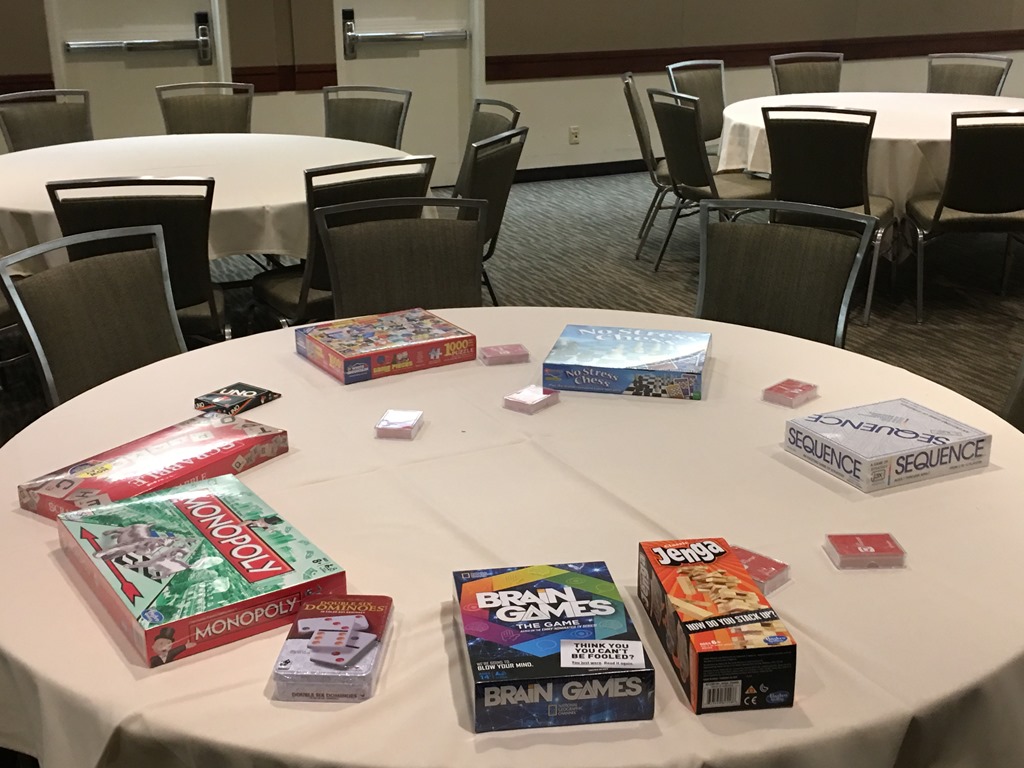
    We ended up with Monopoly, Jenga, Scrabble, dominoes, and something else. I had some Redgate SQL Prompt cards in my bag, and Andy went over to look at Barnes and Nobles for a few more. Our intention was to support about 60 games in groups of 5, so we wanted 15 options.

    Photo Oct 27, 6 44 50 PM

    We were pressed for time, with the #sqldinner meetup, and so after most people were matched up, I raced upstairs and cleaned off the table we’d used, spreading our games out. I’d also grabbed the signs PASS had provided, and in my best handwriting (remember, best is relative), I put up a few signs.

    Photo Oct 27, 6 57 51 PM

    I suspected things would go well when a few people showed up during the #sqldinner. They started chatting as our bartender got set up. Andy had arranged for some tickets to be printed, and he manned the door, checking people in and giving out tickets.

    Photo Oct 27, 7 43 59 PM

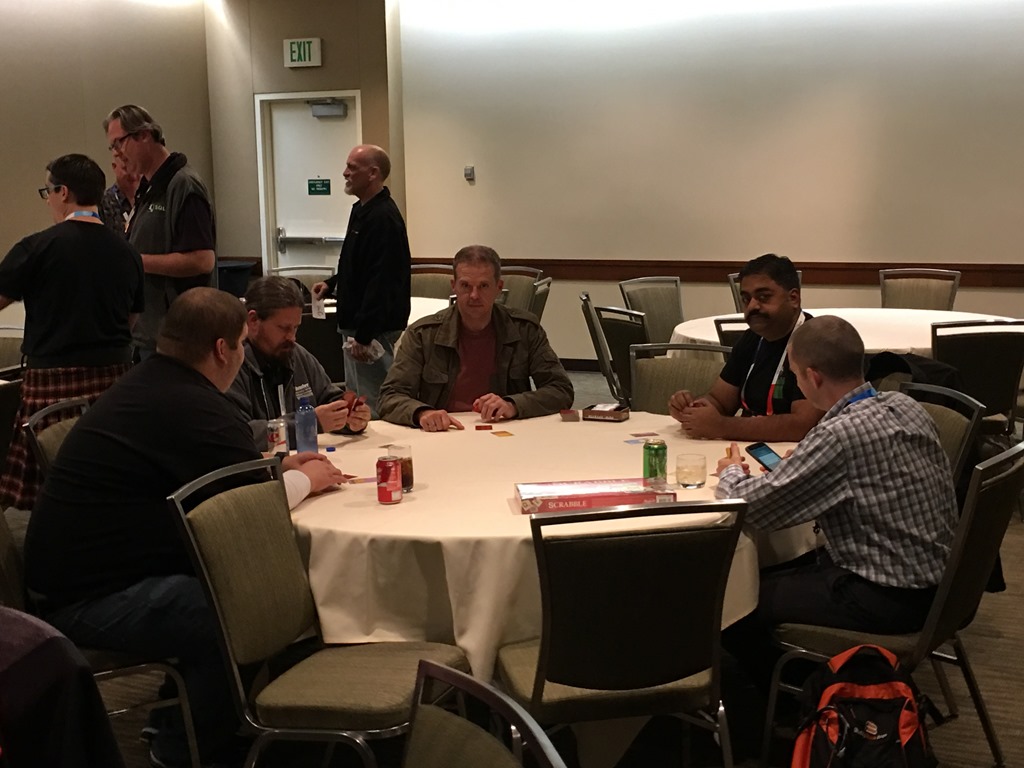
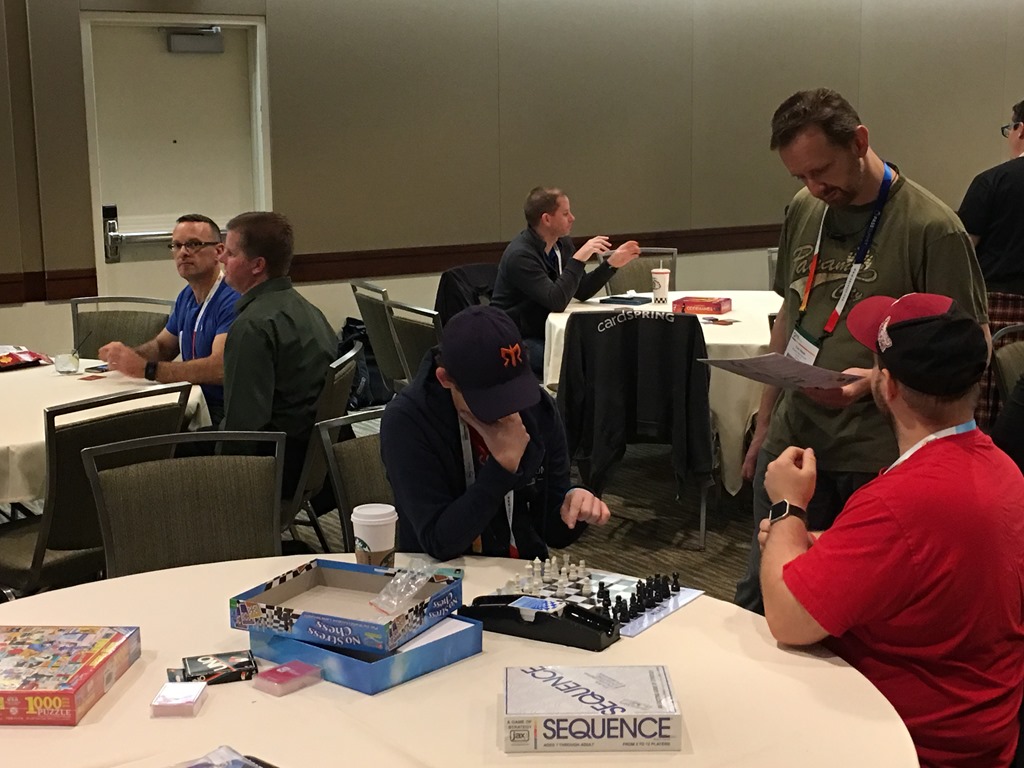
    It didn’t take long before the room was almost full. We had groups at every table (10 tables of 8) each playing different games.

    Photo Oct 27, 7 44 02 PM

    At some tables there were two games taking place, but it didn’t seem as though anyone was disturbing any other group. In fact, with 80 people in the room, I could still have a normal conversation with people. That’s exactly what we wanted.

    Photo Oct 27, 8 38 23 PM

    I had to leave early, around 9, but I heard that many people stayed until the room closed, and even then, a group went back to the Sheraton and played there until after midnight.

    What Went Well

    The concept was a success. Clearly there is a group of people that want a quiet, safe environment to play games. There’s nothing wrong with #sqlkaraoke or a night of drinking with friends, but of the 3000+ attendees, we have a number of introverts, a number of people that don’t drink, or aren’t comfortable in a raucous atmosphere.

    Providing some games was a good idea, and allowing people to bring their own games ensured that not only were there enough options, but people had the chance to try different games.

    We had some very introverted individuals come, and despite their very shy nature, they opened up and engaged with other attendees. I’m confident that not only did they enjoy themselves, but I suspect this is one of the highlights of the conference for a few of them.

    The space was good, and easy to find. Best of all, no security was required. I didn’t hear from anyone that they struggled to find the location on the 3rd floor. The signs PASS provided were helpful. If anyone has thoughts on the location, please let me know. One of the highlights of this space was having Tom Roush (@geeql) show up. Tom wasn’t attending the conference, but it’s always a joy to have a few minutes to chat with him.

    The bar worked out well, and everyone was able to get a soda or alcoholic drink at their leisure.

    What Needs Work

    First of all is the funding. When we approached PASS for this, they gave us the options to rent the room for $500 + guarantee $500 of drink purchases, or rent the Sheraton ballroom for a $1000 guarantee. Andy and I have had success with our events, the idea of putting up $500 for people to have some fun is a stretch for my budget. PASS did agree to cover the $500 room cost, but Andy and I had to guarantee the food and drink spend ourselves, hence the ticket charge.

    I’m not opposed to the ticket idea, since it helps prevent people just randomly showing up, or not showing up and preventing others from using a space if we have a limited number of seats. However, I’d like to see the cost match up with the bartender cost and have PASS assume the risk.

    I’d also like to organize the games better, perhaps having some people post or list the games they might bring. That could help engage others, and certainly reduce the stress from whoever runs the event. I wouldn’t even think that we need to provide any games next year.

    We could use more space, so I’d like to see a second room, or a third, that might allow people to spread out, perhaps put louder games in one room and quiet ones, like chess, in another room.

    I’d also like to see gaming on multiple nights. The opening reception and vendor parties end relatively early (9pm or so). I’d like to see gaming options on all nights.

    Looking to Next Year

    I really hope that Andy and I can convince PASS to just host this. This feels like a way to serve and engage a segment of our community that prefers games to bars. I hope they will add more space, and more nights.

    Having refreshments handy is important, so I’d certainly like to have a bartender handy each night. If this requires a ticket to get a free drink (and ensure a minimum spend), then I think that’s a good compromise. Most of us would spend $5-10 at a bar if we were playing games, so I’m fine with this.

    I also think there’s an opportunity to connect gamers together outside of the convention center. There are a few bars that host games in the Seattle area, but finding other gamers can be a challenge. I think PASS can do more work to increase the “Connect” part of their message here and help put people together next year.