Tag: software development

  • Pair Programming

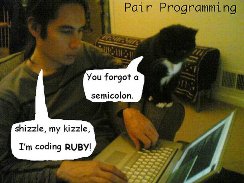
    pair programming with cat
    I could probably handle some pair programming with this little one.

    I’ve never pair programmed, but I’m not sure I’d like it. As much as I like collaborating, I prefer alone time to work on problems, or think things through and experiment a bit on my own. I prefer brainstorming and discussion sessions to be limited in nature, with the chance to then go work on my own pieces along.

    However pair programming has been touted as a way to improve software quality by many people. It’s not as popular as some other methodologies, but it still exists out there. I ran across a programmer’s reflections on nine months of pair programming that made for a thought provoking read. He looks back at the experience and lists some pros and cons. Better code, more productivity, and lots of knowledge transfer were some of the positives, and would lead many managers to try and push developers into working in pairs.

    However there were downsides. As someone that speaks regularly, I think that the strain on my vocal chords would be hard if I had to speak constantly to someone else. The fact that the environment needs to be consistent for both people would also be a problems as I often find strong opinions from  developers in technology as to how they want an environment configured for their tasks. I know that watching someone else control a browser drives me a little crazy. I think I’d definitely need to have a separate machine for many tasks.

    As with anything, pair programming makes sense at times. I know that I’d like to have senior T-SQL coders work with junior ones when developing complex queries and explaining how and why they solve problems with certain techniques. Doing this in real time might slow down the senior person, but I think the evolution of one’s thoughts as they solve a problem is as important to learn as the inner workings of the actual code.


    The Voice of the DBA Podcasts

    We normally publish three versions of the podcast each day for you to enjoy. Today there is no podcast due to Steve being ill. Hope to have the podcasts return tomorrow.

  • Trade-offs

    scale
    There are always trade-offs when building software.

    I’ve always told my managers that building software is a trade off. We can do things cheaply, or we can do them quickly, but we can rarely do both. We can certainly fail in both ways, and many people do, but I usually see the need to trade time for money, or vice versa, when building software.

    I ran across a piece recently that was similar, though in it Allan Hirt says you can do things right, do them fast, or do them cheap. Allan talks about limited resources in working on projects. At some point time, budget, and staff resources are constrainted and you can’t expect stellar performance on extremely large workloads in a 24x7x365 environment. Something has to give, and one of those resources is going to let you down.

    I had always looked at people as a “money” cost, since they are paid for work, but there is another constraint to people that I hadn’t considered. Each individual in your company isn’t just a resource that’s exchangeable for others. Each individual has knowledge and skills that aren’t easily transferred to, or replaced by, other employees. In addition, each person has time constraints; they will only work so much in a given time period.

    Building powerful, efficient, effective systems, whether in software, infrastructure, or even in culture takes effort, time, and money. However if you do it well, it’s something you’re not only proud of, but something that pays for itself over and over.

    Steve Jones


    The Voice of the DBA Podcasts

    We publish three versions of the podcast each day for you to enjoy.

  • Rewrite the Coding Rules

    Cryptanalyses
    It’s becoming more important to code securely.

    Security is a problem in technology. Whether it’s technological misconfiguration, social engineering, or brute force attacks, we see a constant stream of headlines about security issues. The situation is not likely to change anytime soon as security isn’t seen as a priority by many companies. If that’s the case, then is there anything that can be done to improve security?

    Security expert Dan Kaminsky says that we need a fundamental change in the way we write code. By rewriting the way that code is developers, rewriting the rules, we can reduce the vulnerabilities in our applications. One theory is that our languages and the coding techniques used are making it entirely too easy for vulnerabilities to creep into code.

    It’s an interesting theory, especially these days when it seems so many of our applications are under attack. I suspect that we have lots of poor habits ingrained in many developers. People are loathe to change and they like to continue working in ways that have worked for them. However the world of security in software changes constantly. What might have made you a very effective and productive developer five years ago might make you a liability today.

    I believe that we need to somehow build new coding methods, but even more importantly I think people that provide sample code and framework need to do so in a way that showcases best practices and good habits from a security perspective. That includes presenters, who should never show security issues, even if it’s for the sake of simplicity. Raise the bar and your audience will come along with you.

    Steve Jones


    The Voice of the DBA Podcasts

    We publish three versions of the podcast each day for you to enjoy.

  • Three Rules for Database Development

    shared database development
    Do you have rules for database development?

    I’ve always followed a few maxims over the years that have guided me well. One of those is that we must all agree on how we are going to perform any process and then all work that way. We can define whatever standards, rules, frameworks, processes, etc. that the group wants, but once we decide, we all need to work along in the manner we’ve prescribed. That’s worked well for me, and when everyone follow the rules we’ve agreed on, things run smoother.

    I ran across this post on three rules for database work from Scott Allen, a developer that has a lot of experience writing software. The three rules are never use a shared database server for development, always have an authoritative source for your schema, and always version your database. The last two rules are things I’ve always followed in the past since I think these are extremely important for maintaining control over the environment. Not control as a way to ensure developers are hamstrung, but control in that at any point in time you are aware of the state of the database.

    The first rule, never using a shared database, isn’t something I’ve usually done. Most of the time I’ve worked with small enough teams that people are working on separate sections of the database, and they almost never run into any conflicts with each other. A shared database server means changes from one person appear almost immediately to others is valuable. It allows development that is dependent on other changes to take place right away. That was in the past. These days with a tool like SQL Source Control (or custom scripting), you could simulate this on separate databases for separate developers.

    As with most rules in the database world, I think the answer to whether you follow these particular rules in your environment depends. It depends on what your resources are, your needs, your team structure and more. You can choose the framework that works best, whatever it is. You just need to make sure that everyone works within whatever you decide.

    Steve Jones


    The Voice of the DBA Podcasts

    We publish three versions of the podcast each day for you to enjoy.