Tag: speaking

  • Rejected for a Speaking Submission

    I got a speaking rejection today. Well, not today, but the day I wrote this.

    Not really a big deal, but it was interesting that the event organizer included a note that they had a lot of sessions, hard decisions, etc., and they hope I respect their decision on the schedule.

    I speak, or have spoke, a lot in my career. My speaking CV shows lots of events and sessions across the last decade. I had 20 sessions in 2020, a down year. The years from 2015-2020 have me delivering 197 sessions in those 6 years.

    This isn’t to brag, but show that I have had lots of success submitting to, and getting into many events across time. I’m semi-popular, though I honestly don’t think many people come to my sessions unless they like the topic.

    I don’t take rejections hard. It happens, and I know that my submission has to match up with what the organizers want from the event. Sometimes they might want me to speak because it helps with sponsorship or marketing, but mostly, they want sessions matching their idea of the event.

    I’m fine with that, and I wish them the best of luck with their event. As much as I might want to attend and speak somewhere, I wouldn’t complain because they made a different choice. That’s happened in the past, and it’s disappointing, but fine with me.

    I would love the chance to alter a session or change my submission to meet a conference agenda, but I also know this is asking a lot from organizers to work with speakers. A few of the larger conferences sometimes do this for certain people, but rarely for me.

    It’s hard to be rejected, whether for a speaking slot, a job, a date, a sports team, or anything else. It happens, however, and usually it’s not a personal decision. It’s often that the match isn’t there.

    If you get rejected, accept it, don’t complain, and submit to another event. Don’t get discouraged, but learn from it and move on.

    If you want feedback from submissions, drop me a note on Twitter. Happy to give my thoughts.
  • Are You a Diverse User Group or Event?

    One of the things that I’ve seen crop up at various points in my career is a question of diversity. I know there are many people that don’t think this is a problem, or maybe more specifically, their problem. They don’t think that it is their fault that not enough women or minorities are represented in their industry.

    One thing I’d ask user groups and events to do is publish a diversity scorecard, either after a schedule is selected, or annually for user groups.

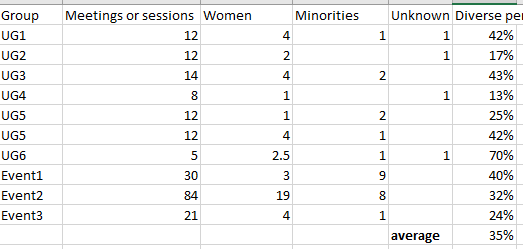
    What do I mean? Here’s a short look at something I noticed. I went out and grabbed a set of data from a few user groups and event that I thought of. I have no real idea of what to make of this:

    2021-06-14 11_53_42-Dviersity in User Groups.xlsx - Excel An average diversity of 35%, though I could have made some mistakes. I counted women, and separately counted minorities that were not white males as diverse. I think I counted those I know as LBGTQ as minorities as well.

    It’s not scientific, nor is it necessarily some quota I’m looking to meet here. As a minority (I’m in a few data sets above), I think 35% is pretty good, but likely it ought to be higher, especially with regards to women. They make up half of the world, but are underrepresented in our industry.

    A quick anecdote, in case you think that this isn’t important. Early on, the computer jobs were mainly for women. They programmed a lot, and helped get things working in various industries. The job was seen as “secretarial”. Once companies started to pay more, men wanted those jobs, and took over the industry. Hiring practices, and men being comfortable with other men, not because of talent. Good programmers come in all colors, creeds, and genders.

    That has happened in other industries as well. It’s not a malicious thing, but it is a trend when there isn’t visibility or attention paid to the issues. Those that are in charge tend to aim for homogeneousness, or some level of uniformity. That displaces others.

    I’d like to call on all user groups to add a report to their main meeting page. Just cull the data from the last 12 months (or meetings) and report on it. Microsoft does something like this for their company, as does Apple, Google, Facebook, Redgate, GE, Walmart, and many others.

    Do us all a favor and pay attention to your actions in this area, and encourage others. I was happy to speak to the local WIT group years ago on how to give a presentation and managed to get one person to start speaking. If I did that every year, we’d have a lot more women speakers, so this is on me as much as on many others.

  • Back to Basics, Reaching for the Clouds, and Leveling Up

    The three themes for speakers at this year’s PASS Data Community Summit are: Back to Basics, Reach for the Clouds, and Level Up. The goal here is content that covers a wide variety of areas, with many fewer restrictions from previous years. Perhaps the big thing to note for this year’s event is:

    Free.

    That’s right, this year’s Summit is free for the general conference. That should boost attendance, and it might mean some incredible audiences for this year’s speakers. I’d recommend you submit something and take a chance, as there are opportunities ranging from 10 minute lightning talks to 2 1/2 hour half day sessions. This is a great chance to speak at the largest Microsoft Data Platform focused conference out there. There are also pre-conference sessions. They’ll cost something, but with all the proceeds going to the speakers, I’m looking to support someone that will teach me a few new skills.

    We all need fundamentals, and the idea in Back to Basics is practical, day-to-day solutions. All of us build those on a regular basis. What creative, solid solutions have you implemented at work? What code or configuration do you rely on to keep your business moving? Those are the topics to share with others.

    The cloud has really started to prove it’s a fantastic solution for many organizations. Not for everything, but for many things. The modern data professional needs to know about the cloud, and when to move or not move. Many of us have been excited by the cloud, and plenty forced into adopting it, but there are lessons and experiences to be shared here. Good and bad.

    Level Up is the internal Redgate Software conference, where we look to improve skills. It’s a theme here where we try to help people advance their careers in some way, whether that’s a technical skill, a soft skill technique, or a new way of thinking. I’m glad to see that among the tracks, we have both a Professional Development and a DE&I (diversity, equity, and inclusion) track. Both are ways to help us round out our ability to work in a team. I hope to see lots of “Level Up” type sessions, both technical and non technical, delivered this fall.

    I wasn’t sure there ever would be a Summit again, and I am glad that we have a chance to get a large group of incredibly talented speakers and attendees that all care about data, databases, and building better systems, reports, and employees. I’m excited by the free online Summit, and I look forward to a hybrid event in 2022 when we get the chance to connect and smile in person again.

    Steve Jones

    Listen to the podcast at Libsyn, Stitcher, Spotify, or iTunes.

  • The PASS Data Community Summit Call for Speakers

    The other day I saw something that I wasn’t sure I’ve ever see again. The call for speakers for the PASS Data Community Summit went out. After the dissolution of the PASS organization, I wasn’t sure this conference would ever appear again, but it is happening.

    Redgate is running this as a community summit, and we’ve engaged a number of people that helped put things together in the past to help again. It’s a free event this year, like many large conferences, and that means your sessions could be seen by hundreds or thousands of people.

    If you have ever spoken, or want to try, submit. There are less rules and restrictions. The program committee is headed by Grant, Kathi, and Marcella, all of whom have worked on the program in the past. They have lots of volunteers to evaluate the talks and put together a great schedule, but they are looking for alternative points of view or unique solutions.

    They’re also looking for back to basics, which is something many of us could talk about. Likely many of us do every day at work.

    I’ll submit something, and I hope you will as well.