Tag: syndicated

  • SQL in the City Streamed is Today

    Today is SQL in the City Streamed!!!

    2019-08-23 14_49_07-Redgate Friend, Events, And Community Activities

    Only three of us, Sad smile, as Kendra has other commitments. Still, it’s exciting for Kathi, Grant, and myself to be presenting the Birthday Edition as Redgate turns 20 this year.

    Join us later today for the broadcast, which will have some fun tech, new tips, and some nostalgia about the company and the last 20 years.

    Register today

  • Restoring an Expired Certificate–#SQLNewBlogger

    Another post for me that is simple and hopefully serves as an example for people trying to get blogging as #SQLNewBloggers.

    One common task that you might need to handle if you work with encryption is dealing with a certificate. Whether this is for TDE, SSL, or something else, you will want to ensure that you know how to restore a certificate.

    I’ve written about this before (restoring a certificate), but what about restoring an expired certificate? If you forget to replace one in TDE, does it still work?

    Tl;dr yes.

    Validating a Restore

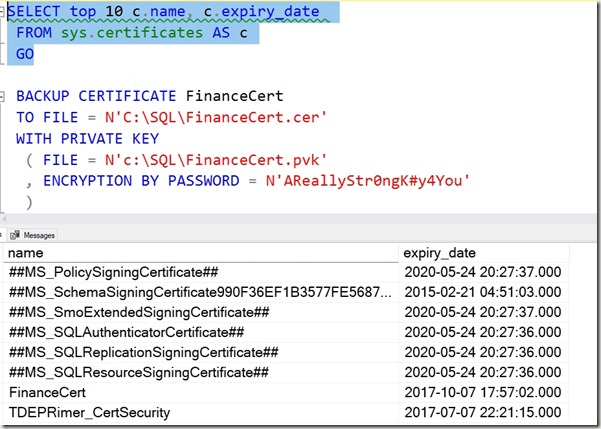
    I backed up an certificate from one instance that had expired. I used this in a customer demo a few years ago, and it was on my system. Here’s what I saw.
    2019-08-23 14_35_57-SQLQuery1.sql - Plato_SQL2014.MASTER (PLATO_Steve (57))_ - Microsoft SQL Server

    I ran the backup script shown to get the expired backup of the cert.

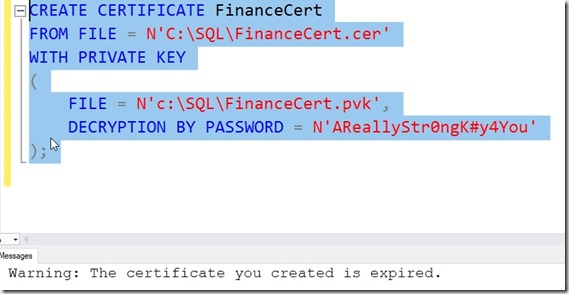
    Next, I connected to a new instance and ran this.

    CREATE CERTIFICATE FinanceCert
    FROM FILE = N'C:\SQL\FinanceCert.cer'
    WITH PRIVATE KEY
    (
         FILE = N'c:\SQL\FinanceCert.pvk',
         DECRYPTION BY PASSWORD = N'AReallyStr0ngK#y4You'
    );

    This completed, but I get the warning that this cert is expired. It’s a warning. SQL Server will still use the certificate to decrypt anything necessary, like a DEK for TDE.
    2019-08-23 14_37_20-SQLQuery2.sql - Plato_SQL2017.master (PLATO_Steve (55))_ - Microsoft SQL Server

    This is a good reason to keep an eye on certificates, as someone might be worried about expired certs. They work, but some people (auditors) do not like to see these in use.

    To change the certificate used, see Key Rotation in TDE.

    SQLNewBlogger

    Anything DR related is a good skill to showcase. Blog about your practicing different skills. The writing will cement the skills further in your mind and employers will appreciate you showing the way you handle things.

  • SQL in the City Streamed Next Week

    I’m off to the UK this weekend, for a few commitments next week. One of those is SQL in the City Streamed, which is taking place on Wednesday September 4, 2019.

    This is a special broadcast, with some technical content, but some fun as well. This is the 20th birthday party for Redgate Software, and we’re looking forward to celebrating online.

    We’ll be talking some DevOps, some products, some tips and tricks, and more, so register today and join me on Wednesday.

  • Finding SQL Configuration Manager in Windows 10–#SQLNewBlogger

    Another post for me that is simple and hopefully serves as an example for people trying to get blogging as #SQLNewBloggers.

    I went to check a network protocol setting for SQL Server the other day on my (newish laptop) and was disappointed.

    2019-08-15 08_26_25-Settings

    This is Windows 10 and on this machine, I’d installed SQL Server 2014, 2016, and 2017. I thought that at least SQL Server 2014 had the SQL Server Configuration Manager installed, but it appears not. I know that this has been a tool that sometimes gets hidden in recent versions, but I was sure I’d seen it here.

    Either I’m wrong or Windows 10 has changed.

    In any case, the Computer Management MMC plugin has it. You can run this in a couple ways. First, hit the Start menu and type “Computer Man”. You’ll get something like this and can run this:

    2019-08-15 08_29_15-Finding SQL Configuration Manager in Windows 10 - Open Live Writer

    The other choice is to his Win+R (run) and type “compmgmt.msc”. Both will get you here:

    2019-08-15 08_30_06-Computer Management

    If you now expand the Services and Applications, you’ll see the SQL Server Configuration Manager and the various items underneath it. For me, the top one (most recent?) was the SQL Server 2017 version. The others were below as other snap-ins.

    2019-08-15 08_31_03-Computer Management

    The good thing about this is I can also manage local users and see the local logs, things I sometimes need when configurating SQL Server.

    SQLNewBlogger

    An easy post that solves a common problem, and shows I know some tips and tricks. How would you rewrite this post? You could show this knowledge with a quick 10 minutes of your time.