Tag: syndicated

  • Upgrading SQL Server on Linux

    I saw this week that there was a new CTP (v1.3) of SQL Server v.Next. I haven’t had a lot of time to work on the Linux version lately, but I thought I’d try and see how well the upgrade went.

    There’s an install and upgrade page at Microsoft you can use, but on Ubuntu, things are easy. First, connect to your system and run this:

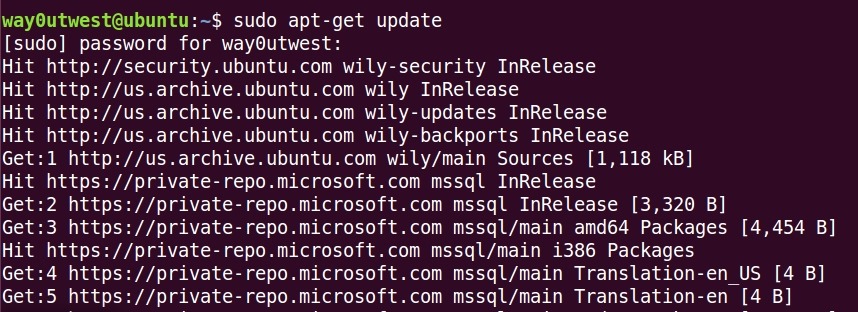
    sudo apt-get update

    That will download updated packages and get the system ready. you can see that I have a lot of stuff to update on this particular system.
    2017-02-22 15_06_08-Ubuntu 64-bit SQL Server .210 - VMware Workstation

    Once this completes, you just run

    sudo apt-get install mssql-server

    This will actually perform the install. That takes a minute, and in my case, I walked away, letting this run. When it finished. I tried to connect from a local machine, but got an error. So I ran this:

    systemctl status mssql-server

    This should give me the status, which was that things had stopped.

    2017-02-22 15_07_39-Ubuntu 64-bit SQL Server .210 - VMware Workstation

    OK, no problem. This starts the service.

    systemctl start mssql-server

    Once this completed, I could connect.

    2017-02-22 15_08_26-Ubuntu 64-bit SQL Server .210 - VMware Workstation

    I’ve done this a few times over the last year, but not since CTP 1.0, so I reminded myself of the process.

    So far, in my testing, most everything I’ve done with the core database engine, all scripts, etc., seem to work. More and more work is being done, and I’m interested to see how this version progresses.

    If you like Linux, maybe you want to give this a try.
  • What’s a DACPAC and a BACPAC?

    Another post for me that is simple and hopefully serves as an example for people trying to get blogging as #SQLNewBloggers.

    If you’ve worked with SQL Server development and database projects, you might have heard about DACPACs. However, if you haven’t, this was a concept that didn’t seem to catch on with many companies. I’m not a fan of the format, but it works and you should be aware of what a DACPAC is and how it can be used.

    The DAC part of the moniker is show for Data-tier Application.  This is the container that includes all of the object definitions for the objects that are contained inside of the DACPAC. The PAC part is just an easy way to note this is a contained in a compressed format.

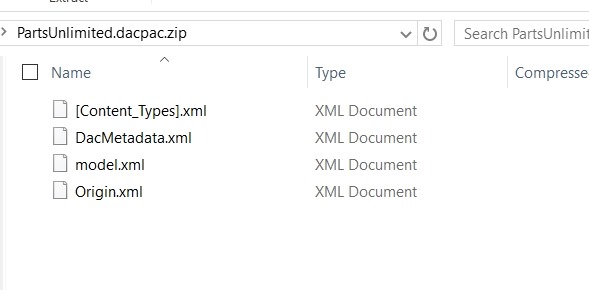
    In fact, the .DACPAC is a zip file. If I rename one of them, I can open is like any other zip file. Here’s one I’ve added a .zip to the end of and opened in Windows Explorer. There are a few files in here.

    2017-02-21 14_30_31-PartsUnlimited.dacpac.zip

    The only really important one is the model.xml, which is a model of my objects. If I look inside, it’s a cumbersome XML format, but I can easily see my Order table as a part of the file.

    2017-02-21 14_25_38-Lab Setup.docx - Word

    These are useful files for having a machine read the format and reproduce database objects in a live database. SQLPackage.exe will do this, as will other tools such as a the DacFX (Data-tier Application Framework).

    I don’t love the format, but it is machine readable and can allow you to package and deploy database changes. There are limitations, especially between versions, and I think that it’s harder to understand than the formats that SQL Compare (From my company, Redgate Software) uses, but that’s me. I’m biased, but I don’t love DACPACs.

    In any case, you can right click and “Unpack” this, or use SSMS to create and read them into a database. In the next post, I’ll show how that works.

    What’s a BACPAC?

    That’s easy. It’s a DACPAC with the data included.

  • Heading Back to SQL Bits

    I’m honored to be selected to speak at SQL Bits 2017 this April in Telford. This is my favorite SQL Server conference, and it’s always a joy to attend. Especially the Friday night party, where everyone seems to have a lot of fun.

    I’ll be presenting “Including Your Database in a DevOps CI/CD Process” where I’ll look at the ways in which database code can be included alongside application code in a CI/CD process, as well as the challenges of doing so. I’ll demo the smooth flow of changes, along with the recovery when things go wrong.

    I’ll use some tools, but mostly working in Visual Studio.

    Join us for a fantastic conference in the UK this spring. Register today and save (until Mar 4). Come to a training day and learn something. I might just see you there.

  • DevOps Webinar Tomorrow

    A quick reminder that tomorrow, Feb 21 at 12pm EST, I’ll be hosting another DevOps, Database Lifecycle Management (DLM) webinar. Together with Arneh Eskandari, we’ll show how we can each make changes to our own database, push the changes to git and reconcile merge issues.

    Register now, and watch us work together to perform distributed database development.