Tag: syndicated

  • A tSQLt Mistake – Debugging a Test

    While I was working on a test the other day, it kept failing. Not a big surprise, but I couldn’t figure out why. When I looked at tsqlt.testresults, I saw extra rows. Double rows in fact, and that threw me.

    This was my Assemble code.

    -- Assemble
    CREATE TABLE #Expected (
    yearnum int
    , monthnum TINYINT
    , salestotal money
    )


    INSERT INTO #Expected
    ( yearnum
    , monthnum
    , salestotal
    )
    VALUES
    ( 2012, 11, 2500.23 )
    , ( 2012, 12, 2200.15 )
    , ( 2013, 1, 2656.75 )

    SELECT *
    INTO #actual
    FROM #Expected AS e

    EXEC tsqlt.FakeTable @TableName = N'MonthlySales', @SchemaName='dbo';

    INSERT dbo.MonthlySales
    VALUES
    ( 11, 1000.00)
    , ( 11, 1500.23)
    , ( 12, 2200.15)
    , ( 13, 1000.00)
    , ( 13, 1656.00)
    , ( 13, 0000.75);

    Here was the output (ignoring the failure messages):

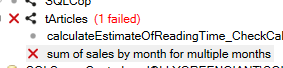
    [tArticles].[test sum of sales by month for multiple months] failed: (Failure) The calculations are incorrect

    |_m_|yearnum|monthnum|salestotal|

    +—+——-+——–+———-+

    |=  |2012   |11      |2500.2300 |

    |=  |2012   |12      |2200.1500 |

    |=  |2013   |1       |2656.7500 |

    |>  |2013   |1       |2656.7500 |

    |>  |2012   |12      |2200.1500 |

    |>  |2012   |11      |2500.2300 |


    Hmmm. What’s going on? Why don’t the rows match? If I run the query, I see the results I expect. Is it the query or test?

    In this case, you read the results as showing that I have 3 rows that are the same in my expected and actual tables (@expected and @actual variables in the assert). However I also have 3 extra rows in the actual table, which appear to be duplicates.

    If I go back to the Assemble, I see a pattern that’s a problem. Some people might think these hassles are a way to give up on testing. Some might build a better pattern. I’ll do the latter.

    In this case I create the expected table and then I insert the expected results. Then I create my actual table from the expected one to keep the schema the same and avoid repeating code. However in this case I have a bug.

    The bug is I’m moving the expected results to actual. If I asserted at this point, I’d pass. However then I run the query and insert the results, which happen to be the same as the expected results (my query works). If the query didn’t work, I might really spend a lot of time debugging it, but here I can tell my test code is buggy.

    I have two choices to fix this.

    1. Add a WHERE clause of WHERE 1 = 0 (no rows inserted)
    2. Move the creation of the actual table.

    My first thought was to adjust the pattern to this:

    CREATE TABLE #Expected (
    yearnum int
    , monthnum TINYINT
    , salestotal money
    )

    SELECT *
    INTO #actual
    FROM #Expected AS e


    INSERT INTO #Expected
    ( yearnum
    , monthnum
    , salestotal
    )
    VALUES
    ( 2012, 11, 2500.23 )
    , ( 2012, 12, 2200.15 )
    , ( 2013, 1, 2656.75 )

    I move the #Actual and #Expected tables together, so that once I get the results set, I immediately create the #Actual copy. I could leave things and do this:

    CREATE TABLE #Expected (
    yearnum int
    , monthnum TINYINT
    , salestotal money
    )


    INSERT INTO #Expected
    ( yearnum
    , monthnum
    , salestotal
    )
    VALUES
    ( 2012, 11, 2500.23 )
    , ( 2012, 12, 2200.15 )
    , ( 2013, 1, 2656.75 )

    SELECT *
    INTO #actual
    FROM #Expected AS e
    WHERE 1 = 0

    EXEC tsqlt.FakeTable @TableName = N'MonthlySales', @SchemaName='dbo';

    Maybe the best thing is to be careful and do this:

    -- Assemble
    CREATE TABLE #Expected (
    yearnum int
    , monthnum TINYINT
    , salestotal money
    )

    SELECT *
    INTO #actual
    FROM #Expected AS e
    WHERE 1 = 0

    INSERT INTO #Expected
    ( yearnum
    , monthnum
    , salestotal
    )
    VALUES
    ( 2012, 11, 2500.23 )
    , ( 2012, 12, 2200.15 )
    , ( 2013, 1, 2656.75 )

    Combine the ideas and keep this insulated from refactoring moving or adding code in there.

    Remember, tests are code. This is why they should fail first, so that you have some confidence in your code working and causing a test to pass.
  • A Long Trip Ahead

    This is my last day at home for a long time. At least long by my standards. I head to the airport tomorrow for a ten day trip, not returning to CO until Saturday, Oct 17. I rarely travel more than 4 or 5 days at the most, so this is one of my longer ones.

    My first stop is Orlando. I’m heading over to help teach a DLM workshop for Redgate Software on Friday. This is our Database Source Control workshop that covers some in depth work with SQL Source Control and version control systems. I’ve done a few of these, so this should be easy for me.

    Saturday is SQL Saturday #442 in Orlando. I haven’t been to a SQL Saturday in Orlando in a long time, so I’m excited to get back to the place where these all started. I’ve got one talk on Saturday, talking Encryption, around which I’ll be hanging out with friends and trying to learn a few SQL things along the way.

    Sunday I travel, though at a relaxed pace. I’ll spend the day making my way to Houston before an overnight flight to London on the Dreamliner. It’s a leisurely day, where I’ll probably spend time catching up on Python work because Monday is crazy.

    Monday is a day I dread a bit. I land in London and immediately drive to Cambridge for a few meetings. I’ve got some SQL in the City rehearsals planned before I turn around and head back to London to catch the fun bus to Bristol for SQL Relay. If you map this out, it seems silly, but that’s what I got myself talked into somehow.

    Tuesday is SQL Relay in Bristol. I’ll be previewing my talk for SQL in the City, so I’ll apologize in advance if things aren’t 100% set. However after a day at the conference, I’ll be heading over to Cardiff where I’ll get dinner and try to fix all the things I did wrong during the talk.

    Wednesday is SQL Relay Cardiff.  A repeat of Tuesday in a new city. I’m not sure if everything is the same, but I’ll be (hopefully) delivering a better talk on Wednesday. Wednesday night Grant and I aren’t doing anything, so it’s a few hours to unwind.

    Thursday morning we make our way back to London. Hopefully we manage the train system fine because we have lunchtime and afternoon meetings with people coming down from Redgate during the day. This is the final SQL in the City prep time, as well as a few other in person events, including seeing my boss for only the 3rd time this year.

    Friday is SQL in the City 2015 London. Redgate puts on a great event, and I’m looking forward to another exciting day. Three times on stage for me, so I’m sure when things wrap up around 5 I’ll be quite tired. However no rest, I head to Heathrow for a night in my 5th hotel on this trip.

    10 days. Orlando, Cambridge, Bristol, Cardiff, London.

    I have the feeling I won’t be doing much on Saturday night or Sunday when I return.

  • Testing Sum By Month

    I’ve been on a testing kick, trying to formalize the ad hoc queries I’ve run into something that’s easier to track. As a result, when I look to solve a problem, I’ve written a test to verify that what I think will happen, actually happens.

    The Problem

    I saw a post recently where someone wasn’t sure how to get the sum of a series of data items by month, so I decided to help them. They asked for a year number, a month number, and a total, so something like this:

    Year   Month   Sales

    2012       1   1500.23

    2012       2   1480.00

    2012       3   1945.00

    2015       7   8933.11

    They mentioned, however, that the had sales data stored as an integer. Not as 201201, but as 1, 2, 3, with a base date being Jan 1, 2012. That’s strange, but it’s a good place to write a test.

    I like to start with the results, since if I don’t know the results, how can I tell if my query works? Let’s get a test going. I’ll start by created my expected results. I’ve come to like using temporary tables, and limited data. I also like to test some boundaries, so Iet’s cross a year.

    CREATE PROCEDURE [tArticles].[test sum of sales by month for multiple months]
    AS
    BEGIN
    -- Assemble
    CREATE TABLE #Expected (
    yearnum INT
    , monthnum TINYINT
    , salestotal NUMERIC(10,2)
    )


    SELECT *
    INTO #actual
    FROM #Expected AS e


    INSERT INTO #Expected
    ( yearnum
    , monthnum
    , salestotal
    )
    VALUES
    ( 2012, 11, 2500.23 )
    , ( 2012, 12, 2200.15 )
    , ( 2013, 1, 2656.75 )

    I like to create the actual results table here as well, which allows me to then easily insert into this table from a procedure as well as a query. In this case, I’ll use a query, but I could use insert..exec.

    Once I have results, I need to setup my test data. In this case, I’d probably go grab the rows from a specific period and put them in a temp table and use Data Compare to get them. Or make them up. It doesn’t matter. I just need the data that allows me to test my query.


    EXEC tsqlt.FakeTable @TableName = N'MonthlySales';

    INSERT MothlySales
    VALUES
    ( 11, 1000.00)
    , ( 11, 1500.23)
    , ( 12, 2200.15)
    , ( 13, 1000.00)
    , ( 13, 1656.00)
    , ( 13, 0000.75);

    I don’t try to make this hard. I use easy math, giving myself a few cases. One, two, three rows of data for the months. If I think this isn’t representative, I can add a few more. I don’t try to be difficult, I’m testing a query. If I had rows that might not matter, or I wanted to test if 0 rows are ignored, I could do that.

    Now I need a query. Something simple, a SUM() with a GROUP by is needed. However I need to also change 11 into 2012 11, so that’s an algorithm.

    An easy way to do this is start with a base date. I’d prefer this is in a table, but I can do it inline.

    INSERT #actual

    SELECT
    yearnum = DATEPART( YEAR, DATEADD( MONTH, datenum, '20120101'))
    , MONTHNUM = DATEPART(MONTH, DATEADD( MONTH, DATENUM, '20120101'))
    , SALESTOTAL = SUM(ms.salesamount)
    FROM dbo.MonthlySales AS ms
    GROUP BY
    DATEPART( YEAR, DATEADD( MONTH, datenum, '20120101'))
    , DATEPART(MONTH, DATEADD( MONTH, DATENUM, '20120101'))
    ORDER BY
    DATEPART( YEAR, DATEADD( MONTH, datenum, '20120101'))
    , DATEPART(MONTH, DATEADD( MONTH, DATENUM, '20120101'))
    ;
    GO

    I’ll insert this data into #actual, which tests my query.

    The final step is to assert my tables are equal.

    -- Assert
    EXEC tsqlt.AssertEqualsTable
    @Expected = N'#EXPECTED',
    @Actual = N'#actual',
    @FailMsg = N'The calculations are incorrect';

    The Test

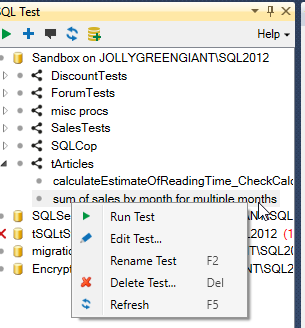
    What happens when I execute this test? I can use tsqlt.run, or my SQL Test plugin.

    2015-09-28 16_07_49-Photos

    In either case, I’ll get a failure.

    2015-09-28 16_08_11-Photos

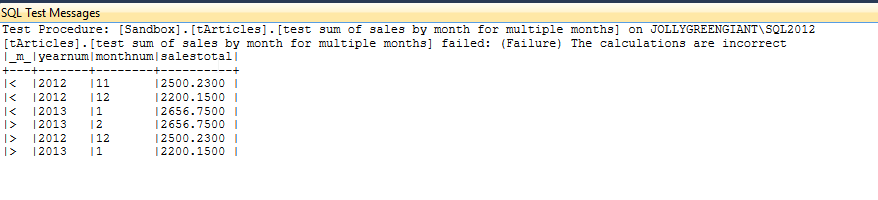
    When I check the messages, I see the output from tSQLt. In this case, none of my totals seem to match.

    2015-09-28 16_15_23-Photos

    What’s wrong? In my case, I’m adding the integer to the base month, but that means a 1 means 2012 02, not 2012 01. I’m a month off. Let’s adjust the query.

    -- Act
    INSERT #actual
    SELECT

    yearnum = DATEPART( YEAR, DATEADD( MONTH, datenum, '20111201'))
    , MONTHNUM = DATEPART(MONTH, DATEADD( MONTH, DATENUM, '20111201'))
    , SALESTOTAL = SUM(ms.salesamount)
    FROM dbo.MonthlySales AS ms
    GROUP BY
    DATEPART( YEAR, DATEADD( MONTH, datenum, '20111201'))
    , DATEPART(MONTH, DATEADD( MONTH, DATENUM, '20111201'))
    ORDER BY
    DATEPART( YEAR, DATEADD( MONTH, datenum, '20111201'))
    , DATEPART(MONTH, DATEADD( MONTH, DATENUM, '20111201'))

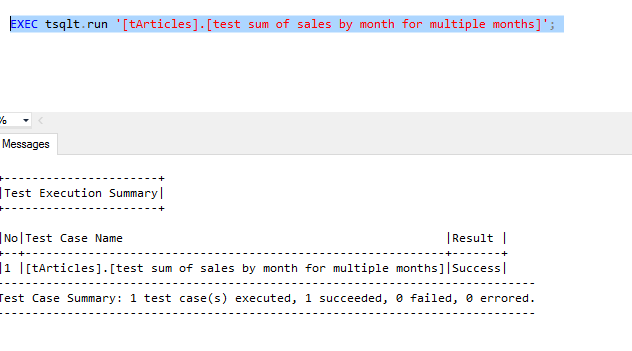
    Now when I run my test, it passes.

    2015-09-28 16_18_09-Photos

    Why Bother?

    This seems trivial, right? What’s the point of this test? After all, I can easily check this with a couple quick queries.

    Well, let’s imagine that we decide to move this base date into a table, or that we alter it. We want our queries to continue to work. I can have this test as part of an automated routine that ensures this test will run each time the CI process runs. Or each time a developer executes a tsqlt.runall in this database (shared or populated from a VCS). I prevent refactoring queries.

    More importantly, I can take results and alter them first, say if someone decides to change this to a windowing query. I could plug a new query in the test (or better yet, use a proc and put that call in the test) , and if I change code, I can verify it still works.

    Write tests. You need them anyway, so why not formalize them? The code around this query, mocking test data, is something I do anyway, so this gets me a few more minutes to verify that the code works. I can tune the query, alter indexes, perf test, and be sure that code is still running cleanly.

    http://www.sqwhere lservercentral.com/Forums/Topic1716471-1292-1.aspx#bm1716535

  • SQL Source Control and Git–Getting Started

    It seems as though Git is taking the world by storm as the Version Control System (VCS) of choice. TFS is widely used in the MS world, but Git is growing, Subversion is shrinking, as are most of the other platforms.

    As a result, I wanted to do a quick setup using SQL Source Control (SOC) and Git, showing you how this works. SOC supports Git in a few ways, so this is the primary way I’d see most people getting started.

    Update: Since this was published, the SQL Source Control team released an updated version (v4.1) with support for Git that allows push/pull within the client. I’ve got an updated post here.

    Scenario

    Here’s the scenario that I’ll use. I’ve got a database, WindowDemo, that has a few tables, some data, and a few procs. As you can see below this isn’t linked to a VCS.

    2015-09-24 16_34_56-Cortana

    I want to store my DDL code in c:\git\WindowDemo\trunk. I’ve got that folder created, but it’s empty. I’ll keep related database stuff (docs, scripts, etc) in c:\git\WindowDemo if I need it.

    2015-09-24 16_37_36-Photos

    Git Setup

    The first thing you need to do is get your Git repository setup. There are many ways to do this, but I’ll use the command line because I like doing that. The commands in the various client GUIs will be very similar.

    I’m going to set the git repository here at c:\windowdemo to keep all my database stuff in one place. To setup the repository, I run a git init in the command prompt. This initializes my repository.

    2015-09-24 16_41_02-Photos

    Now I have a git VCS, I need to get code in there.

    SQL Source Control Setup

    Now I move to SSMS to link my database to the repository. In SSMS, I right click my database and select “link database to source control”.

    2015-09-24 16_42_27-Start

    This will open the SOC plugin on the setup tab. I’ve filled in the path to the place in the repository I want the code to go. This is the trunk folder. I’ve also selected Git, using the “Custom” selection on the left and Git in the dropdown.

    2015-09-24 16_43_54-Link to source control

    Once I click the link button, I’ll get a dialog showing progress and then return to the setup tab.

    2015-09-24 16_44_15-Start

    Notice the balloon near the top. This lets me know the link is active and I have changes in my database that aren’t in the VCS. There’s a pointer to the “Commit changes” tab, so I’ll click that.

    2015-09-24 16_48_00-New notification

    In the image above, I see I have a number of “new” objects from the perspective of the VCS. I can see the name, and the type of object in the middle. At the bottom, I see the version in my database (highlighted code) on the left and the version in my VCS (blank) on the right.

    This is where I commit my changes. I enter a comment at the top and click the “commit” button on the right (not shown). When I do that, I’ll get a clean “commit tab” that shows that my VCS is in sync with my database DDL.

    2015-09-24 16_50_18-SQL Source Control - Microsoft SQL Server Management Studio

    Inside Git

    What’s happened in my VCS? Let’s look in the file system. Here I see my trunk folder.

    2015-09-24 16_51_49-Photos

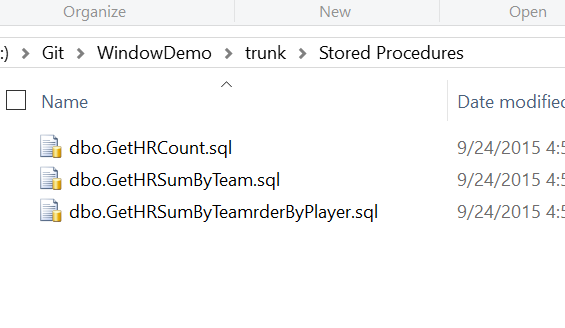
    SOC has created a structure for my DDL code and included some meta data. If I look in one of these folders, such as Stored Procedures, I see

    2015-09-24 16_58_56-Photos

    This is the .SQL code that matches what’s compiled in my database. SOC stores the current CREATE statement for all my objects so that they can easily be examined.

    Inside Git, I see a clean status with all my files as committed objects.

    2015-09-24 17_02_57-Start

    This is what I want. Now I can continue on with database development, tracking all my changes. I’ll look at the flow and tracking changes in another post.