Tag: syndicated

  • SQL Saturday #403–Louisville

    This weekend I’ll be attending SQL Saturday #403 in Louisville, KY. If you’re in the area, think about taking a few hours out of your Saturday and coming to learn some SQL Server stuff. There’s a great schedule, with 6 tracks and 6 sessions per track.

    That’s 36 opportunities to improve your skills and career!

    I’ll be delivering two sessions during the event. I have my Branding Yourself for a Dream Job first thing in the morning at 8am. I know it’s early, but I like to give you some ideas for networking and planning your career for the rest of the day.

    My second session is Continuous Integration for Databases at 10:30. I’ll give you a taste of how to improve your software development process by using version control and a build server to verify and test your database code.

    There are some great afternoon sessions, but I likely won’t be there as I have family in town and want to spent a few hours with them. However come grab me in the morning and say “hi”. I really enjoy meeting the SQL Server community and look forward to another great SQL Saturday in Louisville.

  • Catch up with T-SQL Tuesday

    T-SQL Tuesday is a monthly blog party where we get an invitation the first week of the month to write on a specific topic for the second Tuesday of that month. Adam Machanic came up with the idea and he chooses the hosts.

    If you’re interested in hosting, contact him.

    While there’s a sense of community and participation here, and certainly the chance to showcase some of your knowledge for others, it’s also got another benefit.

    It’s the chance for you to learn something.

    Not by reading other’s posts, but by writing your own. This is your opportunity to bolster your own skills, and teach yourself something new.

    Don’t Worry About Timing

    I know many of you are worried about the pressure of producing something good. I know many of you will find that the first weekend of the month is really busy and you can’t write.

    That’s fine.

    I’ve got a list of all previous invitations and topics. Go back and pick one of them and write your own post today. Start working on it, teach yourself something, and put some thoughts down. Research what others have done by looking through the roundups. Get a friend to review the work and see if it’s readable and makes sense.

    Do that ten times. It might take you ten months, but I’m sure you can write something down about SQL Server once a month.

    When you get ten, start a blog and publish them. Use the T-SQL Tuesday tag, but I’d also encourage you to use the #SQLNewBlogger tag as well. Start showing your boss that you’re improving your skills. Be ready to impress you potential next new boss with a series of posts on SQL topics.

    Your career will be better off, and the world will start to see better software being written.

    Start improving your skills this weekend, or start documenting the learning you already do. Either way, start building a better brand for your career.

  • T-SQL Tuesday #69–Encryption

    TSQL2sDay150x150This is a good T-SQL Tuesday topic for me. This month Ken Wilson asks everyone to write on encryption, which is a topic I’ve presented on quite a few times.

    You can participate, too. Take a few hours, learn something, and tell us what you learned. Let everyone know how you view this topic and grow your blog with a little new knowledge.

    T-SQL Tuesday is a great chance to force you to write a post on a specific topic. Your post needs to publish on the second Tuesday of the month, Aug 11 this month, to be included in the roundup from the host. However feel free to write about this topic anytime, and even include the T-SQL Tuesday title.

    CASTing Results

    A short post this month, as I’m a bit buried in a few things, but this is one of those encryption notes that I didn’t see well documented when I started working with the subject, and I’m hoping I can save you a few minutes of frustration.

    If you encrypt your data, it will be stored as a binary type. This is because encrypted data is supposed to be random, and not easily decrypted.

    Let’s imagine I have some simple setup like the code below. I’ll create a key, open it, and use it to encrypt some data that I’ll insert into a table.

    CREATE TABLE MyEncryptionTest( intsource INT, charsource VARCHAR(50), intencrypt VARBINARY(max), charencrypt VARBINARY(max));
    CREATE SYMMETRIC KEY Mykey WITH    ALGORITHM = AES_128 ENCRYPTION BY PASSWORD = 'M$test78';
    GO
    OPEN SYMMETRIC KEY MyKey DECRYPTION BY PASSWORD = 'M$test78';
    
    INSERT dbo.MyEncryptionTest
            ( intsource ,
              charsource ,
              intencrypt ,
              charencrypt
            )
    VALUES  ( 7, 
              'Spike' , 
              ENCRYPTBYKEY(KEY_GUID('MyKey'), CAST(7 AS VARCHAR(10))) ,
              ENCRYPTBYKEY(KEY_GUID('MyKey'), 'Spike')
            );
    
    SELECT top 20
     * FROM dbo.MyEncryptionTest;


    The results of this are that I get binary data:

    2015-08-04 22_10_22-SQLQuery1.sql - ARISTOTLE.sandbox (ARISTOTLE_Steve (76))_ - Microsoft SQL Server

    Now, the decryption routine for T-SQL doesn’t need to specify the key. That means instead of a *, I can use the DECRYPTBYKEY function and pass in the column.

    SELECT TOP 20
            intdecrypt = DECRYPTBYKEY(intencrypt),
            chardecrypt = DECRYPTBYKEY(charencrypt) ,
            intencrypt ,
            charencrypt
    FROM    dbo.MyEncryptionTest;


    This gives me this:
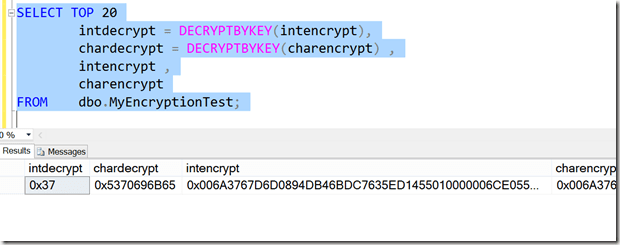
    2015-08-04 22_12_22-SQLQuery1.sql - ARISTOTLE.sandbox (ARISTOTLE_Steve (76))_ - Microsoft SQL Server

    Not quite what I want. What if I cast this back to an integer? After all, the output of the function is listed as an nvarchar.

    SELECT TOP 20
            intdecrypt = CAST(DECRYPTBYKEY(intencrypt) AS INT),
            chardecrypt = DECRYPTBYKEY(charencrypt) ,
            intencrypt ,
            charencrypt
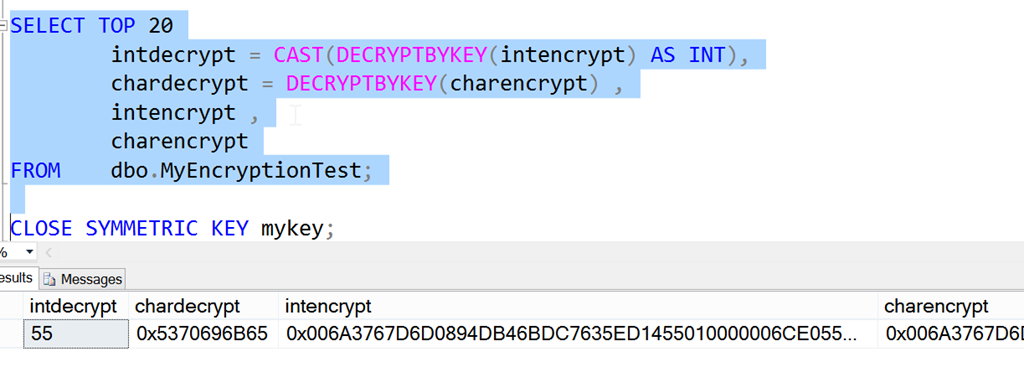
    FROM    dbo.MyEncryptionTest;


    I see:
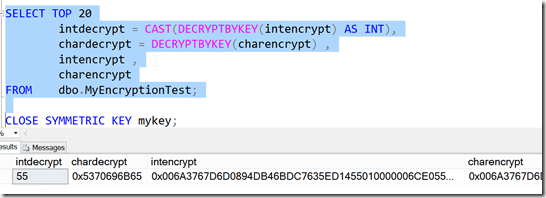
    2015-08-04 22_18_10-SQLQuery1.sql - ARISTOTLE.sandbox (ARISTOTLE_Steve (76))_ - Microsoft SQL Server

    Again, not what I wanted. However, since I know something about conversions, I realize the output is close to what I want. In fact, what I need to do is perform a different CAST before I perform my final one. Here I’ll decrypt the results as NVARCHAR first, then as an INT.

    SELECT TOP 20
            intdecrypt = CAST(CAST(DECRYPTBYKEY(intencrypt) AS NVARCHAR(30)) AS INT),
            chardecrypt = DECRYPTBYKEY(charencrypt) ,
            intencrypt ,
            charencrypt
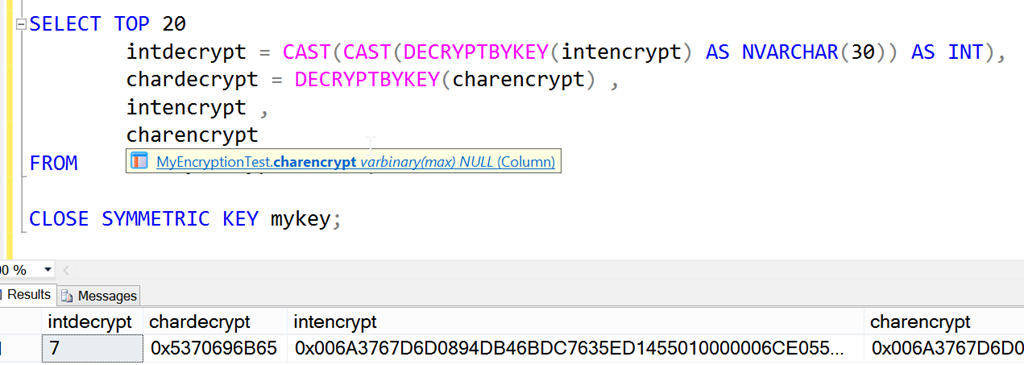
    FROM    dbo.MyEncryptionTest;


    Now I see:

    2015-08-04 22_15_29-SQLQuery1.sql - ARISTOTLE.sandbox (ARISTOTLE_Steve (76))_ - Microsoft SQL Server

    If I do the same for the character column:

    SELECT TOP 20
            intdecrypt = CAST(CAST(DECRYPTBYKEY(intencrypt) AS NVARCHAR(30)) AS INT),
            chardecrypt = CAST( DECRYPTBYKEY(charencrypt) AS VARCHAR(50)) ,
            intencrypt ,
            charencrypt
    FROM    dbo.MyEncryptionTest;


    I’ll get the correct results.
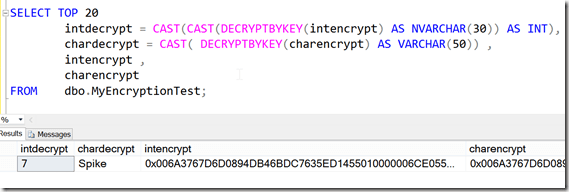
    2015-08-04 22_17_11-SQLQuery1.sql - ARISTOTLE.sandbox (ARISTOTLE_Steve (76))_ - Microsoft SQL Server

    Note that if I take the character column and cast to nvarchar, I’ll get something different. Try it and see.

    And don’t forget to close your key.

    CLOSE SYMMETRIC KEY mykey;

    
    
  • Maturing Your Database Development Process–Version Control

    At Redgate Software, we have a progression of the stages of a database development pipeline. These are the various ways in which you can better engineer your database development to ensure smoother releases to production, with less issues. There are five stages:

    • Manual (S0)
    • Source Control (S1)
    • Continuous Integration (S2)
    • Release Management (S3)
    • Monitoring (S4)

    As I travel around, speaking on these topics, I find many people working in development stops that are really at the S0 level.

    For databases, that is. For their .NET or Java or PHP software, quite a few are at S2, and maybe working towards S3 in many projects.

    That’s a disconnect, and it’s one that we’d like to see changed at Redgate. Certainly we can help and we’d like you to use our products, but more, we want to see better development all around.

    We’re Trying to Help New York City

    In a few weeks, on August 27, 2015, I’ll be in New York to help teach our Database Source Control workshop. Ike Ellis (Crafting Bytes) is teaching the class, and I’ll be there to support him and run the labs. This is a course that Grant Fritchey, myself, and a few others at Redgate Software have built.

    This is the chance to learn how your organization can implement version control for your database, just as most of your developers probably already have for the other software you write.

    We’ll cover setting up Source Control, deploying changes from versions, branching, merging, and more. This is a great hands-on introduction to stabilizing your database development. We’ll provide a VM with labs that you will actually complete.

    We’ve put this first step to building a DLM pipeline on sale for $100. If you’re close to NYC, consider taking a day off and joining us at the Microsoft office in Manhattan for a little database education.

    If you can’t make this workshop, look through our schedule and join us somewhere at a future time.