Tag: tsqlt

  • Refactoring Mistakes Are Why We Write Tests

    I wrote a short piece the other day trying to show how one can use tSQLt to test code. It’s a simple test built against a user defined function. It works well and when the test is run, it passes.

    Here was my code:

    ALTER function [dbo].[calculateEstimateOfReadingTime] ( @value varchar(max) ) returns int as begin declare @ret as int = 1 , @i as int = 1; while @i <= len(@value) begin if substring(@value, @i, 1) = ' ' begin set @ret = @ret + 1; end set @i = @i + 1; end return @ret / 250; ; end

    Someone in the comments pointed out that we can more efficiently refactor this code to :

    ALTER FUNCTION [dbo].[calculateEstimateOfReadingTime] ( @value varchar(max) ) RETURNS int AS BEGIN RETURN ( SELECT LEN(@value) - LEN(REPLACE(RTRIM(@value), ' ', '')) + 1 ) END

    However when I run the test, I get these results:

    functiontesta

    That’s not good, but that’s why we test.

    I could easily see someone refactoring the code, finding a more elegant method of rewriting this code and after running some quick tests, they check this in to source control (hopefully) and maybe deploy it to production. Hopefully QA catches this, but wouldn’t we want to notice this in development?

    The refactored code misses a divide by 250.

    Write tests, use them to catch mistakes. These simple ones slip through at times and are what make deployments really, really stressful.
  • Why Test Table MetaData Tests with tSQLt

    I wrote at SQLServerCentral about using tSQLt to check table metadata. In essence we are testing the API of our table. However, since the table could change, and may need to, what’s the value of having a test fail if the table changes?

    In my mind, I don’t necessarily want to have table structure tests for all my tables. After all, developers need to have flexibility to work with and change tables in our applications. If it’s a pain for a developer to change every table, because a test fails and they have to go change the test, that’s an issue.

    There’s also the problems of a developer changing a table, changing the test, and then having everything pass, without passing along information that a schema change was made.

    I would limit the API tests for a metadata to those tables that are important, with the caveat that anytime someone fails a metadata test, they need to inform the team.

    But Steve, isn’t every table important?

    Yes and no. Certainly all tables should be important to the application in some way, but really many of them are contained in the application. If changes are made, it’s not necessarily a problem to change other objects to catch up to the table change. However, some tables may cross teams or applications and they are an issue.

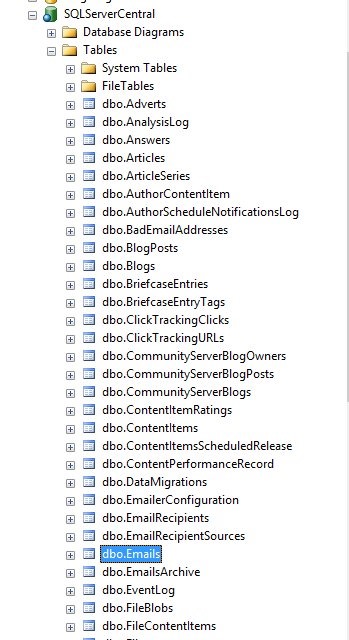
    As an example, I have lots of tables in the SQLServerCentral database.

    tablemetadata_1

    If the Blogs table, or the Articles table changes, then we need to alter stored procedures and possible ASP.NET code for our application. In fact, in this list, pretty much all of these tables could be changed by a developer without a large impact, assuming they’re going to look at the other objects or code affected.

    However the table highlighted, the emails table, along with a few others, are important. These tables not only support SQLServerCentral, the web app, they are also called by our emailer process, which is a completely separate application. In essence, these tables are the opposite of a microservice. They’re shared.

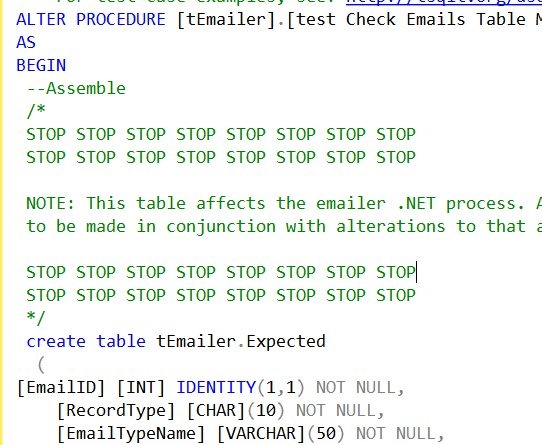
    If someone wants to change the Emails table, I want to be sure that others are informed. In fact, I might choose to include a note in the test header that various groups need to be informed or that the table affects another application. In that case, before a developer went to change the test, they might at least have a chance or noting this has far reaching implications.

    tablemetadata_2

    It’s not a perfect solution, but it does help. The other thing I could do is limit access to metadata tests for various tables/views and merely call these tests in a CI, or other automated, process. That way failures would be public, and a variety of people could be informed, preventing a developer from making changes without a discussion.

    As I mentioned, I wouldn’t do this for all tables. In fact, I’d limit this to particularly sensitive tables that might require lots of rework if they were changed. We want to speed development, and ensure code works, not slow developers down.

  • tSQLt with TRY..CATCH

    Someone asked me the question recently about how tSQLt works with TRY..CATCH blocks and the exceptions that we might test for. It works fine, just as it would with other code, but you need to understand that a CATCH still needs to re-throw an exception.

    Here’s a short example. I’ve got this query, which has issues.

    SELECT TOP 10
             cs.CustomerID
         ,   cs.LastSale
         ,   cs.Salesman
         ,   CAST(cs.SaleValue AS NUMERIC)
         FROM
             dbo.CustomerSales AS cs;

    If I run it, I get this:

    Msg 8115, Level 16, State 6, Line 1
    Arithmetic overflow error converting varbinary to data type numeric.

    The CAST here has issues, but that’s fine. Perhaps it’s a data issue, perhaps something else. I can test for that, but for now, I want to be sure I handle these errors correctly.

    Now, I embed that in a TRY..CATCH block.

        BEGIN TRY
            SELECT TOP 10
                    cs.CustomerID
                ,   cs.LastSale
                ,   cs.Salesman
                ,   CAST(cs.SaleValue AS NUMERIC)
                FROM
                    dbo.CustomerSales AS cs;
        END TRY
        BEGIN CATCH
            SELECT @@ERROR
                ,  ‘A CASTing Error has occurred.’
            ;

        END CATCH;

    If I do this, and in the CATCH block I "handle" the error, I’m not really error handling. I’m error swallowing. Here are my results.

    EXEC spGetCommission 12

    casterror

    I could log this, or try to return some data with a new query, maybe alter something that ensures the client gets results, but what I really need to do is give an error back, but one I’m aware of.

    We could delve into error handling, but I won’t do that here. Instead, I want to be sure the application gets an error, when we have an error. It can then decide what the user does or sees.

    If I write this test:

    ALTER PROCEDURE [misc procs].[test spGetCommission Exceptions]
    AS
    BEGIN

    — Assemble
    EXEC tsqlt.ExpectException;

    — ACT
    EXEC dbo.spGetCommission @userid = 0 — int

    — Assert
    END;

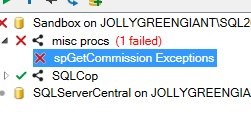
    Now I can run it, but it fails. I see the failure

    test1

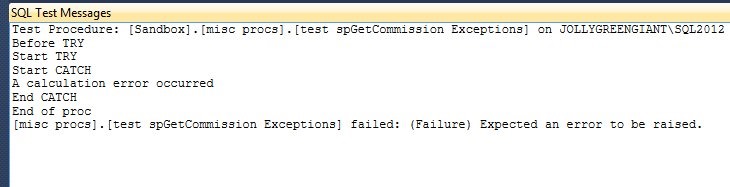
    and I see this in the results

    test2

    What I should have is something more like this:

        BEGIN CATCH
            THROW 51001,  ‘An CASTING Error has occurred.’, 1;
        END CATCH;


    Then my test should be looking for that message.

    ALTER PROCEDURE [misc procs].[test spGetCommission Exceptions]
    AS
    BEGIN

    — Assemble
    EXEC tsqlt.ExpectException
       @ExpectedMessage = ‘An CASTING Error has occurred.’
       , @ExpectedErrorNumber = 51001
    ;

    — ACT
    EXEC dbo.spGetCommission @userid = 0 — int

    — Assert

     
    END;

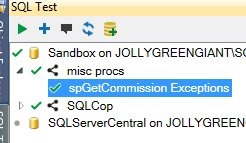
    If I do that, things work well. The error is handled, but also re-thrown, and my test passes.

    test3

  • tSQLt – SQLCop – Checking Naming Conventions

    I’ve been using tSQLt a bit to do some testing and one of the things I’ve tested is standards for code. I’ve been using a framework on top of tSQLt called SQLCop. These are a series of tests written to look for specific things. One of the items I do check is for sp_ named procedures. I’ve mostly gotten out of the habit of doing this, preferring spProcName, but at times I make a mistake in typing. This catches those simple errors.

    Using SQL Cop

    You can Download the SQLCop tests and install them in your database after you’ve setup tSQLt. If you are using SQL Test, then you also get the SQLCop tests installed when you add the framework to a database. For me, I see the tests in the SSMS plugin.

    tsqlt7

    There are a lot of tests, but in this piece, I’ll look at the Stored Procedures Named sp_ test.

    If I edit the test, I see it’s fairly simple code. I’ve included it here.

    USE [EncryptionPrimer]
    GO
    SET ANSI_NULLS ON
    GO
    SET QUOTED_IDENTIFIER ON
    GO
    ALTER PROCEDURE [SQLCop].[test Procedures Named SP_]
    AS
    BEGIN
    -- Written by George Mastros
    -- February 25, 2012
    -- http://sqlcop.lessthandot.com
    -- http://blogs.lessthandot.com/index.php/DataMgmt/DBProgramming/MSSQLServer/don-t-start-your-procedures-with-sp_

    SET NOCOUNT ON

    Declare @Output VarChar(max)
    Set @Output = ''

    SELECT @Output = @Output + SPECIFIC_SCHEMA + '.' + SPECIFIC_NAME + Char(13) + Char(10)
    From INFORMATION_SCHEMA.ROUTINES
    Where SPECIFIC_NAME COLLATE SQL_LATIN1_GENERAL_CP1_CI_AI LIKE 'sp[_]%'
    And SPECIFIC_NAME COLLATE SQL_LATIN1_GENERAL_CP1_CI_AI NOT LIKE '%diagram%'
    AND ROUTINE_SCHEMA <> 'tSQLt'
    Order By SPECIFIC_SCHEMA,SPECIFIC_NAME

    If @Output > ''
    Begin
    Set @Output = Char(13) + Char(10)
    + 'For more information: '
    + 'http://blogs.lessthandot.com/index.php/DataMgmt/DBProgramming/MSSQLServer/don-t-start-your-procedures-with-sp_'
    + Char(13) + Char(10)
    + Char(13) + Char(10)
    + @Output
    EXEC tSQLt.Fail @Output
    End
    END;

    This code looks at the meta data in the database for an routines, stored procedures, that start with sp_ as part of their name. If any results are returned from the query, the IF statement will be true and the @output will be returned as part of the tSQLt.Fail call.

    Using the Test

    Let’s write a stored procedure. If I do this:


    CREATE PROCEDURE spLetsTestThis
    AS
    BEGIN

    SELECT TOP 10
    e.EmployeeID
    , e.EmpTaxID
    , e.FirstName
    , e.lastname
    , e.lastfour
    , e.EmpIDSymKey
    , e.EmpIDASymKey
    , e.hashpartition
    FROM
    dbo.Employees AS e;

    RETURN 0;
    END;

    GO

    This is a simple procedure. I wrote it, execute it a few times and be sure it’s what I want. I’ve done basic testing, not let’s check it before I commit it to VCS.

    The easy way to execute all the SQLCop tests is to right click them in SQL Test and execute them. I can also use T-SQL to run tests. However since I just want to show this one, I’ll right click it and select "Run Test".

    tsqlt8

    This runs the test selected. I can also run an entire class, or all tests, but clicking in the right spot. In this case, the test passes and I see a green mark.

    tsqlt9

    Now let’s write a new procedure:

    CREATE PROCEDURE sp_GetArticles
    AS
    SELECT *
    FROM dbo.Articles

    GO

    This is a bad procedure for a variety of reasons, but let’s execute my test. I see it fail, and a red mark appears next to my test.

    tsqlt10

    In this case I also get a window from SQL Test popping up with more details. This contains the output from the test, which is also inserted into a table by the tSQLt framework.

    tsqlt11

    Note that there is a URL with more information on this particular test. That is a part of the SQL Cop test code above. I could easily replace this with something particular to my environment if I chose.

    At this point, I can rename the object, drop and recreate it, etc. to correct the issue. However running this test helps me to be sure I’ve gotten good code into the VCS. If I have this also run as a part of a CI process, it then prevents bad code from other developers appearing.

    Meeting Standards

    There are all sorts of SQLCop tests, and I’ll write about more, but this is an easy one to implement to prevent a bad practice in your coding by a team of developers. Allowing each developer to test themselves, as well as an overall check by some CI process means that our code quality improves.

    If I have other standards, I can even write my own tests to enforce them, which I’ll do in another piece.

    Downloads