Author: way0utwest

  • Lots of Resources

    I’ve got a small Azure subscription, but there are a lot of resources in my mini lab. Forty seven, to be exact right now.

    2017-07-18 16_31_56-All resources - Microsoft Azure

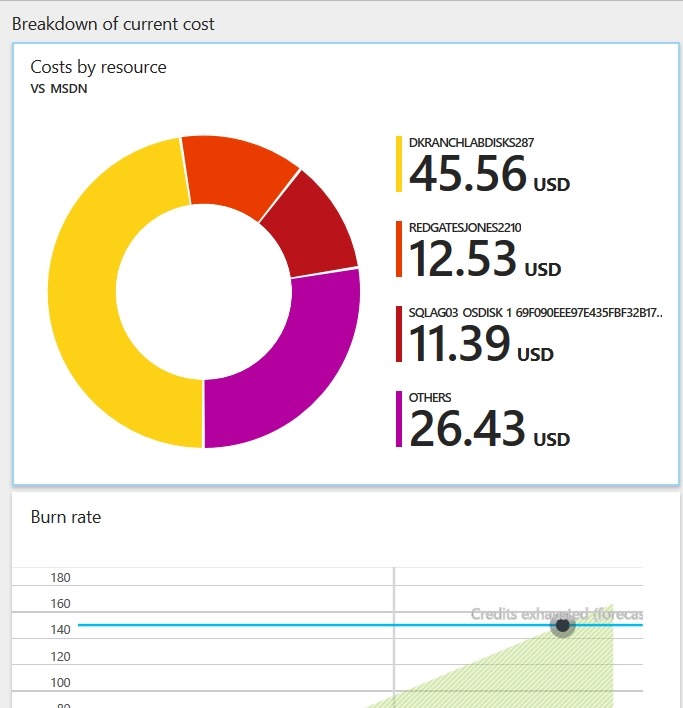
    When I look at my bill, it’s got lots of details, but not always easy to understand.I get a breakdown and burn rate.

    2017-07-18 16_33_17-VS_MSDN - Microsoft Azure

    I can also see details, but tracking these down to ensure I’m making good use of my credits and other charges is hard.

    2017-07-18 16_33_27-Costs by resource - Microsoft Azure

    I can only imagine what this looks like for a company like Redgate, and the struggles between developers, admins, and finance people trying to determine what we have, use, need, and can let go.

  • SSMS is Free

    Really, Management Studio (SSMS) is free as in beer. Go download it today.

    I got a note from a reader recently that was complaining about SSMS and the lack of MDI support. This individual mentioned that they would undock windows (something I never do) and if they minimzed the parent, the child windows all disappeared. I  wondered if there were still issues with SSMS, so I fired up my version, undocked some windows and played around. Things worked as I expected, and every window was independent of the others. I had no issues working, though I did find I’d forget on which monitor a particular child window would appear.

    Last year (2016) we saw SSMS get released as a separate download for SQL Server. The tool has it’s own release cycle, and we saw new updates every other month. As this development team at Microsoft got up to speed with the process and began improving and changing the product, we saw some rough release cycles, but things stabilized a bit late last year. The move to the Visual Studio 2017 shell with v17.x was nice, and I’ve found the latest version to be very stable and easy to use.

    After working with Enterprise Manager in my career, then moving to Management Studio and seeing the product languish over the years as SQL Server grew, I am pleased with the direction of SSMS. The changelog is quite impressive, and I expect more things to be fixed and improved in the future. The team is more responsive, and while they won’t fix everything I (or you) want, they are making progress.

    The new SSMS is not tied to any version of SQL Server. You can use it with SQL Server 2008 and later (though there are OS requirements). It will work with SQL 2000+, though there may be some issues. If you can, I’d say abandon whatever SSMS version you’re using and get the latest 17.1 release. It works well, is stable, and has lots of fixes for previous issues. Plus, you won’t need to apply those old 2008/2012/2014 patches to your workstation. Just update SSMS on your schedule.

    SSMS is free, and while some of us have known this for awhile, I regularly meet people still using the version that came with 2008, R2, 2012, etc. Go download the latest bits today. This is the easiest SQL Server upgrade to justify.

    Steve Jones

    The Voice of the DBA Podcast

    Listen to the MP3 Audio ( 4.1MB) podcast or subscribe to the feed at iTunes and Libsyn.

  • Back to the Big Easy and SQL Saturday #628 in Baton Rouge

    I’ve been fortunate enough to get to the Baton Rouge SQL Saturday a number of times. I think I’ve been 3 times and am heading back in a week for my fourth.

    This is an amazing event, one of the largest in the country. I’ve met people from Texas to Florida to Tennessee, all of whom drive to join the crowd of 500+ developers and database professionals. Held at LSU, it’s also a beautiful location.

    If you’re anywhere close, come down for a great, free day of training and inspiration. I’ll be doing two sessions:

    Hopefully I’ll see a few of you there.

  • DevOps Basics–Git log

    Another post for me that is simple and hopefully serves as an example for people trying to get blogging as #SQLNewBloggers. This is also a part of a basic series on git and how to use it.

    In a few previous posts I’ve looked at getting going with git, and in this post we continue by looking at how we can get some information about the actions we’ve taken.

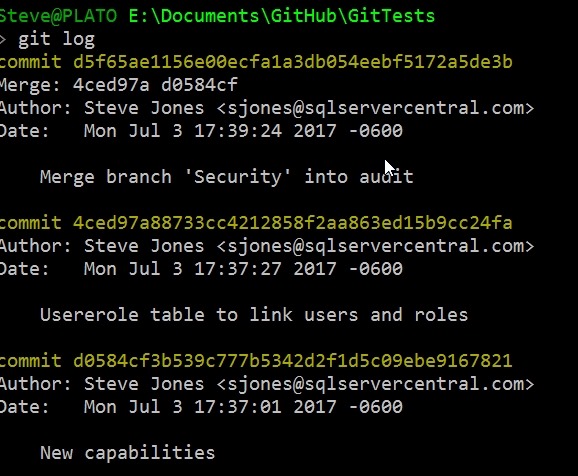
    If we want to see what has happened in our repo, lots of clients will show a list of changes, but from the command line we use a simple “git log”. When I do this, I see the reverse chronological view of commits.

    2017-07-05 11_21_52-cmd - git log

    There are a lot of options for the log command, but there are a few I use often.

    Limit Entries

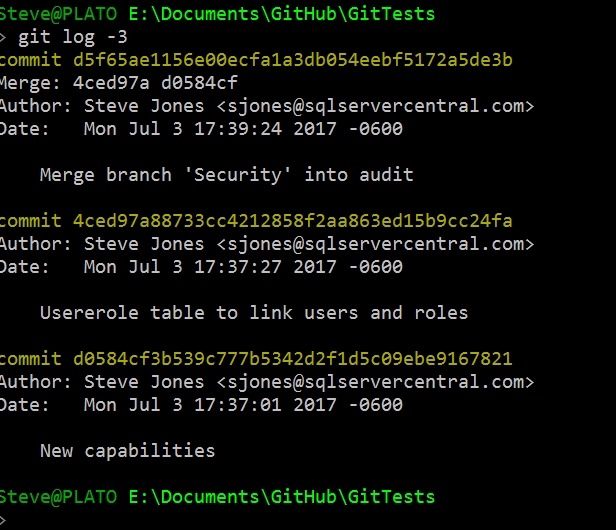
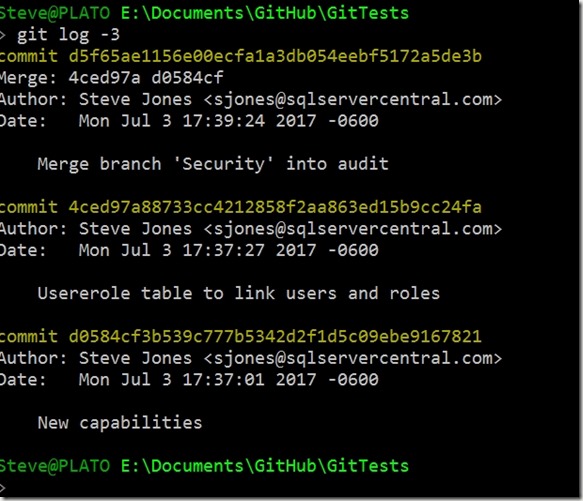
    I often use a –n, where n is a number, to limit what’s returned. For example, I’ll use –3 to show the last 3 commits.
    2017-07-05 11_27_17-cmd

    I also like the –p option, which will show differences. As you can see here, I added the UserRoles.SQL file, putting in new lines.

    2017-07-05 11_28_53-cmd - git log -3 -p

    At times, I like the –decorate option, which lets me know which branch was affected. This is helpful if I’m moving around on branches and I get confused. That does happen.

    2017-07-05 11_32_29-cmd - git log -4 --decorate

    There are lots of search options, and I use them at times, but rarely, so I’m usually searching for the documentation to know the dates or patterns. I do look at the –committer= syntax with my name. That lets me find my changes among others.

    I also like to keep things small, so using the –pretty=oneline option is handy.

    2017-07-05 11_36_04-cmd

    Now I can easily see what I’ve done lately.

    There are lots of ways to look at history, and certainly a client makes things easier, but I’d say that you should learn the command line, just in case there’s some issue and your client doesn’t display it properly.

    Last thing, when you run git log and end up with a colon prompt, you’re in the less utility (I think, been a long time since Unix). To get out just type:

    q