Author: way0utwest

  • Using Out-GridView To Pick Parameters–#SQLNewBlogger

    Another post for me that is simple and hopefully serves as an example for people trying to get blogging as #SQLNewBloggers.

    I was editing an article on PoSh and learned something cool. I can use Grid-View to surface an object in a pipeline and then change the items passed through to the next command.

    Here’s how it works. Suppose I have a simple comment, like Get-SqlDatabase. I can run this and get a series of database. (command and output shown here).

    Get-SqlDatabase –ServerInstance .\SQL2014

    2017-01-03 12_50_20-powershell

    I get a bunch of data, but I don’t want all the items. For example, maybe I just want the “SimpleTalk” databases.

    Get-SqlDatabase -ServerInstance .\SQL2014 | Where-Object { $_.Name -like ‘SimpleTalk*’}

    2017-01-03 12_51_42-powershell

    I don’t want to edit this Where-Object clause all the time. I want something simple to easily fix this.

    Enter Out-GridView

    Instead of changing my filter, I can do this graphically. I can pipe my output to Out-Gridview, and I’ll get this.

    2017-01-03 12_54_44-Get-SqlDatabase -ServerInstance ._SQL2014 _ Out-GridView

    All of my output data appears. No big deal, right? Is this useful? It sure is. Look at the filter item above. I can type in there, and my data is filtered.

    2017-01-03 12_55_29-Get-SqlDatabase -ServerInstance ._SQL2014 _ Out-GridView

    How can I use this? Suppose my code is this:

    PS SQLSERVER:\SQL\Plato\SQL2016\Databases> Get-SqlDatabase -ServerInstance .\SQL2014 | Out-GridView -PassThru | Backup-SqlDatabase -CompressionOption Default –Script

    Here I’m getting a list of databases, passing them to Out-GridView, and then sending the results to Backup-SqlDatabase, which will return a script to back up all my databases.

    I’ll run this, and then enter a filter in the grid.

    2017-01-03 12_57_47-Get-SqlDatabase -ServerInstance ._SQL2014 _ Out-GridView -PassThru _ Backup-SqlD

    I can now highlight all these rows (if that’s what I want).

    2017-01-03 12_59_11-Get-SqlDatabase -ServerInstance ._SQL2014 _ Out-GridView -PassThru _ Backup-SqlD

    This time I have an “OK” button in the lower right corner of the grid.

    2017-01-03 12_58_23-Movies & TV

    When I click “OK”, my filtered list is returned to the pipeline and send to the backup command.

    2017-01-03 12_59_32-powershell

    This is a quick way to work with the parameters in your pipeline in an ad hoc way. Use Out-GridView to filter and select the rows you want to return to the rest of your script.

  • Quick SQL CLone Support

    I have been playing with SQL Clone for a few weeks now and liking the product. I’m looking forward to using this more and more, especially for testing ideas in development. However, there are times I have questions or am unsure of how to use things.

    I work for Redgate Software, so I have an in. I can certainly email developers if I need to, but we also have this:

    2017-01-16 14_29_03-sqlclone _ Redgate Slack

    There’s a great Slack channel where I can quickly reach developers. This comes in handy as it seems various people at Redgate pay more attention to Slack than email or other communication methods.

    No, this post won’t get you on our Slack channel.

    However, when opening the SQL Clone beta, I see this dashboard.

    2017-01-16 14_26_55-SQL Clone

    Notice the little circle in the lower right? Click it and you get this:

    2017-01-16 14_32_14-SQL Clone

    Apparently there’s a semi-live chat system that our developers are using. Chris is actually one of the SQL Clone developers, and he helped me solve the registry issue a few weeks ago.

    That’s pretty cool. If you type something in there, it will get sent to the developers, and if they’re around, they will respond. I sent a test, with a semi-legitimate question, and see this below my text:

    2017-01-16 14_34_39-SQL Clone

    Given I sent the note late in the afternoon, I’m sure all developers are gone for the day. I can hide the popup, and then will see when someone responds.

    Update: in the am, I got an email from the system, at the same time, I got a reply in my SQL Clone dashboard. As you can see, my question was answered.

    2017-01-17 08_29_47-SQL Clone

    If I click the arrow in the upper left, I can see all my conversations, which is handy if I’m trying to report or work on a few issues.

    2017-01-17 08_29_53-SQL Clone

    That’s pretty cool, and it’s an neat way to get quick feedback. Assuming it doesn’t take too much time away from developers actually developing the product.

    I suspect we’ll get support involved here, with escalations to developers. At least, that’s what I’d do, but for now, it’s good that our developers are responding to beta users and helping them use and test the product.

  • Getting My Alias in #SQLPrompt

    I got a tweet after my SQL Prompt formatting piece that said a user would be interested in upgrading from v5 if “as ‘Alias’” was transformed into “’Alias’ = “.

    Well, in v7.3, this is in there, and I didn’t realize it. You can clearly see this in the formatting actions options, which is a place I didn’t think to look.

    2017-01-17-09_00_38-sql-prompt-options

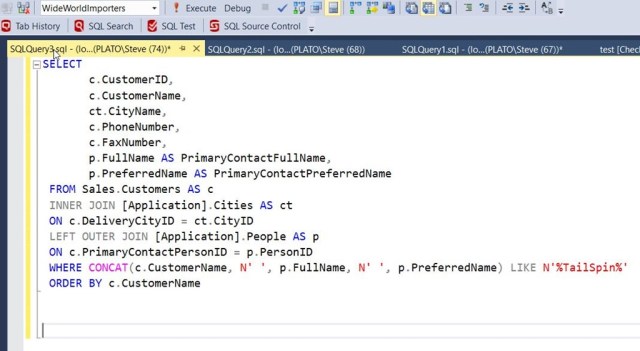
    Does this work? It sure does. Let’s examine a query you might get from a VCS or a colleague. Suppose you’re working in the new WideWorldImporters database.

    2017-01-04-08_39_52-SQLQuery3.sql-local_SQL2016.WideWorldImporters-PLATO_Steve-74_-Microso.jpg

    You prefer to see the actual columns returned in the result set at the front of the query, with an alias = format. That’s what I prefer as well, and so I want to have the column list shown as:

    PrimaryContactFullName = p.FullName,
    PrimaryContactPreferredName = p.PreferredName

    A quick CTRL+K, Y and I see this.

    2017-01-17-09_11_08-sqlquery18-sql-local_sql2016-wideworldimporters-plato_steve-70_-micros

    My aliases have moved.

    This is a great feature for those of you that need consistent formatting. There are other alias options if you prefer the alias at the end.

    Update: I originally had this as single quoted aliases, but as pointed out, that format is deprecated, so I wouldn’t use it.

    And if you want to change this back, you can have a second formatting preference that you choose to reformat code before sending it back to someone else.

    Give SQL Prompt a try today.

  • Delaying Patches is Problematic

    I was listening to a DevOps podcast from Josh Corman, of Rugged Software. Rugged Software aims to improve security by asking developers and sysadmins to adhere to their manifesto, which recognizes both the importance of software in the modern world, as well as the problems associated by not properly securing and patching software. These are duties that both developers and administrators should perform in their respective roles.

    The goal of the Rugged Software is to promote best practices and constant vigilence to create and deploy secure code, and ensure that software installations remain that way. This isn’t a security state, but rather a process. A way to approach software development, deployment, administration, and maintenance to improve the security of our computer systems. This maps nicely to a DevOps approach to software development, with a focus on security. The ideas here include not just patching, but fixing underlying issues, learning from mistakes and from other organizations, improving the skills of their developers and administrators. This is a holistic approach to ensuring security.

    This not only includes the software we write, but also the software products, platforms, libraries, etc. that we use. For many of us, this means the Windows host OS, the networking software and connections, http servers, vendor .NET libraries, and more. This also includes database software of all sorts, whether you use an RDBMS like SQL Server, perhaps a search service like ElasticSearch, a caching database like Redis, or some other NoSQL data store.

    The idea is that we not only code securely, but also make sure we patch our software. That’s a problem in many cases. In fact, MongoDB has had a security issue for the past few years that was well publicized but still affects many installations. Far too few people have patched their MongoDB databases, and it’s a problem. Data is exposed to anyone on the Internet, and it’s likely someone is taking advantage of this to access the bits. In fact, many hackers exploit flaws in software for which patches are often available. The updates just haven’t been deployed.

    Patching software is a challenge, and it seems that there is no shortage of ways in which companies deploy updates. Microsoft is pushing automatic patches. Some applications make these optional. Some apply changes in the background, some require downloads. If you use a service, then patches are seamless, but the changes may break functionality or force a new workflow on the user.

    Ultimately I think that we, as an industry, need to mature with the ways in which we patch software. Customers and clients should demand better, and the impact of applying patches should go down. Quality should go up, and while that has happened with some companies, I think we need better patterns and practices that are taught and adopted by more developers. Perhaps more people sharing their techniques, templates, and practices will help others become better at building and managing our software updates.

    Steve Jones

    The Voice of the DBA Podcast

    Listen to the MP3 Audio ( 5.5MB) podcast or subscribe to the feed at iTunes and Libsyn.