Author: way0utwest

  • Querying My Named Instance in PoSh–#SQLNewBlogger

    Another post for me that is simple and hopefully serves as an example for people trying to get blogging as #SQLNewBloggers.

    I was looking at some sample code the other day and it looked like this.

    cd sqlserver:\sql\localhost\default\databases

    This allows you to browse the list of databases on your local instance. However, this is for a default instance, which I don’t have on this host. How can I get to a named instance? Usually I connect as .\SQL2016, so where does that fit in PowerShell?

    The format you see above is for the SQLServer provider, which is provided as part of the SQLServer PoSh module (or SQLPS if you haven’t adopted the new cmdlets).

    If I start at the SQLServer:\ node, I see this:

    2017-01-03 15_31_37-powershell

    Let’s drop into the SQL node and see that.

    2017-01-03 15_32_32-powershell

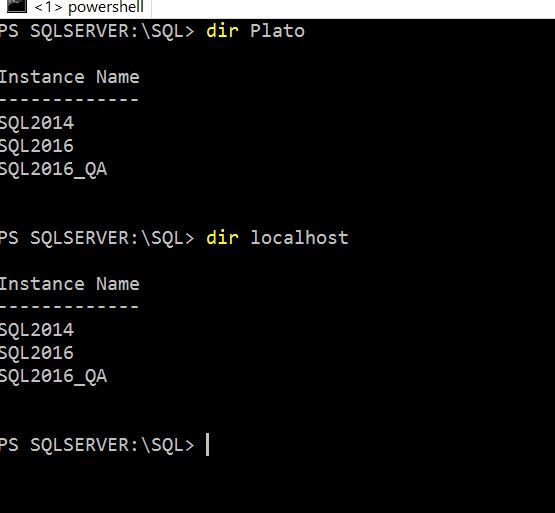
    At this point, I see my localhost and my local computer name. These are really the same thing. We can see that by querying each of them.
    2017-01-03 15_33_12-powershell

    In my case, I like to type fewer characters, so I’ll look at the Plato node. If I change here, I can also change to an instance, as shown here.

    2017-01-03 15_34_21-powershell

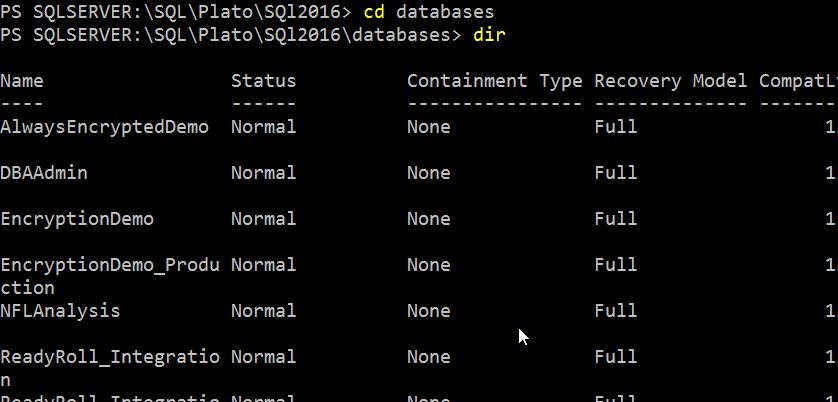
    Now I can see the databases by changing to that path and getting the directory.
    2017-01-03 15_34_31-powershell

    Thus, we can see that to query an instance, we use this path:

    SQLServer:\SQL\Host\instance

    If you want to use the default instance, then use “default”.

    A simple query path, but one that some people might wonder about, substituting the named instance for localhost, and not realizing that “Default” means just the default instance.

  • The War Room

    I remember the first time I worked in a large, 10,000+ employee company, and we had a crisis with our systems. A number of us crowded into the cold computer room, gathering around a few workstations and trying to solve the issues. We worked furiously to restore service, with various managers and executives periodically knocking on the locked door wanting status updates, unaware they were slowing us down. Eventually we stabilized things, but it was a chaotic and inefficient environment with too many people involved and more time spent talking and discussing problems than solving them.

    Later I worked in a similarly sized, but more mature company. We had various virus issues, including SQL Slammer. When we realized there was a crisis, we’d contact a director who would convene a crisis team. There were designated individuals from various groups (network, security, database, etc.), each of which had a backup, but only one representative from each area was a part of the team. Those were the only people that participated in the meetings, giving status updates, or taking actions to be distributed to their team. Each was responsible for coordinating the activities of their area with others. Status updates were scheduled regularly with a specific individual posting them. The director leading the crisis would update executives.

    I thought back on these experiences (I was the main person in the database area) when I read about the Amazon war room experiences around launching one of their products. While our crisis management wasn’t quite like this, it was fairly well scripted. There were times that the process didn’t proceed smoothly, but it worked well overall for problem situations. I wish that we had handled deployments a little more formally, though not as strictly as Amazon did. Our deployments didn’t have a large an impact as a product launch, but we certainly could have used more coordination between different groups. I remember no shortage of networking/firewall issues, security mismatches, or missed communications with customers from deployments.

    I’d like to see software deployment to be an easier and simpler process. My hope is that more people learn to code better, and they implement unit tests to ensure they meet requirements and prevent regressions. I want to see automated deployments into staging environments to catch potential issues, and eventually, smooth execution from the client perspective. I want these things to happen for both database and application software.

    A better development, test, and deployment process doesn’t mean that there isn’t a need for strong coordination among everyone involved, and certainly doesn’t mean a crisis team isn’t prepared to respond if there are issues. Thinking ahead to potential issues and ensuring everyone is on the same page helps to smooth any of the bumps that will occasionally crop up. At least, I expect they are only occasional if you follow a good CI/CD process.

    Steve Jones

    The Voice of the DBA Podcast

    Listen to the MP3 Audio ( 5.5MB) podcast or subscribe to the feed at iTunes and Libsyn.

  • Useful #SQLPrompt Tips

    One of the tools that Redgate write is SQL Prompt. This might be my favorite product, and I’m constantly impressed by the improvements that the dev team releases. In fact, I’m also impressed by the rate at which they produce changes, with updates happening every week or two.

    At this point, the product has a lot of features, some of which I’ve forgotten about, and a few that slipped by me. At SQL in the City streamed last year, I watched a short piece from Carly Meichen that taught me a couple things. I’ll write about a few of them, but take a look at this video and see if any of these will help you become more productive.

  • The Purpose of a Database

    A great quote from a blog on machine learning in SQL Server: “…nobody buys a DBMS for the sake of DBMS. People buy it for what it enables you to do”. The post is from Rimma Nehme, who has given a few keynotes at the PASS Summit. While the focus of the post is how you can implement deep neural network learning with R Services in SQL Server, I thought that quote stands out for any database, relational or NoSQL, from Microsoft, another vendor, or open source.

    I think it’s easy to get caught up in the debate over which features are better than others, or which database might perform better for the money spent. Pehaps we want to debate how easy or difficult it can be to build an application with the platform. We can look at the ROI, the ability to easily implement HA, DR, or some particular subsystem that we need. Those are all good questions, and certainly part of the decision to use a particular platform.

    At the end of the day, it doesn’t often matter which database platform you choose. Whether a JSON file, a relational platform like SQL Server, or the Neo4J graph database. The people that will use the database to query information, make decisions, or just store information need the system to work for them. The system needs to do something that helps their organization in some way. Often that’s based on the capabilities of the software that connects with the database, the capabilities and performance of the platform, and certainly the abilities and execution of the staff that work on the system.

    There’s plenty to debate about using SQL Server with the R language. We can make some determination about whether or not there’s value in spending licensing dollars on expensive SQL Server licenses and using those cores for analytics rather than some other, cheaper hardware. Microsoft R Server (another some other service) might be a better choice. Ultimately, the value to the end user is in getting the data processed and returned to them, whether this is through a query, a report or some recommendation from a machine learning algorithms.

    My view is that more complex processing, whether through machine learning or other types of data analysis, are going to be more important for data professionals in the future. As we build new applications, or even seek to keep older ones viable for a long time, we need to keep in mind that the DBMS isn’t the reason we have a project or job. It’s because we can somehow extract information from the DBMS and process it in a way that adds value to an organization. Whether we do this in a database or application is up for discussion and debate for each individual situation, but we need to ensure we are providing value for our customers.

    Steve Jones

    The Voice of the DBA Podcast

    Listen to the MP3 Audio ( 3.8MB) podcast or subscribe to the feed at iTunes and Libsyn.