Author: way0utwest

  • SQL Server is Getting More Popular

    At the db-engines.com site, SQL Server was named the DMBS of the year. This was the site’s choice based on a measure of how popularity changed from Jan 2016 -Jan 2017. Apparently SQL Server grew in popularity in a number of ways, including job offers and LinkedIn profiles, but also with various search engine metrics and forum discussions. A few people have noted that SQL Server isn’t the most popular DBMS, as Oracle and MySQL are above it in January 2017. However, the change in score was dramatic for SQL Server, with MySQL a close second.

    Perhaps Microsoft’s embracing of open source is a reason why SQL Server is growing in popularity. That’s what some people think. With the announcement of SQL Server on Linux, as well as the regular commitments they make to Github, where Microsoft is the largest contributor. Microsoft has had a place for open source projects, CodePlex, for years, but now they have an open source site as well where they have numerous announcements and resources about how one might integrate some of the open source products with their closed source products.

    I certainly think the popularity of SQL Server is increasing as it grows to encompass more and more features. Compared to Oracle, SQL Server is a much less expensive, and it integrates well with the .NET stack of programming tools. Microsoft has made strides to make it easier for connections from Java and Python code to SQL Server. I’ve run across quite a few people using Redis, ElasticSearch, and more in applications along with SQL Server, which implies it’s becoming more acceptable and easier to integrate different data platforms than in the past.

    SQL Server has been a part of my career for over two decades, and in that time I’ve seen it become more and more popular, more useful, and easier to integrate into a wide variety of applications. I expect this will continue with the Azure SQL Database and Azure SQL Data Warehouse, as well as the Azure Data Lake. There might not be as many installations of SQL Server as Oracle or MySQL, but I think it’s the best database platform for me.

    Steve Jones

    The Voice of the DBA Podcast

    Listen to the MP3 Audio ( 3.9MB) podcast or subscribe to the feed at iTunes and Libsyn.
  • Getting Started Blogging–#SQLNewBlogger

    It’s a new year, and the perfect time for you to start blogging about your SQL Server work. I think blogging is a great way to showcase your knowledge, and over time, this can become as important to your potential employers and clients as your resume or CV.

    This post won’t look at what to write, but rather, how to get started. I’ve divided this up for people that might have written some technical articles and those that haven’t. If you have, feel free to skip the next section.

    Starting From Scratch

    If you’ve never really written a blog or technical piece, I recommend do this:

    1. Create a folder on a shared drive
    2. Open Word (or another WYSIWYG) editor
    3. Begin Writing
    4. Save the post you’ve worked on as 1_SomeTopic.
    5. Repeat, incrementing the number so you get files such as 2_OtherTopic, 3_ReallyInteresting, etc.

    That’s it. Just begin writing. Don’t worry about publishing, don’t worry about anything else. Just get in the habit of putting some thoughts down on paper that talk about the work you do.

    When you get 10 posts, you are ready to move on.

    I would recommend you calculate the average time it takes for you to produce a post. This would be the rate at which I’d look to schedule my posts.

    Choosing a Platform

    The next step when you are comfortable with your writing is to choose a place to publish your work. There are lots of choices, and a good comparison of sites is listed in this article.

    I use WordPress and Blogger/Blogspot for different blogs. I chose two to have a comparison and after a few years, I think WordPress is better. You can certainly download the WordPress software and set up your own site on a VM somewhere, but I don’t think that’s a good place to start unless you want a project. If you want to write, wordpress.com is a nice start. It does enough for me, and it’s easy to let them update the software and just pick a theme.

    I also recommend OpenLiveWriter to write with. I can easily draft posts in a WYSIWYG way, keep the drafts private (and on a OneDrive folder) and then publish to my platform at will. I find this easier than trying to work online. The project looks slightly abandoned for now, but it is stable and useful on the Windows platform.

    Scheduling

    How often should you blog? I think this is a hard question, but I’d blog at the pace that works for me. If you are a new writer, you should have written 10 pieces and tracked the time to produce those. For most people, this is between 2 and 4 weeks for a piece. Some might do 1 a week, but whatever is possible in your busy life is the pace I’d stick with.

    My goal is to blog 3 times a week. Sometimes I can do more, but I don’t usually try to do more. It’s better to schedule out posts and ensure I can maintain some level of consistency than I get my posts out right away. Most of the time I have a couple of posts scheduled a few weeks out because I’m not producing news. I’m showcasing knowledge.

    My advice is to schedule less frequently than you think you should. It’s easier to add in most posts later than try to maintain some pace that causes you stress.

    This should be fun.

    Post Reviews

    No matter what topics you choose or the frequency of your posts, it is important that you do a good job in producing them. That doesn’t mean you need 3 peer reviews and a copy edit, but you should take the time to get some feedback from others on your work.

    If you aren’t an experienced writer, or you worry about the impression your writing makes, then ask a friend, spouse, co-worker, etc. to review a few posts and help you with your grammar, spelling, and the way you communicate the concepts.

    Communication is a skill, and you will get better if you work at it. However, the best way I have found to do this quickly is to get feedback from others.

    Take the Challenge

    Challenge yourself and start blogging today. Even as little as 15 minutes a week can really help you showcase your knowledge, and give you an edge for your next interview.

  • Changes are Coming to the SQLServerCentral Forums

    The codebase for SQLServerCentral is old. Not as old as it looks, since our developers tried to keep the look and feel of the original site when they upgraded the underlying framework in 2009. Since then we’ve made a few changes, but not a lot of development. Like many of you working in organizations, I struggle for development resources when there are higher priority projects inside the company. I think I’m a bit of a victim of my own success here as the site has remained popular despite the aging design.

    Around September 2016, we did get more resources and a project approved to make changes. The first of which is an upgrade to our forum software. We’ve been running an old version of InstantForum, which was customized to integrate into the rest of the site. After evaluating quite a few options, we decided the newest version of this software was the best fit and have had developers working on integration as well as sending feedback to the vendor about some bugs we’ve discovered (and fixed). They’ve taken some pull requests from us, and since we’ve abstracted some of our customizations away from their codebase, we should be able to take upgrades and improvements over time.

    This is a large change, with a database upgrade, data movement, and large deployment of changes. After many practice runs and a beta test period with a number of users, we’re ready to deploy the new software. Our plan is to deploy the changes on the early morning (UK Time) of January 12th, and the site will have a short outage during this time.

    While much of the appearance of the main site will be similar, the underlying forum code and styling has been revamped with some new features and integration with SPAM detection engines. Hopefully that will cut down on some of the annoying posts we’ve seen across the last year. My fingers are crossed for that this happens.

    This should be a smooth upgrade, and I have confidence in the technology team that’s been working on this project. At the core, however, the mission of SQLServerCentral is to educate you, and that doesn’t depend on technology. We seek to publish information that helps you learn more about SQL Server and allow to ask questions and get answers to the problems you face in your work. When we come back up on the 12th Jan, we’ll get back to the business of helping you get better at your job.

    Steve Jones

    The Voice of the DBA Podcast

    Listen to the MP3 Audio ( 4.4MB) podcast or subscribe to the feed at iTunes and Libsyn.

  • Easy Database Space with dbatools

    One of the things that I’ve seen DBAs query for is free space in a database. In fact, this is one of the most common questions posted on SQLServerCentral by newbies that are trying to manage their instances and ensure they don’t use too much space or run out of space.

    The most common way to do this is with sp_spaceused. This system stored procedure has been around for a long time and is commonly used. However, it’s cumbersome to me. I get two result sets, I get data formatted in both MB and KB, it’s hard to use for multiple databases, and incorporating it with some automated tracking gets annoying. Not hard, just annoying.

    Get-DbaDatabaseFreespace

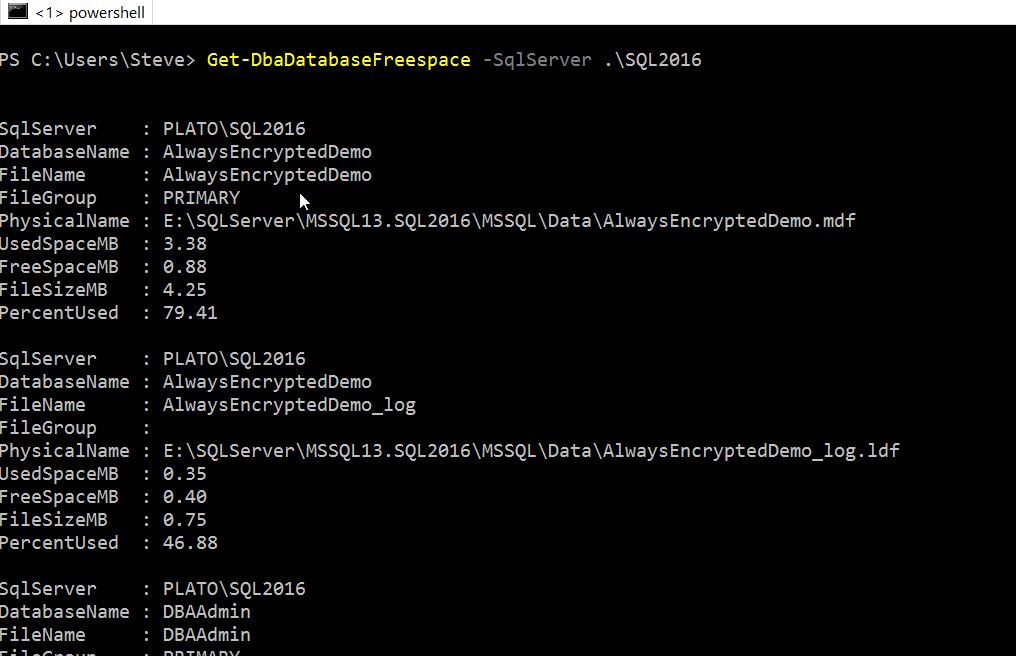
    Enter dbatools. One of the cmdlets included is Get-DbaDatabaseFreespace and this does exactly what you’d expect. This takes the name of an instance as a parameter, and when you run it, you get a bunch of information about your databases and their space usage.

    2016-12-29 09_17_01-powershell

    These are good numbers, but with PoSh, I can easily just get the data I want. For example, I can add a –Databases parameter and see specific databases.

    2016-12-29 09_31_21-powershell

    I can also limit reformat the data in a table and limit what’s returned:

    2016-12-29 09_32_29-powershell

    This flexibility to easily see data is one thing that I like about PosH. I could pipe this into a filter and look for those items that are of a certain size, or have a certain percentage value.

    Putting this into a report, or even an alert that might get sent to DBAs is a great way to keep an eye on space and ensure that you don’t run out of space. Of course, tracking this over time is easier with a tool like SQL Monitor, but for quick checks, this dbatool is very handy.

    If you haven’t played with these, I’d recommend you do this. This collection makes working with SQL Server and PoSh much easier.